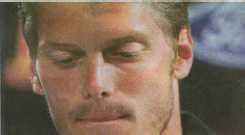
"Prophet of Doom" ~
Sydney Morning Herald Feb 1 1999Article by Richard Hinds; Photo by Ray Kennedy
[only excerpts relating to Thomas Enqvist included]
Poor Thomas Enqvist. It's one thing to be beaten in a grand slam final, but another to have your opponent label you a choker. RICHARD HINDS reports on Yevgeny Kafelnikov's powers as a soothsayer.
Yevgeny Kafelnikov entered the Australian Open as a one-slam wonder, with his game on training wheels and space to rent on his shirt. He rushed off two weeks later to catch the 8:30pm flight for Frankfurt with a second piece of grand-slam hardware and a new-found reputation for prophecy.
Before yesterday's final, Kafelnikov had not merely suggested but promised his meeting with Thomas Enqvist would be long. Over four sets - 4-6 6-0 6-3 7-6 (7-1) - and 146 minutes it was not a marathon but by recent standards, particularly last year's blink-and-miss-it Petr Korda-Marcelo Rios affair, it counts as a minor epic.
Where Kafelnikov really earned his title as the Nostradamus of the Rebound Ace, however, was in his assertion that, to put it bluntly - and Kafelnikov did - Enqvist would choke. All the Russian had to do was stay in the match, he had insisted, and his chance would come.
At the time it had seemed a bold and quite possibly misguided statement. Besides a slight wobble in closing out his fourth-round victory over Mark Philippoussis, Enqvist had been awesome in winning his 14 previous matches in Australia.
So, why provide the Swede with any extra motivation before his first grand-slam final?
As Enqvist blitzed through the first set, cracking ground strokes just inside the line and picking off Kafelnikov when he made his rather clumsy attacks on the net, that is just what it seemed Kafelnikov had done. Indeed, it was the Russian whose double-fault in the fifth game brought the first break of serve. So, who was in need of an oxygen tent now?
"You know, the way that the first set was going on, I never felt I would come back," said Kafelnikov. "Thomas was making the winners from every angle of the court, not only from the forehand but backhand, too. He was striking the ball as well as he could and, you know, I was glad the main strategy was working out."
That strategy was simple: if Kafelnikov stayed in the match, Enqvist would break.
The first chinks were suddenly revealed as Enqvist served for the first set. On his first set-point he double-faulted, on the next two he hit backhands well long and, while he finally clinched the set with a well-placed serve, there was a definite sense that the Swede's muscles had tightened.
"Basically what happened was I broke Thomas mentally," Kafelnikov later claimed. It was to be no mere anxiety attack, but a fully fledged breakdown.
Kafelnikov won the next nine games, with Enqvist coughing up the second set with a double-fault followed by a forehand that landed closer to the VIP enclosure than the baseline. While he fought back to 3-3 in the third set, Enqvist unravelled again, lost serve and conceded a two-sets-to-one lead.
Kafelnikov agreed the pattern for the match had been set in the concluding stages of the first set.
"Definitely he [Enqvist] knew that it wasn't going to be easy for him. Like I said, he wasn't going to win in three straight sets because not many times you get such an opportunity in a grand slam final, no matter who it is, and how he's playing."
While Enqvist hung on in the fourth set, his fragility was against evident in the tie-breaker. After being on the wrong end of a bad line-call on the first point, his response was three errors and a double-fault to fall behind 0-5. He ended the match by hitting another second serve long.
Having already branded Enqvist a choker, after the match the Russian rubbed salt in the wounds by saying his opponent had not given it everything. "I felt like Thomas had something still in his body, that he could have tried probably a lot harder. But I don't know … maybe he can tell you later on."
Predictably, Enqvist denied he had not tried his hardest, or that nerves played a part in his downfall. "I felt good out there, I had a lot of fun. I was not nervous, I was playing the same kind of tennis I've been playing. But today I missed a little bit more and he was playing a little bit more solid."
Enqvist was somewhat miffed at Kafelnikov's "choking" crack. "Well, that was not nice to say. I think playing, before this, 14 matches in Australia … I've been winning them all, so I don't think that's a sign of choking."
But with the trophy, a cheque for $722,000 and a world ranking elevated to No.3, Kafelnikov had good reason to feel vindicated. "I knew how to handle the pressure, how to respond in different circumstances in the match," he said.
"That's what happened. I knew exactly when to win a point, when I had to concentrate on the games. There was a difference."
For the 24-year-old Kafelnikov there was a relief at having elevated himself from the group of seven "one-slam wonders" still playing the circuit, into the realms of the more notable multiple champions. And, while the 1996 French Open title had been won in a daze, this was a moment to savour.
"When I won the French Open I wasn't really thinking about it," he said. "It was just a quick moment. Now I am really enjoying it, it's a great moment."
Among the list of those who Kafelnikov thanked were his wife Mascha and new coach Larry Stefanki. Marriage last year, Kafelnikov said, had increased his focus and motivation, while his coach had helped rejuvenate a career that had been on the slide. Previously, Kafelnikov had also thanked himself for relinquishing a clothing sponsorship, part of a campaign to free his time from added distractions.
Related Image: