|
|
|
|
|
|
"In the Footsteps of Champions" ~
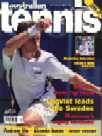
Australian Tennis April 1999Article by Suzi Petrovski; Photos by Darrin Braybrook
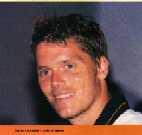
His emergence may have been slower than his more famous predecessors, but Thomas Enqvist now shoulders much of the responsibility for maintaining Sweden's proud tennis history.
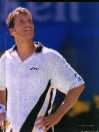
Thomas Enqvist, heir to the wonderful Swedish tradition established by Bjorn Borg, Mats Wilander and Stefan Edberg, has all the credentials of a Swedish No.1 - Nordic good looks, baseline mastery, competitive cool, exemplary sportsmanship. Everything except a Grand Slam win.
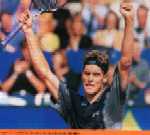
How close he came in Australia! Up a set against Yevgeny Kafelnikov in the Australian Open final, riding a tidal wave of form that saw him romp through Adelaide and Kooyong undefeated, the 25-year-old looked assured of succeeding Edberg as the latest Swedish Slam winner. Until a horror patch of nine straight losing games effectively ended his bid and the Russian sealed victory in a fourth-set tiebreak. Still, Enqvist's Australian campaign was impressive enough - he reached the final unseeded and scored back-to-back victories at Melbourne Park over Pat Rafter and Mark Philippoussis - to stamp himself a legitimate Grand Slam threat.
Enqvist's arrival on the Grand Slam high ground has taken a lot longer than expected of the kid who was world No.1 junior in 1991 and a top tenner for much of 1995-96. "He's always been the one expected to win the big one," says Swedish journalist Paul Burman. "Magnus Larsson and Jonas Bjorkman were Grand Slam semi-finalists but they were surprises. With Thomas, the surprise is that it's taken him this long."
It's no surprise that Sweden's players have not yet emulated Grand Slam deeds of Borg, Wilander and Edberg. The superb trio bagged 24 Grand Slams between them, established Sweden as the most successful Davis Cup nation of the last two decades and won over the world with their classy play and sportsmanship. No young player could hope for bigger shoes to fill. But Enqvist denies that the responsibility of extending the Swedish winning streak has weighed heavily on his shoulders. He feels no special burden because, with typical Swedish modesty, he says he is not the only one of his countrymen with the talent to win a Grand Slam.
"We don't really have the Edberg or the Wilander but we still have a lot of good players who can win the big tournaments," says Enqvist during a break from practice. "We won the Davis Cup now the last two years. That shows we have a really good group of players. All the Swedes feel we have a responsibility to take the (winning) tradition further. It's not like just one guy who has to do it. There's a lot of guys who are up there and can do it."
Former players have always thought Enqvist the obvious, and worthy, successor as Swedish No.1. Joakim Nystrom, a top tenner in the 1980's, was Enqvist's travelling coach in his first couple of years on the pro Tour. Mats Wilander funded their first yearm in 1992. Edberg served as a Davis Cup teammate, role model and regular practice partner. Even with Edberg around, in 1995 Enqvist clearly established himself as the Swedish No.1. In 1996 he compiled a 7-0 record against his countrymen, including two wins over Edberg in the former champion's last year on the circuit.
Waiting for Enqvist to blame his predecessors for setting impossibly high standards is like waiting for the next Ice Age. As Swedish as smorgasbord, Enqvist sees his heritage as nothing but a blessing. No other player is so firmly in the Swedish mould.
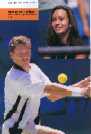
The Enqvist game is straight from the Swedish assembly line. Efficient more than brilliant. A double-handed backhad as safe as a Volvo. Some '90s modifications include a forehand hit with more penetration and less loopy topspin than past models. The serve, delivered from well above Enqvist's height of 191cm, is the biggest owned by any Swede, past or present. Volleys an optional extra.
His devotion to Davis Cup is also textbook Swedish. Enqvist has led his country into two finals (for a win and a loss) and his overall record is 11 wins from 16 rubbers. "The Swedish tennis players always had this tradition, to play Davis Cup," he explains. "That's just the way it is. Everybody feels the responsibility (to play), not only to yourself and your country, but also your teammates. Everybody feels the best team of the moment should play. Sometimes it's you, sometimes it's someone else. Everybody's taking the responsibility." The Swedes have the strongest, most cohesive team spirit since the great Australians of the 1950s and '60s. Typically, Enqvist's tight circle includes a couple of Swedish mates, Nicklas Kulti and Mikael Tillstrom.
Of the past champions, it is Edberg with whom Enqvist is said to have the most in common. Both were world junior champions; both are reserved, uncomplicated characters; and both are regimented in their work habits. Asked once to compare them, Wilander commented: "They both go to bed early." Like Edberg, Enqvist is very well liked but not well know. Apart from his teammates he keeps company with just coach Mikael Stripple (a former neighbour) and fiancee Daniela Danilovic ("No wedding date yet but soon in the future I think").
In character, Enqvist is your typical Swedish sweetheart. "He's not demanding at all but he has a very strong character underneath," says Caroline Herbert of IMG, Enqvist's management company since his junior days. Some of the most glowing testimonials come from the Swedish media. "He's probably the best person of all the Swedish players," says journalist Ulrik Cahn. "In public he is shy. Bjorkman is acting a bit more like the star. But Enqvist, you never see him out." Adds fellow journalist Paul Burman: "He's handling the media the same as his opponents - very straight and correct." Burman recalls Enqvist ending phone interviews by saying, "It was nice of you to call me." In Melbourne, Enqvist cracked up the interview room by stopping mid-sentence to say "Bless you" to a sneezing journalist.
Born and raised in Stockholm, Enqvist had a typically Swedish, relaxed introduction to the game. He began playing on claycourts near his grandmother's house at age five with his brother Torbjorn (Toby), older by three years. "In summertime we almost lived at the tennis courts," he recalls fondly. "We were there just waiting for someone to step in (and unlock the gate) so we could go in and hit some balls." When Thomas started beating his brother at around age 13, he started to think he might have a talent for the game. At 14 he gave up soccer, which he also excelled in. At 17, he won the Australian and Wimbledon junior titles and ended the year as world No.1 junior.
Most parents at this stage would have mortgaged the house, outfitted themselves in freebie tracksuits and hit the tennis Tour with their talented kid-cum-passport to the good life. Not the Enqvists. Folke, an engineer, and Birgitta, an economist, wanted their middle child to continue his education rather than risk all on a tennis career. "They thought a career in sport was impossible," Thomas recalls. "I chose to be in a (touring) team when I finished high school and then I said I would go to college. They didn't really support me ... they supported me but only because I said I would try it for just one year." By the end of that year (1992), Enqvist had won his first pro tournament (in Bolzano, Italy) and climbed to 63 in the world, enough to convince his parents he might do okay at this tennis caper.
His best year was 1995, when he won five of six finals, climbed from 60 to No.7 in the rankings, compiled a 10-7 record against Top 10 opponents and overtook Edberg as Sweden's No.1. By the end of 1996, he'd held down his place in the Top 10, led Sweden into the Davis Cup final (and a narrow loss to France) and achieved a 10-1 record in finals, the best winning percentage of active players.
Conspicuously absent was a big showing in the Grand Slams. Enqvist had scored some upsets - notably Andre Agassi in the first round of the 1993 US Open - but his best finish before the Australian Open this year was a quarter-final, also in Melbourne, in 1996.
There was talk of Enqvist lacking a big-match temperament. On the eve of the Australian final, Kafelnikov stated that the Swede all but choked in pressure situations. Responded Enqvist: "Before (the final), I played 14 matches in Australia and I won all of them. I don't think that's a sign of choking." But he admitted: "So far in my career I have beaten a lot of good players but I haven't really followed it up consistently."
Enqvist observers maintain that the reason he hasn't yet fulfiled his potential is a shocking run of injuries and mishaps. He underwent knee surgery twice in 1994, then in May of 1997, just as he was about to make a concerted push in the Slams, Enqvist stumbled on an equipment bag and wrenched his left ankle. (Thomas' off-court clumsiness is legendary. According to one journalist who knows him well: "He always takes 10 racquets around, because he is sure to lose nine of them.") Enqvist missed three Grand Slams, fell back to the No.2 Swede behind Bjorkman and slipped to 28 in the rankings.
In 1998, Enqvist set about busily making amends, winning two events in the first half of the year - including Munich, his first win on European clay - and amassing more match wins (33) than any other player but Marcelo Rios (with 45) before disaster struck again. This time it was the right ankle that forced him off the circuit for almost three months. Following surgery in August to remove bone chips, Enqvist played just eight more matches in 1998. It would be pleasing to report that the enforced layoff motivated Enqvist, that it was some sort of blessing in disguise, but he sees it as nothing but a big setback. "That was very tough." he sighs. "My first six months last year was really good and that was a big disappointment for me, to be going back to surgery and try to come back. It's frustrating because I've done it (rehabilitation) so many times now." While his teammates were winning the 1998 Davis Cup, Enqvist was into his sixth week of rehab.
All the more amazing then that he could turn it around so dramatically in 1999 in tough, Australian conditions. He believes the turning point was winning the Australian Hardcourt Championships (over boy-wonder Lleyton Hewitt in the final). "It was important for me to get a lot of matches in Adelaide in the beginning of the year because I didn't really know where I stood after the injury," he says. "Winning Adelaide really gave me the confidence to lift my whole game." If he could win an event in such brutal heat with hardly any match fitness, the sky was the limit.
And so it seemed at Melbourne Park as Enqvist ripped through Jan-Michael Gambill and Byron Black without dropping a set. Next came his most impressive wins in the Open: back-to-back defeats of Rafter and Philippoussis. The tumultuous fourth-round match against Philippoussis saw Enqvist serve for victory in the third set, only to lose it and become embroiled in a tense struggle as Philippoussis roared back on a tide of patriotic fervor. Eventually it was Enqvist who had to come back from a break down in the fifth to take the decider 6-2. The third-set lapse was the incident that prompted Kafelnikov to question Enqvist's competitive mettle. "I'm not the only guy who has lost a serve when serving for the match," Enqvist replied. The point was he'd kept his cool and found a way to avert disaster.
But Kafelnikov was right about his greater experience in big occasions proving decisive in the final. The Swede played about as well as he could in taking the first set but as the next nine games slipped away so quickly, and the match took on a more mental dimension, Enqvist found himself on unfamiliar psychological terrain.
The question is: can Enqvist use this valuable experience to become a regular Grand Slam contender? "I'm confident that I can beat anybody and I have beaten everybody, but that's not the same thing as being able to do it consistently," he says. "I'm going to do my absolute best." The key for him, says Enqvist, is match fitness, which means avoiding injury. "The best thing for me is to be 100 percent as much as I can. Stay injury free and be focused. There's so many good players around that you know you're good to have your ups and downs. Hopefully more ups."
No wholesale changes are necessary. Enqvist knows that he has a big enough game to succeed at the highest level. What he's lacking is consistency and the confidence that comes with it. "When you are confident you really trust your own game." Calm, measured and assured. It's the Swedish way and Enqvist is sticking to it. With one exception. The three Swedes - Borg, Wilander and Edberg - who won their first Slam finals went on to become world No.1s. The two other Swedes apart from Enqvist - Sven Davidson and Mikael Pernfors - did not. That's the only Swedish tradition Enqvist is hoping to break.
Related Images:
|
|
|
|
|
|