
Beer Brewing Recipes
by
Sean Sweeney
West
Highland Pub and Brewery
Here you will find details and specifics about each batch of gluten free beer that I brew, as well as my regular beer batches. If you have questions, please feel free to contact me via e-mail here.
User's of the brewing software Promash,
please feel free to send me your recipes via e-mail.
Promash is available in a free evaluation version, download it so you can view
the recipe files below.
Note: Promash recipe files are compressed in .ZIP format. For some reason my elcheap-o free ISP decided not to allow files with the .REC file extention any longer. If you need a ZIP utility, try here.
Click here to jump to my 'normal' beer recipes.
Batch #1
(Exploratory batch)
Brewdate: Unknown, Early 1999
(Searching archives, please stand by...)
Batch #2
(Expanding the available ingredients)
Brewdate: Unknown
Grains & Fermentables
70% Sorghum
30% Corn
Hops
Chinook - homegrown whole leaf, estimated 10-12% alpha
Yeast
Dry - Redstar lager yeast
Details/Notes
Detail are sketchy, once again poor note taking. Will keep digging for
brewday notes.
Beer was unpalatable, to say the least. Strong, skunky aroma from dark
roasted corn.
Batch #3
(First real attempt at a drinkable batch)
Brewdate: February 25, 1999
Click
here for Promash Recipe
Grains & Fermentables
90.3% Sorghum - 9.3 lbs.
9.7% candy sugar - 1 lb. (homemade)
Hops
Hallertau Hersbrucker - commercial plug type, 4.5% alpha
0.70oz. for 60 minutes - bittering, 12.8 IBU
0.40oz. for 10 minutes - flavor/aroma, 1.5 IBU
Yeast
Wyeast liquid - #1728 Scottish ale
Details/Notes
Used alpha amylase enzyme in the mash for the first time, quantity 0.16oz.
1.5 hour mash, 1 hour sparge, 1 hour boil.
OG: 1.028, FG: 1.006, 2.86% alcohol by volume
Post boil volume about 4 gallons. Force carbonated in keg.
Batch #4
(The hops test)
Brewdate: June 17, 1999
Click
here for Promash Recipe
Grains & Fermentables
64.5% Sorghum - 10 lbs.
16.1% Buckwheat - 2.5 lbs.
19.4% candy sugar - 3 lbs.
Hops
Horizon - commercial pellet type, 10.0% alpha
1.0oz. for 60 minutes - bittering, 40.7 IBU
Hallertau Hersbrucker - commercial plug type, 4.5% alpha
0.5oz. for 15 minutes - flavor, 2.6 IBU
0.5oz. for 5 minutes - aroma, 1.6 IBU
Cascade - homegrown whole leaf, estimated 4-6% alpha
1.0oz. dry hopping, will add to secondary fermenter for added aroma.
Yeast
Wyeast liquid - #1084 Irish ale
Details/Notes
Used alpha amylase enzyme in the mash, quantity
0.2oz. Mash temperature: 150°F
1.5 hour mash, 1.5 hour sparge, 1.5 hour boil.
OG: 1.040, FG: (still fermenting)
Post boil volume about 4.25 gallons.
Batch #5
(The body/mouth feel test)
Brewdate: October 6, 1999
Click
here for Promash Recipe
Grains & Fermentables
66.7% Sorghum - 10 lbs.
13.3% Buckwheat - 2 lbs.
13.3% candy sugar - 2 lbs.
6.7% Agave extract - 1 lb.
Hops
Horizon - commercial pellet type, 10.0% alpha
0.3oz. for 90 minutes - bittering, 14.5 IBU
Czech Saaz - commercial plug type, 3.5% alpha
0.5oz. for 10 minutes - aroma/flavor, 1.4 IBU
Yeast
Wyeast liquid - #3068 Weihenstephan Wheat
Details/Notes
OG: 1.050, FG: 1.008, 5.5% abv
3.5 hour mash, 1 hour sparge, 1.5 hour boil.
First use of malto-dextrin. Used 8 oz. powdered.
Used 0.3 oz. alpha amylase enzyme.
Mash temperature, 160°F falling to 152°F in 3.5 hour
mash.
1 tsp. Irish moss added to boil at 10 min.
Bottled 11/02/99, primed with 4.5oz. corn
sugar.
Used 4.67ml. heading agent.
Batch #6
(The 'dark' beer)
(Brewdate: January 12, 2000)
Click
here for Promash Recipe
Grains & Fermentables
35.3% Corn malt - 6 lbs.
35.3% Sorghum malt - 6 lbs.
11.8% Dark roasted Buckwheat malt - 2 lbs.
5.9% light candy sugar - 1 lb.
5.9% dark candy sugar - 1 lb.
5.9% lactose (milk sugar) - 1 lb.
Hops
Hallertau Hersbrucker - commercial whole leaf type, 4.5% alpha
2 oz. for 60 minutes - bittering, 22.4 IBU
Hallertau Hersbrucker - commercial whole leaf type, 4.5% alpha
0.5 oz. for 10 minutes - flavor, 0 IBU
Hallertau Hersbrucker - commercial whole leaf type, 4.5% alpha
0.5 oz. for 0 minutes - aroma, 0 IBU
Yeast
Wyeast liquid - #1084 Irish Ale
Details/Notes
OG: 1.042, FG: 1.012, 3.92% abv
(details when completed)
1.5 hour mash, 1 hour sparge, 1.5 hour boil.
First use of darkly roasted malt, made from malted buckwheat. Added some
dark color, but not to the point of being 'black', more of a dark brown.
Added significant roasted nut and coffee aroma. Some burnt character in
the flavor, but blends well with the hop character.
First use of lactose (milk sugar). Used
16 oz. powdered.
Used 0.2 oz. alpha amylase enzyme.
Mash temperature, 154°F falling to 148°F in 1.5 hour
mash.
1 tsp. Irish moss added to boil at 15 min.
Batch #7
(The 'session' beer)
(Brewdate: March 31, 2000)
Click
here for Promash Recipe
Grains & Fermentables
59.3% Corn malt - 8 lbs.
14.8% Millet malt - 2 lbs.
7.4% light candy sugar - 1 lb.
7.4% rice syrup solids - 1 lb.
11.1% honey - 1.5 lbs.
Hops
Hallertau Tradition - commercial whole leaf type, 4.9% alpha
1.5 oz. for 60 minutes - bittering, 19.9 IBU
Hallertau Mittelfrüh - commercial whole leaf type, 4.3% alpha
0.5 oz. for 10 minutes - flavor/aroma, 0 IBU
Yeast
Wyeast liquid - #2112 California Lager
Details/Notes
OG: 1.050, FG: 1.006, 5.76% abv
1.5 hour mash, 1 hour sparge, 1.5 hour boil.
0.3 oz. powdered amylase enzyme added to mash.
Mash temperature, 154°F falling to 148°F in 1.5 hour
mash.
1 tsp. Irish moss added to boil at 15 min.
0.5 lb. malto-dextrin added to boil at 5 min.
Honey added to boil at 5 min.
First trial use of rice syrup solids, honey
and millet malt in gluten free beer.
Final gravity rather low due to highly fermentable adjuncts.
Tasting Notes: Not a terribly remarkable beer, but rather
drinkable. For an ale, it was rather clean in flavor.
Batch #8
(Lager Batch #1)
(Brewdate: January 6, 2001)
Click
here for Promash Recipe
Grains & Fermentables
75.1% White sorghum malt - 9.5 lbs.
7.9% Millet malt - 1 lbs.
7.9% light candy sugar - 1 lb.
9.1% rice syrup solids - 18.5 oz.
Hops
Hallertau Hersbrucker - commercial whole leaf plug-type, 4.5% alpha
1 oz. for 60 minutes - bittering, 13.8 IBU
Czech Saaz - commercial whole leaf plug-type, 3.5% alpha
1 oz. for 30 minutes - bittering and flavor/aroma, 5.9 IBU
Yeast
Wyeast liquid - #2124 Bohemian Lager
Details/Notes
OG: 1.050, FG: still fermenting
1.25 hour mash, 45 minute sparge, 1.5 hour boil.
3ml. liquid enzyme added to beginning of mash
Mash temperature, 145°F falling to 142°F in 1.25 hour
mash.
1 tsp. Irish moss added to boil at 15 min.
0.5 lb. malto-dextrin added to boil at 5 min.
Batch #9
(Lager batch #2)
(Brewdate: March 14, 2001)
Click
here for Promash Recipe
Grains & Fermentables
55.2% White sorghum malt - 8 lbs.
27.6% White rice (steamed before adding to mash) - 4 lbs.
6.9% Flaked corn - 1 lb.
10.3% Clover honey - 1.5 lbs.
Hops
Saazer - US domestic commercial whole leaf, 7.2% alpha
0.7 oz. at beginning of sparge (First Wort Hop) - bittering, 22.7 IBU
Tettnanger - German commercial plug-type, 4.3% alpha
0.5 oz. at 30 minutes - bittering and flavor/aroma, 4.4 IBU
Strisselspalt - French commercial whole leaf, 1.9% alpha
0.5 oz. at 5 minutes - aroma, 0.6 IBU
TOTAL IBU = 27.7
Yeast
Wyeast liquid - #2124 Bohemian Lager
Details/Notes
OG: 1.048, FG: 1.012 (est.)
1.25 hour mash, 45 minute sparge, 1.5 hour boil.
6ml. liquid enzyme added to beginning of mash
Mash temperature, 145°F falling to 142°F in 1.25 hour
mash.
1 tsp. Irish moss added to boil at 15 min.
0.5 lb. malto-dextrin added to boil at 5 min.
Future Recipe Ideas
(Concluded tests will be shown in red)
Will evaluate quantity of candy sugar used in batch #4 to see if it gives an undesirable 'winey' taste, which some brewers claim to be the case when 'excessive' amounts of sugar are used. (Up to 3 pounds of invert candy sugar was not noticeable in a 5 gallon batch size.)
Will evaluate hops utilization in batch #4 for bitterness, flavor and aroma, and adjust accordingly. (I have concluded that an increased hopping rate of 25% will adjust bitterness in GF beers.)
I would like to increase amount of grain used, without increasing batch size, in order to boost initial gravity.
On that same vein, possible addition of honey and/or agave nectar to boost initial gravity. (See batch #5 above. More on this when batch #5 is complete.)
I will try to produce a small quantity of dark roasted grain (probably sorghum), to add color and roasted/chocolate/coffee flavors. (See batch #6 above)
Possible addition of lactose (milk sugar), an unfermentable sugar that increases body and mouth feel... to counter the thinness of past gluten free brews. (I discovered that malto-dextrin is gluten free as well, and does a much better job of increasing the mouth feel/body of beers without increasing the sweetness. More on this when batch #5 is complete.) (See batch #6 above)
I have a small amount of Amaranth from last years growing season, which when finely ground, gives an amazing nutty aroma. (Think peanuts!) This may or may not translate to a desirable aroma in beer. The next brew may lean towards a Nut Brown Ale, such as a Newcastle.
Must use malted corn in next batch. I have overlooked this non-gluten grain far too long. (See batch #6 above)
Future batch emphasis might include:
Big Beer (high gravity, above 1.070, stretching the limits of adjunct
fermentables)
Dark Beer (brown beer, maybe even porter or stout, depending on how well
I can make homemade dark malt, see batch #6 above)
Fruit Beer (Utilizing a fruit for flavor and additional fermentables,
think chick-beer!)
Session Beer (Low gravity/easy drinking style, i.e. Budweiser, Miller,
Coors. See batch #7 above)
Style Match (Attempt to match traditional styles, i.e. hefeweizen, belgian,
IPA, porter, etc.)
Lager (Attempt the 'other' kind of beer. A cold fermented and aged
lager, much cleaner than the usual fruity/flavorful ales made)
Non-GF Recipes
(Also known as regular beer)
(click on the beer name link to download the Promash
recipe file)
Indian
Summer Strong Ale
Here is my latest, brewed for the new year's
millennium party. I was shooting for something similar to a Belgian Dark
Strong Ale. We'll see how close it comes to the mark. The real test
here was the first use of this years harvest of my new hop, a variety called
Santiam. See my hops
page for more about my amateur hops growing efforts.
Dockside
Brown Porter
Here's a tasty porter that I brewed up recently. It is a slightly modified
version of one I brewed with Mark Naski at his facility at Growler's
Pub. It was entered into the national round of the AHA Club-Only
competition. No results back yet. Also entered in the HHHC99, the St.
Louis Brews (local homebrew club) annual competition. This beer was
slightly on the full-bodied side due to the large amount of Crystal 40 (caramel
malt) used.
Dockside
II Brown Porter
Second attempt at this recipe. Modified to lower the body (less crystal
malt) and roast character. Still a bit too roasty, but better all
around. When I make this recipe again, I will also drop the bitterness
down some, maybe to the low 20 IBU's. A great cool weather beer, and for
drinking with food.
Dockside
III Brown Porter
Third incarnation. This beer is just now carbonated enough to
sample. It appears to be an improvement over the previous versions.
The hopping levels and roasted character seem to be just right now. At a
recent brewclub meeting, a comment was made that this was one of the only true
examples of a brown porter brought that night. All other 'brown' porters
leaned too far toward the robust porter catagory.
Lemon
Hefe
A better than expected hefeweizen that was supposed to be a test of Lemon Balm
in beer. Lemon Balm is a leafy herb that has a strong lemon aroma (think
Pledge furniture polish). The lemon was almost imperceptible, but the
underlying beer was terrific, considering it was made with homemade wheat
malt. It was consumed at the Brews fall picnic and finished off at the
Mudrunner Halloween party.
Belgian
Ale
This extract Belgian Ale was made to blend with a Porter that was very tasty,
but contracted a nasty lactic infection, giving it a strong sour
character. I didn't have the heart to pour it out, so I made this ale and
blended them to make a Flemish Brown/Oud Bruin.
The final beer turned out rather well, but needs some time to mature.
Scottish Light
(60 shilling)
This was an experiment to round out my knowledge of the Scottish category.
I have had great success with the heavier Scottish styles, so I decided to go to
the opposite end of the spectrum. This recipe turned out very well...a
excellent summer hot weather beer. Great for parties and for those who
like the lighter mega-brews.
Scottish
Export II (80 shilling)
An attempt to split the difference between the Scottish Light above and the
heavy Strong Scotch Ale style. Another big hit with commercial beer
drinkers. Malty enough to be enjoyable, but not too cloying. My
second attempt at this recipe, and by far the better version.
Oak-aged
ESB
I received some wonderful oak chip samples from the good people at World
Cooperage and decided to brew up a 10 gallon batch of a big pale ale and split
the batch to test two different chip varieties (American vs. French oak, light
vs. dark toast, large vs. small chip size). I will also dry hop one of the
batches with some Bramling Cross whole leaf. I have been dying to try this
hop used in dry hopping. 10/24/00: The beer is
finished and turned out even better than expected. The oak aroma and
flavor is at noticeable levels but is not overwhelming. The base beer
recipe is a perfect English ESB background for the oak and dry hopping.
All Sugar 'Beer'
An idea recently brought back to my attention by a reader in the UK.
Brewed using only various sugars as fermentables, otherwise much like
beer. This first batch contained yellow lump (an unrefined rock candy from
Asia), honey, light and dark brown sugar, palm sugar, agave nectar, black strap
molasses and sorghum syrup. Well, it looked good on
paper! This beer, with all of its very fermentable sugars, dried out
completely. This allowed any off flavors to show through. Better
attention to the fermentation, stopping it when it reached 1.010-1.015, may
result in a better beverage. It is basically dry, slightly hoppy alcohol
water now. Oh well.
Dry
Stout
My first attempt at brewing my favorite style of beer and emulating one of the
great beers of the world, Guinness Stout. Except for the unnecessary late
hop addition, this beer turned out wonderful. If you make this beer, leave
out the late hop addition. The use of a real British hop (Fuggles, Kent
Goldings, etc.) and a cleaner yeast such as Wyeast Irish Ale may refine this
recipe even further.
Belgian
Wit
A Belgian white beer, flavored with sweet and bitter orange
peel and coriander. One of the best light summer drinking beers
around. This beer needed additional aging time, so was not consumed until
Spring 2001 at the St. Louis Microfest. I added the liquid from a can of
whole blueberries to the finished beer in the keg. This added a light
blue/purple color, a mild blueberry aroma and significant berry flavor.
Went like gangbusters!
West
Highland Scotch Ale
One of my favorite recipes... to brew and to drink. Definitely not for the
faint of heart or hot summer consumption. Big and malty, with a bit of
smoky character in the background from the kettle caramelization and Wyeast
Scottish Ale yeast. Improves with 6-8 months of cold aging. A sure
contest winner. Also guaranteed to increase your caber toss!
100%
Wheat Porter
This is a low gravity beer with exceptional body and mouthfeel from the use of
100% wheat malt. It was an experiment in using some newly available malts,
namely chocolate and crystal wheat malts from Weyermann.
The base was Ireks wheat malt, kindly donated
by Tom at T&M Homebrew Supply. 12/10/00: Not
exactly what I was shooting for. This beer has far too much acrid bite
right now. Hopefully some aging will mellow it some. I believe the
culprit it the chocolate wheat malt. I see now that it is NOT like
using regular chocolate malt.
Wedding
Mead
This mead, dubbed Friar Sean's Nuptial Mead was created for the wedding of Bart
and Vanessa Niedner. We drank 10 gallons of it that night (50 wine
bottles), but a few 12 ounce bottles were saved for competitions. Lucky
so, because this mead won a Second Place Silver Medal in the recent Happy
Holiday Homebrew Competition hosted by my homebrew club December 9, 2000. Here's
the medal. It is a rather simple recipe utilizing 50/50 Orange Blossom
and Sage honey, purchased from Miller's
Honey.
Black
Beer/Schwarzbier
My first attempt at one of my favorite beer styles, Schwarzbier, and more
specifically a clone of the brand called Xingu from Brazil. I used a
technique of cold steeping the crushed, roasted grains and adding the steep
liquid to the wort at the same time I pitched the yeast. Click
here for more info on this technique. The beer turned out very nice,
with a clean, less bitter roasted edge.
Mexican-style
Vienna Lager
Another attempt at cloning commercial beers. This time it is the
Mexican-style lagers and specifically the brand Negro Modelo. To get as
close as possible, I even went as far as to get one of White Labs Platinum Yeast
strains called WLP940 - Mexican Lager Yeast. This is supposed to be a
special strain isolated from Mexican breweries. This first batch does have
a unique flavor and aroma profile that I cannot attribute to anything other than
this new yeast. A very tasty beer all around, lighter in body for summer
drinking.
Belgian
Specialty Ale
So named simply because of the yeast used and its unusual ingredients. I
threw together this recipe as a base for using some freshly picked
mulberries. It uses homemade wheat, rye and oat malts. Base malt is
German Pils. I also wanted to try some new Czech Sladek hops I
purchased. Fermenting now, more details when it finishes.
Maibock
My first attempt (in a long time) at one of my favorite beer styles, Maibock.
This one is still carbonating, so you will have to come back for updates in a
few months. 06/07/02: This beer is now a little over
three months in the bottle and is coming into focus nicely. I thought it
was ready for it's first competition, and lo and behold, it comes away with a
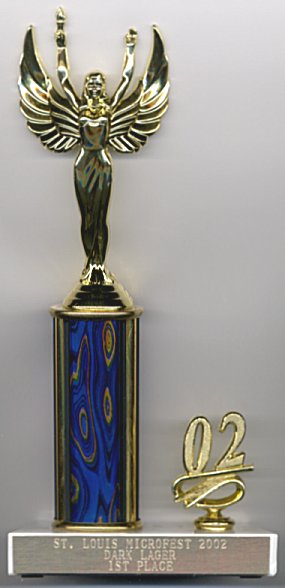
first prize in the dark lager category at the 2002 St. Louis Microfest. Click
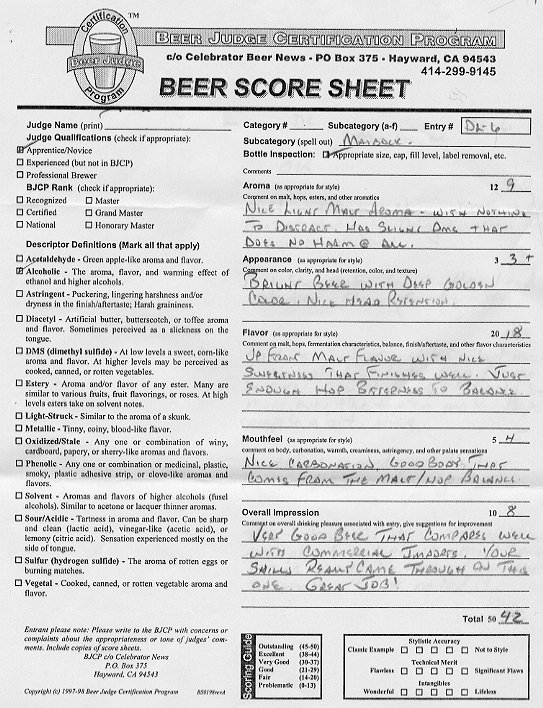
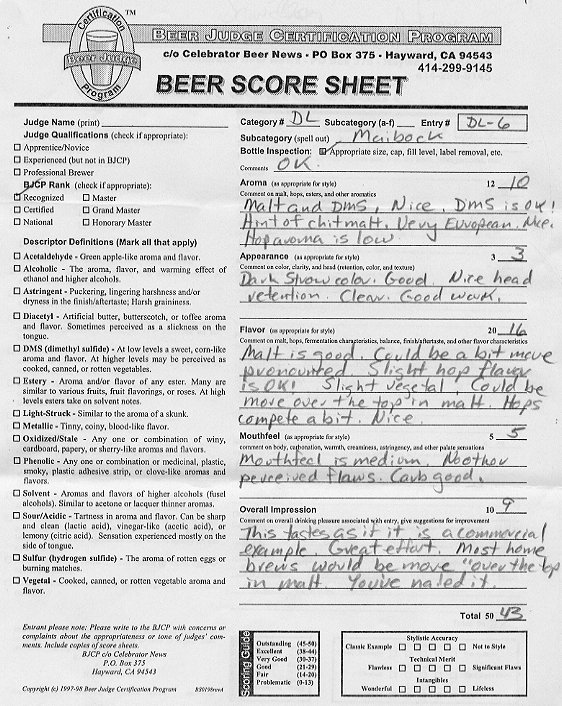
here for a look at the trophy. Here are the judge's score sheets as
well: Scoresheet
#1, Scoresheet
#2
Cayenne
Pepper Beer
Something I've wanted to try for some time now. This beer was made for a
Mardi Gras party. It came out excellent, with just the right amount of hotness.
Superb food beer, especially spicy foods.