

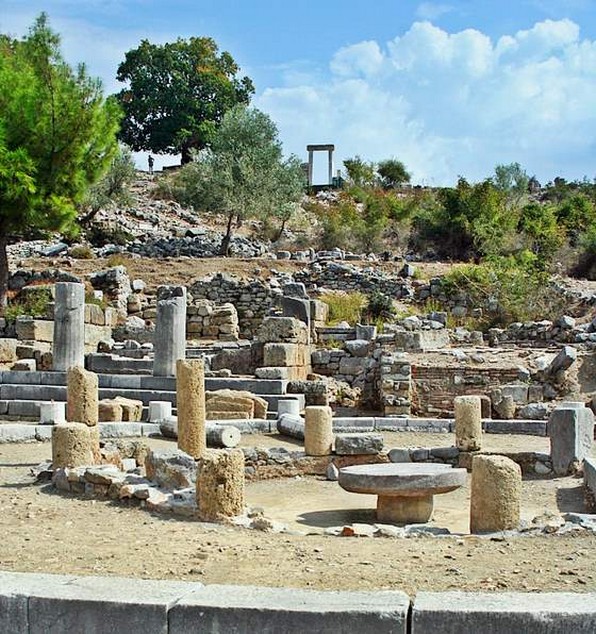
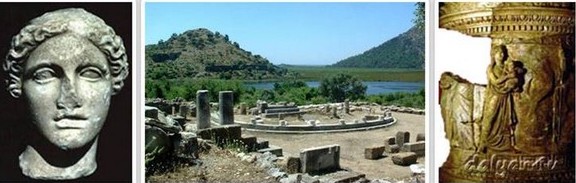
The Terrace Temple : During the ancient era, there were many gods of religions. People who lived in this area believed in Zeus, Aphrodite, Artemis and Apollo. In some antique cities people chose a god or goddess that would protect their city. In an inscription was found at Caunos, the names of Apollo, Poseidon, Artemis and Aphrodite are mentioned. Heredotos said that people of Caunos worshiped their own gods and not gods. Archaeologists found six temples at Caunos. Four of them belong to the Roman period and two of them belong to the Hellenistic period. The temple was built during the second half of the 1st century BC, on an artificial terrace dominating the agora and the harbor. It has a northeast-southeast orientation and an in antis plan with exterior measurements of 9.60x6.78 m. |
|---|
 |
 The Terrasse-Temple CAUNOS |
|---|
| The apse to be seen lying to the southeast of this building, belonged to a three-naved church which was built in the 5th or 6th century AD. The temple consists of a front space (Pronaos) containing two Doric columns between its side walls and an approximately square sacred room (Cella). The courtyard of the temple, which measures 30.50x35.00 m. was enclosed by a colonnaded gallery built of sandstone. This was originally coated with plaster and painted. According to the inscription on the cylindrical column drum at the western end of the Courtyard (Temenos), the temple was dedicated to Zeus Soteros.
|
|---|
 |
|---|
It was determined that the elements in marble and stone, used here, were not original and they belonged to other structures. Most likely, other temples must have been under this temple. Just next to the altar they started to open a borehole to investigate the background of the temple and to date the filling of the place. They soon encountered a surprise ; a monolith, sitting on the bedrock of about 3m50 tall, appeared about 6m50 below the floor of the temple; an ancient block of stone broken in two, slightly chipped pyramid. The upper part was lying to the south. |
|---|
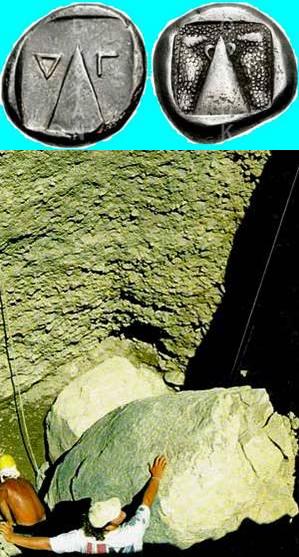 |
Around the base of the rock, they found waste of ashes, animal bones, pottery fragments and a large number of colored stones. Those are evidence that this rock was a symbol of a god. It was realized that the black ceramics dated by the IV. or -V. century BC. When the sacred stone was completely covered with earth the new temples are built on it. But each time, the altar has occurred almost on the sacred stone. The Baitylos, which was the symbol of the city, represented on the coins of Caunus until the middle of the Classical Period, is a non-figurative representation of Basileus Kaunios, the god-king of Caunus. This stone had great significance in the religious life of the Caunians and this sacred stone was the underlying reason for the successive constructions on this spot: of the round structure, of the temple and even of the Christian church built upon this terrace. |
|---|
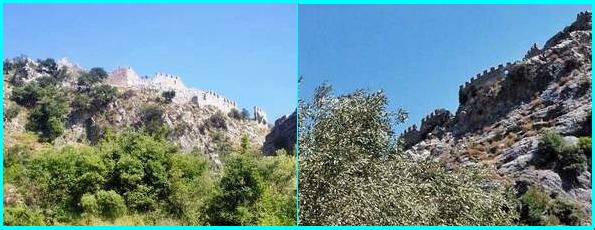
Acropolis - Forteress : The elevation of the limestone mass of the greater acropolis is 152 m. above the sea level. Its southern, southeastern and eastern faces are as steep, forming a rock wall, while its northwestern and western sides are quite precipitous. The path, which began on the slope to the east of the theater was the only access to the acropolis in antiquity and climbs to the highest terrace. The garrison building lining the north side of the terrace must have been constructed, together with the cistern cut into the rocky slope to the south, during the Middle Ages. The surviving remains showing the settlement and use of the acropolis during antiquity are mostly on the terraces extending from the area below the peak towards west. The remains of the wall, constructed of large polygonal blocks lying below the Byzantine terrace walls, which are preserved up to the crenellations, and also the cistern lying to the east of the gate providing entrance to the terrace, are the traces of the earlier periods of the acropolis's use. The peak is a rather rocky hill descending with a discontinuous silhouette towards the west. The remains of a north-south oriented wall to the east and block cuttings at the north and south edges of the uppermost flat area, on which a survey triangulation point is located today, indicate the presence of a 15x35 m open-air sanctuary on this peak. This sanctuary was used for the cult ceremonies of Basileus Kaunios which were performed under the open sky. The fortress, which dates lately during the Crusades and transformed into a castle by the Knights of St. John, was built (in the XIVth century) on an older fortress but not dated. After the conquest of Rhodes by Sultan Suleiman the Magnificent, the Knights finally leave the Eastern Mediterranean on 1 January 1523. |
|---|
| CITY RAMPARTS : Apart from the ramparts that surround Acropol, there are also ramparts surrounding the city. The ramparts extend through Balyklar Mountain in the south and southeast, through the smaal fortres in the north and northwest, through Çömlekçi Hill in the west and through the region that overlooks the town of Dalyan in the south. The city walls were erected during the reign of Mausolos in the 4th century BC but restored in different periods. The height of the ramparts is a few meters at some points. The remnants of the doors inside the ramparts are visible. The regularly-shaped rectangular blocks and the way the blocks |
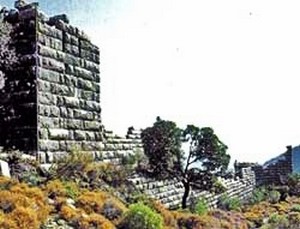 have been positioned, give a fine impression of Hellenistic building techniques. Parts of the wall are well-kept, other parts have been taken down and rebuilt. It is still not understood, how they got to move these large blocks there, with which technology they have carved and removed at a height of several meters, and bricked walls. |
|---|
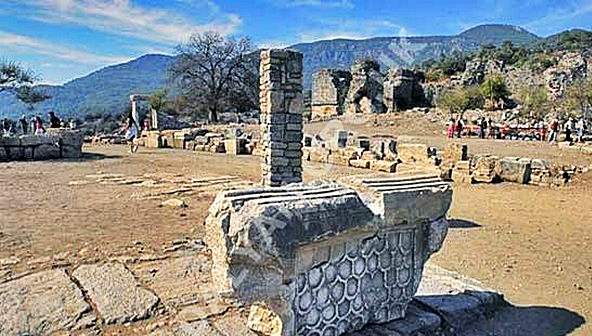
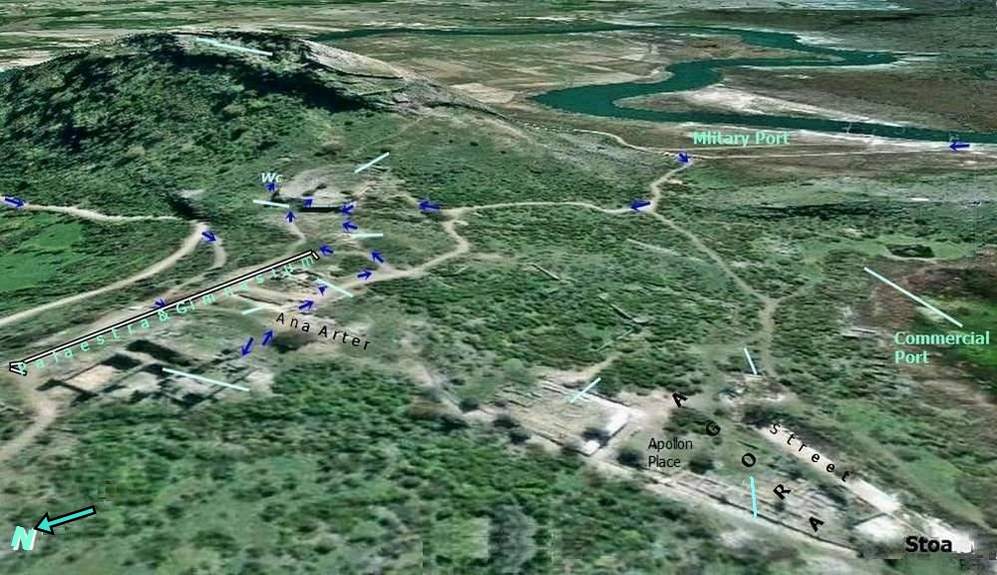
Palaestra Terrace & GIMNASIUM : The flat area lying between the Measurement Platform and the Roman Bath conceals the earlier settlement layers which date from the Late Archaic period onwards. The most important among these earlier structures is a sacred precinct. The remains of its terrace walls, which were repaired several times, were discovered in the soundings excavations made around the church.The well, in front of the remains of the northwestern terrace wall and the remains of a wall found at the lowest level of the excavation suggest that this terrace area was widened and completely developed by 600 BC. A street paved with cobblestones, which was found at a quite level to the north of the area, ascends from east to west. This street, which was certainly constructed by the end of 3rd century BC, connected the city center to the ancient cemetery, including the rock-tombs. This street lost its function around 100 AD; the area was filled to make a terrace. In the east of the bath a sports school (Palestra), from the Roman period, extends towards the church. There were schools in each city to prepare young people for life and war. Military education and culture was conducted always together. Undoubtedly, athletic competitions, training and practice in wrestling and other athletics were held here. The Palestra that covers a large area is not available today. |
|---|
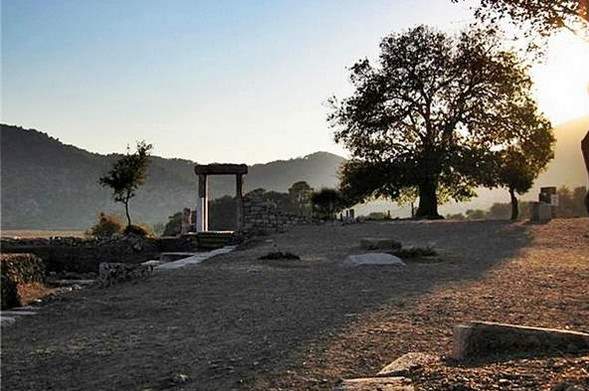 After a monumental gate (restored to its late antique phase), the east-west street wich through the terrace of Palestra, down to Port-agora as a paved road. |
|---|
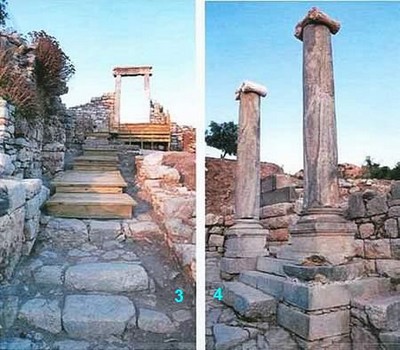 |
Photo3: The artery of the east-west connecting the terrace of Palestra, the agora of the port. This paved street is sacred and at the beginning of landing a monumental gate has been restored.
Photo4: Down on the side of the same sacred road is located a building called 'Villa'. The monumental entrance of the building recently restored and a missing column header is copied from the original, with the help of the mold. |
|---|
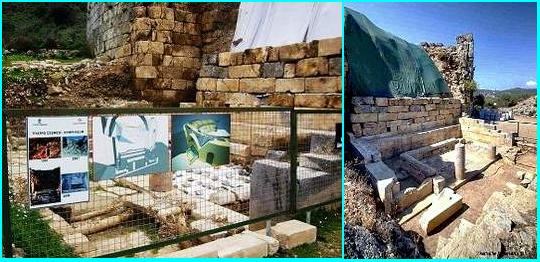
The Fountain of Theatre : The Theatre Fountain of Caunos takes place within the tail of analemma wall of the theater. It is a construction of a monumental fountain of 10.60 x 6m, built here in the interior of a large niche (11.80 x 3.15) with a single arc. For the construction of the structure used columns and marble blocks of lilac. The structure with two columns located between the two side walls, in-antis plan, was put in the form of a niche in the wall of the theater. This wall continues from above the building with three large arches.At that time, used to human trafficking to the upper terrace of the city; An estimate can be made, for now, only on the date of construction of the fountain: Late Classic Period (400-300 BC). |
|---|
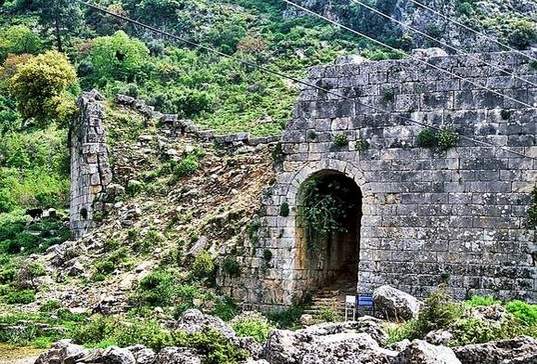 The fountain, until recently, remained unnoticed under the ruins of the wall of the theater; A section on the left of the north entrance gallery of the theater was destroyed. For years, archaeologists have searched and finally found the cause of degradation. Underneath, a monumental fountain building was revealed and the water, gradually weakening the field, had caused the collapse of the wall. |
|---|
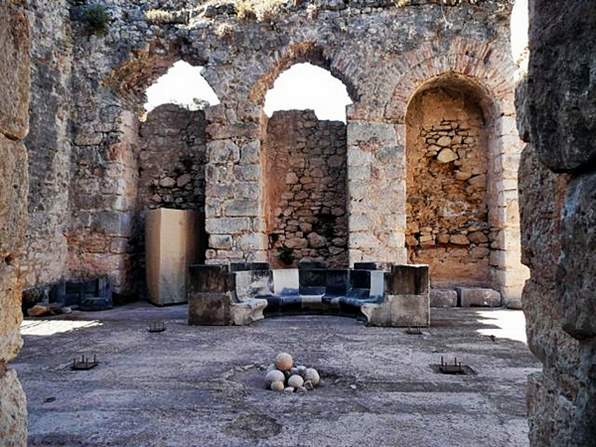
The Roman Bath : The Roman baths served as a social meeting place and were intended to impress the Caunians. The Romans went to the baths for hygiene and comprehensive care of the body, but this place was also an important social function. The baths were part of Roman urban life; not only they washed, but also met their friends, made sport, played a game of dice, could conduct business there. Public baths played an important role for general hygiene. They belonged to the state or to private persons. The entrance fee was nominal. Often, to be argued, the rich burghers |
were building luxurious baths that they were free to the public.
|
|---|
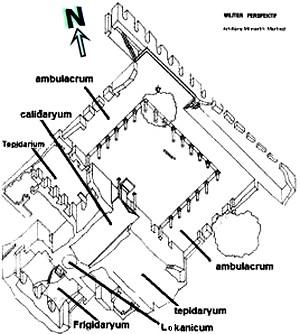 |
The bath building, which measures 58.20x28.20 m, consists of large halls. The two warm halls (Tepidarium) and the two exercise halls (Ambulacrum) were on either side of the hot room (Caldarium) and the sweating room (Laconicum) which form the middle axis. All these rooms are crowned by the cold room (Frigidarium) to the southwest. Each of these halls were originally paved with thin marble slabs. In the Byzantine period, the baths were dismantled and the frigidarium was re-used as a church. The sections of undressing, cold bath, warm bath, hot bath, oiling, heating system and a swimming pool, which became ruins over time, are now being restored. |
|---|
| We knew that the Romans were going to bed in their clothes on, but after work, they were usually to the baths to relax. They came with their servants. First, they would drop their clothes in the changing room (apodyterium, or spoliatorium) guarded by slaves, they were warming while playing sports (ball games, running, weightlifting, etc..) in the gym, because the Romans thought it evacuated the crass and those who did not like the physical effort went into the tepidarium, warm room, and then heated in a room over the laconicum (the dry sweating room) or the Sudatio (oven humidity) which is 60 ° C, made them sweat as much.. Then they went into the caldarium, |
|---|
| where they got rid of his sweat with a strigil (scraper iron or ivory), and then they went to frigidarium through the tepidarium (to avoid hypothermia), this served to strengthen their skin. They would eventually swim in the Natatiopiscine. The bath was then completed, they rested in the caldarium, and they could get a massage with perfumed oil and take tweezers. Generally, they cover his body with oil in the destrictarium (the Romans did not use soap). |  |
|---|
| [The apodyterium (plural: apodyteria) (changing rooms), the sudatorium (sweating room), caldarium (hot bath by sprinkling or immersion), the tepidarium (warm bath) the frigidarium (cold bath).] Oils and perfumes were kept in an unctuarium. The baths were not mixed, with very few exceptions (the end of the Roman Empire, the baths have become mixed). Some installations were doubled, with a separate section for women. Others practiced alternate schedules for each sex. The morning is more likely for women, while men took advantage of all the afternoon and even at night. |
|---|

|
|---|