 |
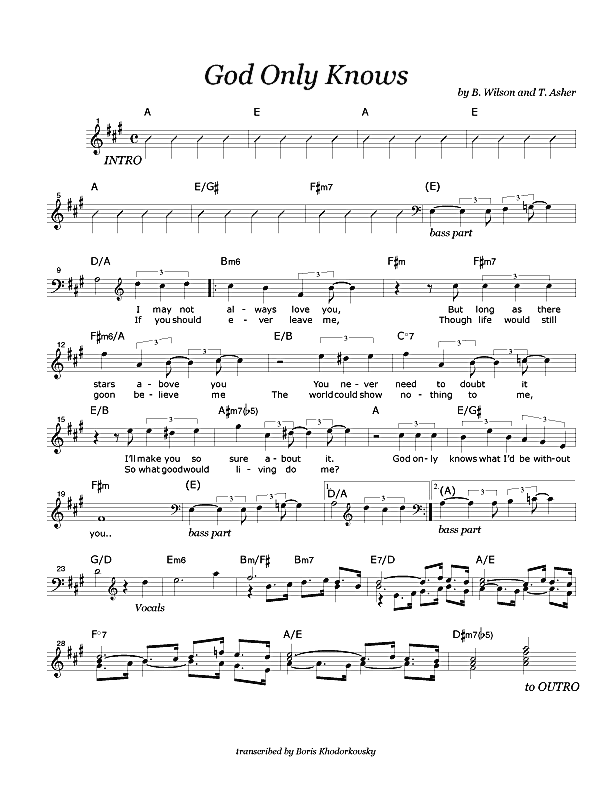
The melody line is a beautifully shaped acceding sequence, it soars into the sky sung by Brian's brother Carl Wilson whose voice would astonish not one classically trained musician. This song is a masterpiece of a genius composer. He paints his feelings so beautifully with the music. As we see in every measure he shows an incredible emotion which is "framed" in gold by an astonishing knowledge of Classical and Jazz harmony. There are not too many composers that have achieved the same deepness of expression being very sophisticated in their harmonic language. In my opinion Brian Wilson is one of them! Just by listening and analyzing this one song one can put him in the same line as J.S.Bach and Mahler. He has done for Pop music as much as they have done for Classical. His very seamless Baroque like bass lines, beautiful counterpoint of the melody and amazing ability to "paint" one's emotions on the canvas of music is a true gift to us. Now I can see the influences of his compositions on many other pop composers. And I will never stop admiring his genius wondering about the roots of some of the best pop compositions of today. He was the first!
THANK YOU, BRIAN!
 |
In measure 8 the bass line hints on a V to
I motion, that is why I have indicated the harmonic tension of this measure
by (E) - quasi E-Major chord. But G-Natural shows the modal use of a mixolydian
flat 7 - a device used by many Classical composers to broaden the feel
of tonality. At the same time Brian underlines a very Plagal nature of
the opening three bars of the song. The mixolydian A mode creates a feel
that we are actually leading into the 4th degree major - D-Major.
Therefore bars 8 to 12 could be analyzed in the key of the Subdominant.
|
|
|
|
|
|
|
|
|
|
|
|
|
|
|
|
|
|
Taking a look at the table above we can see that, for example the F#m6/A chord in m.12 works better as is in the key of D-Major and what a fascinating discovery, it is a Neapolitan 6, as they call it in Classical composition!..
That section, floating in-between two closely related keys is crafted by a Composer from the capital "C".
There is even some "word painting" - a Classical technique of Romantic period - is used, note how well the C-Diminished chord in m.14 describes the word "doubt". Brian uses VII dim7 (or 4/2 as classical composers would call that inversion) of the dominant E-Major chord inverted so that we would get this intriguing B to C motion creating a quasi leading tone tension and then smoothly descending onto a bII half diminished chord - a very jazzy device, again rooted into the Classical Neapolitan 6 chord..
Finally we resolve to tonic! in the m.17, descending then classically through a V6 chord into the VI-minor and then again back to the A-Major/D-Major puzzle of the second verse.
The chorus section is not less interesting.
From the end of the second verse the bass line keeps going up using the
opening idea in a sequence, bringing us up to the next puzzle. Are we in
D- or G-Major?.. This time it is clearer that we actually lend on
D, the following progression proves that:
|
|
|
|
|
|
|
|
|
|
And here comes another jewel: a mini-fuge that
uses the augmented imitation (classically speaking) of the opening bass
line as a theme. Here Brian comes back to the home key and again as a Master..
The composer uses purely Classical technique:
|
|
|
|
|
|
|
|
|
|
|
|
|
|
And what is this chord in the m.30?.. And again
he is using bII half diminished chord in the key of D-Major, we have seen
it before in the song. So he returns back regularly except the last
jump into the Plagal area, where we have started by the way:
|
|
|
|
|
|
|
|
The fadeout is simple:
|
|
|
|
|
|
|
|
|
|