|
 Although the eighteenth-century Scotch
Irish settled in every part of the colonies, like other immigrants of the
period they tended to shun New England. They concentrated on the middle
colonies, particularly Pennsylvania, which had generous land policies and
whose chief city, Philadelphia, was the major port of debarkation of the
emigrant trade. Large numbers of Scotch Irish came as indentured servants,
and the emigrant trade from the Ulster ports -- Belfast, Londonderry,
Newry, Larne, and Portrush -- seems to have been particularly venal. Many
ships were overcrowded and underprovisioned, which sometimes resulted in
tragedies. One of the most horrible involved the Seaflower out of Belfast
for Philadelphia in 1746. Forty-six of her passengers starved to death,
and the sixty who survived did so only by resorting to cannibalism. Although the eighteenth-century Scotch
Irish settled in every part of the colonies, like other immigrants of the
period they tended to shun New England. They concentrated on the middle
colonies, particularly Pennsylvania, which had generous land policies and
whose chief city, Philadelphia, was the major port of debarkation of the
emigrant trade. Large numbers of Scotch Irish came as indentured servants,
and the emigrant trade from the Ulster ports -- Belfast, Londonderry,
Newry, Larne, and Portrush -- seems to have been particularly venal. Many
ships were overcrowded and underprovisioned, which sometimes resulted in
tragedies. One of the most horrible involved the Seaflower out of Belfast
for Philadelphia in 1746. Forty-six of her passengers starved to death,
and the sixty who survived did so only by resorting to cannibalism.
Large numbers of the Scotch-Irish servants were skilled craftsmen and,
after the collapse of the Ulster linen industry in 1771-72, many involved
in that trade emigrated. Scotch-Irish servants seem not to have had the
social mobility that Germans did � perhaps because they did not have the
support of a compact ethnic community. However, some of them prospered,
like Charles Thompson (1729-1824), who after emigrating from Londonderry
as a youth made his mark in business and politics, serving as the
secretary of the Continental Congress from 1774 to 1789.
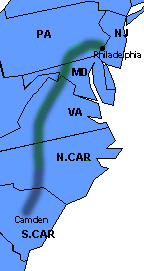 It was from Pennsylvania that the
settlement of the interior of the southern colonies proceeded, a
settlement that was chiefly Scotch Irish but that also contained large
numbers of Germans and lesser numbers of Swiss and Welsh. The route was
the Great Philadelphia Road, which proceeded west from the port city
across Chester and Lancaster counties, turned southwest at Harris' Ferry
(today's Harrisburg), where it crossed the Susquehanna, passed through
York and Adams counties, and after traversing the western neck of
Maryland, headed down Virginia's Shenandoah Valley and then across North
Carolina's central plateau on into mid-South Carolina, terminating at
Camden. Migration along this route occurred in stages. The Germans
pioneered the settlement of the upper Shenandoah Valley in the late 1720s
- early 1730s, but in the later thirties and the forties, Scotch Irish
predominated, particularly in the central and southern valley. Two
counties there, Augusta, birthplace of Woodrow Wilson, and adjoining
Rockingham, claim to be the most heavily Scotch-Irish counties in the
United States. In the later 1740s Scotch Irish began to move further
south, past Roanoke into the North Carolina Piedmont, where they had been
preceded by groups of Scots who had reached it via an overland trek from
the coast through the Cape Fear Valley. By the 1760s the Scotch-Irish
migration had reached South Carolina. It was from Pennsylvania that the
settlement of the interior of the southern colonies proceeded, a
settlement that was chiefly Scotch Irish but that also contained large
numbers of Germans and lesser numbers of Swiss and Welsh. The route was
the Great Philadelphia Road, which proceeded west from the port city
across Chester and Lancaster counties, turned southwest at Harris' Ferry
(today's Harrisburg), where it crossed the Susquehanna, passed through
York and Adams counties, and after traversing the western neck of
Maryland, headed down Virginia's Shenandoah Valley and then across North
Carolina's central plateau on into mid-South Carolina, terminating at
Camden. Migration along this route occurred in stages. The Germans
pioneered the settlement of the upper Shenandoah Valley in the late 1720s
- early 1730s, but in the later thirties and the forties, Scotch Irish
predominated, particularly in the central and southern valley. Two
counties there, Augusta, birthplace of Woodrow Wilson, and adjoining
Rockingham, claim to be the most heavily Scotch-Irish counties in the
United States. In the later 1740s Scotch Irish began to move further
south, past Roanoke into the North Carolina Piedmont, where they had been
preceded by groups of Scots who had reached it via an overland trek from
the coast through the Cape Fear Valley. By the 1760s the Scotch-Irish
migration had reached South Carolina.
|
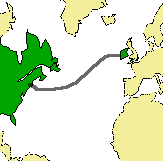 While many equate Irish immigration to
America with the potato famine of the 1840s, the fact is that a
considerable number of Irish were among the early settlers and influenced
our formative years.
While many equate Irish immigration to
America with the potato famine of the 1840s, the fact is that a
considerable number of Irish were among the early settlers and influenced
our formative years. 

