IF AMPLIFIERS by Harry Lythall
Here are a few IF amplifier subsystems that may be of interest for a few
different applications. All of these would normally be preceeded by a crystal or
ceramic filter to limit the IF bandwidth for communications purposes. Where a
capacitor is marked Cx this means the capacitor is an integral part of the coil
or transformer that it tunes.
Traditional AM
This circuit is the old traditional two-transistor AM receiver type of
circuit, complete with some form of AGC. For amateur use the amplifier is still
quite usefull as the IF out can be used to feed a product detector for CW or SSB
use.
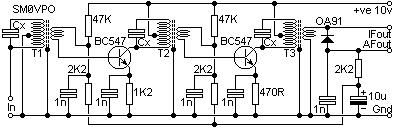
This circuit normally operates at 455KHz using readily available coils. A
Pack of 5 coils costs $0.95 (P-C216) from Antique Electronic Supply, but I don't
think they have many left in stock.
Cascode Novel IF strip for FM
This is a really novel circuit and is suitable for Narrow Band FM
applications for a 455KHz IF system. It is particularly usefull in portable
applications where battery power consumption is of prime importance.
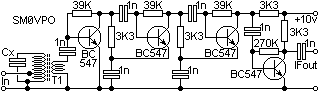
If you fillow the DC path from positive to negative you will see that the
first three transistors are in series whilst the signal paths are consecutive. A
final output transistor can give quite high IF voltages. The gain of this
circuit is so high that clipping of the IF signal takes place making it ideal
for driving an FM detector.
FM IF subsystems
This IF subsystem is a complete IF amplifier and FM detector. It't particular
advantage (for me) is that I have used it in many receivers and I know it well.
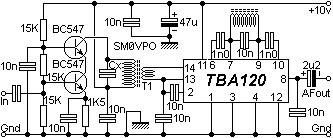
I have found the IC to be rather cheap and available from a company called
Mainline in the UK. No further info - sorry. In spite of this circuit having
quite a few components it can be built in a small space and detect 455KHz IF. L1
is about 50 turns (thin wire on a 5mm former).
If you want something for 10.7MHz then I can recomend the CA3089 or the more
sensitive CA3189 (direct plug-in equivalent)
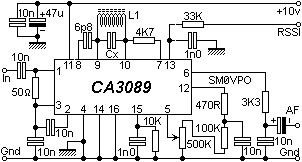
One word of warning, I have not been sucessfull in using the CA3089 in a
double superhet where there is both 10.7 AND 455KHz at the input circuitry. It's
gain seems to fall off rapidly as the frequency is reduced. This circuit is NOT
as sensitive as the TBA120.