Introduction
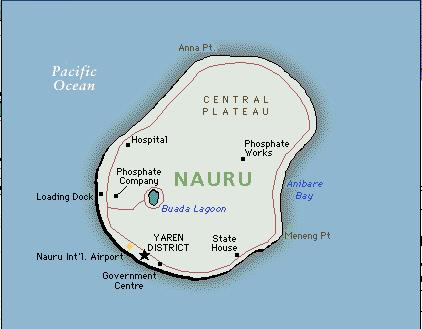
Nauru (also spelled Naoero), island republic in Micronesia in the central Pacific Ocean, situated just south of the equator and 4,000 km (2,486 mi) north-east of Australia. It is a raised coral island, oval in shape, with an area of 21 sq km (8.2 sq mi). Nauru has a population (1996 estimate) of 10,273, giving a density of 489 per sq km (1,253 per sq mi). It is made up of about 58 per cent Nauruans, 26 per cent other Pacific Islanders, 8 per cent Chinese, and 8 per cent Europeans. The Nauruans are of mixed Polynesian, Micronesian, and Melanesian descent. About four-fifths of the population is Christian. Nauruan and English are the main languages. The district of Yaren is the country's capital. Most of the population of Nauru lives along a narrow, fertile coastal strip that encircles the island. The rest of Nauru consists of a central plateau, about 61 m (200 ft) in elevation, that contains some of the world's richest deposits of high-quality phosphate rock.
Economy
The monetary unit of Nauru is the Australian dollar of 100 cents (A$1.28 equals US$1; 1997). The Nauruans receive generous royalties from mined phosphate, and this makes Nauru relatively rich on a per capita basis. Nauru's annual gross national product averages US$80.7 million (1985, Organization for Economic Cooperation and Development), equivalent to US$8,070 per head. In 1994 approximately 680,000 metric tons of phosphate were exported annually to Australia, New Zealand, the Philippines, South Korea, and Japan, primarily for use in the manufacture of fertilizer. In the early 1990s, demand for and exports of phosphate declined. However, the phosphate mining has severely damaged the island's environment, and by the time the phosphate mines are exhausted around the year 2000, about 80 per cent of Nauru will be uninhabitable and will require extensive rehabilitation. To help provide for this time, the Nauruan government is investing much of the royalty earnings abroad and attempting to develop service industries to ensure the country's economic future. In 1993 an agreement was signed with Australia for a US$80 million compensation package to cover mining damage caused during the Australian mandate and trusteeship periods.
History
Little is known of the history of the Polynesian inhabitants of the island before 1798, when it was explored by Captain John Fearn from Britain. Nauru was annexed by Germany in 1888; the phosphate deposits were discovered in 1899. Nauru was surrendered to Australia in 1914 and in 1920 became a British mandated territory under the League of Nations. It was occupied by the Japanese from 1942 until 1945, and in 1947 the mandate was replaced by a United Nations trusteeship, still administered by Australia.
Nauru gained its independence and was proclaimed a republic on January 31, 1968. In the same year it became a member of the Commonwealth of Nations. Its unicameral parliament has 18 members elected by universal adult suffrage to serve terms of up to three years. The president, elected by parliament from among its members, is assisted by an appointed cabinet. Hammer DeRoburt became president upon independence, a post he held until 1989, apart from a brief period in 1986-1987 when Kennon Adeang held power. In August 1989, after a period of political turmoil and a vote of no confidence, he was forced to resign. Bernard Dowiyogo was elected president later that year and was re-elected in 1992.
Nauru is one of the island nations under threat by the rise in sea level that may result in the next century from global warming. It was one of the more vociferous opponents of the resumption of nuclear testing in the Pacific by France in 1995.
Information from Microsoft Encarta