A History of Water Polo
Water polo has a history that spans
roughly four centuries in one form or
another.
Initially horses were used to play the game, as this
Dutch painting shows. The game was a version of
modern polo, played on the beach, with high tide signalling the
end of the match.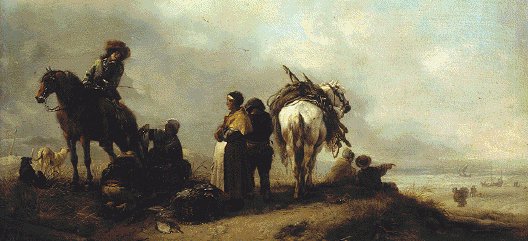
This version of the game was phased out early in the eighteenth century,
however, as the Dutch
chose to reclaim land from the sea and beach space became scarcer:
these tracts of reclaimed land
were named after the sport in its original Welsh, polo dwr, hence the
Dutch polder. Moreover, the
tendency to play on until the last possible moment drew criticism from
the first animal liberationists,
and with good reason: one account tells of how an entire team of seven
horses was lost in a
championship final as Utrecht sought a last-minute equaliser against
their deadly rivals, the Hague.
The game therefore suffered a major lull in popularity, as what had
previously been the sport of kings went underground in a bid to escape
unwanted attention. While the traditionalists struggled to avoid animal
welfare groups, however, another set of pioneers formed a breakaway leauge
that laid the foundations for the game we know and love today.
These founding mothers and fathers had played the original game and
had thereby grown used to
surviving the drowning horses in what had come to be known as "injury
time". Their swimming skills had consequently vastly improved, and they
decided to put this "side-effect" to good use.
Abandonning the use of horses, though retaining full riding gear, these
sportsmen and women created modern waterpolo.
The nineteenth-century saw many changes in the game, notably in the
ball; an inflated cow's bladder was used in place of the original puck.
For the sake of convenience, most of the riding gear was now abandonned,
though the riding helmet was retained to protect against injury.
Andy Cuthbert, of Thetford Water Polo Club, points out that in eastern
England riding crops are still in evidence, particularly in more vigorously
contested games.
Water polo's popularity reached its zenith in the second half of the
nineteenth century, particularly in France. The game had generally moved
inland to fresh water, and the Seine proved a particularly popular location.
Newspapers carried spot the ball competitions for water polo, most of which
have since been lost.
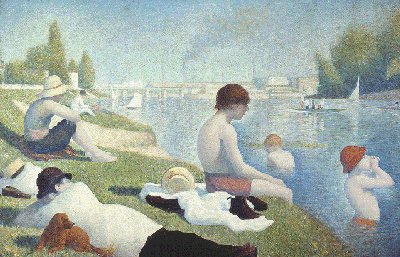 Some do survive, however, including this picture of a famous encounter
between Asnières and La Grenouillère. It is clear from this
illustration that the game was a spectator sport, but that on wider
Some do survive, however, including this picture of a famous encounter
between Asnières and La Grenouillère. It is clear from this
illustration that the game was a spectator sport, but that on wider
rivers one umpire had to resort to skulling to keep up with play
(he is just visible in the far right of the picture). Note also that the
technology of water polo hats was still somewhat limited, with very little
protection for the ears.
These days, of course, tactics and technology are far more advanced
and the rules have been
standardized. Though its original form would seem to have vanished
completely, the modern game is played across the world, even in west Wales,
where a group of hardened professionals struggle to keep the game alive.
This text was originally devised by Phillipe Parker
Back to index