TERMS AND TOOLS OF THE INFORMATION TECHNOLOGY TRADE
Cynthia Dorrington uses many computer terms and tools on a regular basis to do her job. To understand just exactly what she does, it is helpful to define the following computer terminology:
binary code: A number system that uses two digits, 0 and 1, to represent a wide range of information. All information entered into a computer is changed into combinations of these two digits. These combinations of 0s and 1s create patterns of switches. 0 represents off, and 1 represents on. Changing the information entered into a computer just means changing the pattern of switches.
byte: Bits are arranged in groups of eight and called a byte. A computer's memory is measured in kilobytes, each roughly a thousand bytes. Today the byte is universally used to represent a character (a letter or figure).
chip: A miniature device inside the packages in a circuit board. A chip has its own network of electrical paths.
circuit boards: Within a computer, there are one or more circuit boards. A circuit board is an arrangement of paths and other devices that direct the flow of electricity. The paths connect the packages.
computer: A computer is a machine that can solve problems at great speed and store immense amounts of information. To perform any task, computers need step-by-step instructions. These instructions are called programs. A person who prepares computer programs is known as a programmer. The path that electricity follows through a computer determines what the machine does. All information entered into a computer is translated into a special binary code. This code creates patterns of switches, each turned ON or OFF to direct the flow of electricity.
CPU: This is the central processing unit or control centre of every computer. In the CPU, information is processed according to the instructions outlined in the program.
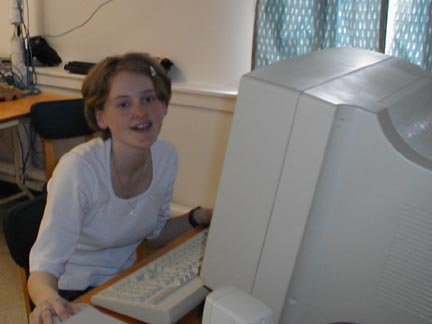
input device: An instrument like a keyboard is used to put information into the computer.
LANsystem: This is a local area network information system. It allows a lot of PCs to talk to one another.
mainframe: The name for a very large, general-purpose computer. These computers can fill an entire room, and they are equipped to process and store immense amounts of information. They can be programmed by the user.
memory: The part of the computer used to store information.
PCs, personal computers, microcomputers: These are small general-purpose computers that are smaller than mainframe computers and that have less storage capacity. They can be programmed by the user. Laptops are portable computers in a small briefcase.
ORACLE: One of a number of databases.
output device: Any information that a computer puts out is called output. Output devices include this computer screen, a printer, the overhead etc.
teleworking: A recent practice of many companies which allows employees to work at home for 2 to 3 days a week. This practice caters to the needs of women who want to stay home and raise their families as well as work.
transistor: A transistor is an incredibly tiny device that controls the flow of electricity along the paths within a computer chip. Transistors are really switches that can detect, amplify and correct currents; or they can break currents. Transistors produce very high-frequency electromagnetic waves, and open and close circuits in the space of a millionth of a second. They have allowed advances to be made in information technology, communications, and aeronautics.
UNIX: The UNIX is a complex operating system that is multitask, and as a result, very popular in a variety of information technology settings. Information technologists like Cynthia Dorrington use it like we use DOS or Windows.
WANsystem: This is a wide area network information system.
This system allows communities to talk to one another through network servers
which are also computers. Network servers stand as tall as the average
person or as small as a personal PC.