
What is electricity?
The Dorling Kindersley Dictionary of Science defines electricity as a form of energy produced by the movement of electrons. There are two kinds of electricity: static electricity and current electricity. Static electricity stays in one place and doesn't move like current electricity. Lightning is the most spectacular example of static electricity. This is a huge spark that flows between positive charges in the top of a thunder cloud and negative charges in the bottom. Current electricity is the flow of electric charge through a substance that conducts electricity such as copper wire. A battery is a good example of a device that uses current electricity. Alternating current, also known as AC, is the kind of electricity that comes into most homes from power stations. For more definitions about electricity, see the vocabulary.
How do we get it?
Electricity is generated in many ways. In Virginia, for example, our power company uses at least three different fuels. There are four nuclear power units, producing 3392 Mw (Mw = megawatt = 1000 kilowatts or a million watts). There are also 54 fossil fuel plants (coal, oil, natural gas), producing a total of 8348 Mw. Finally, the 8 hydroelectric plants in Virginia produce a total of 1590 Mw. Notice how four nuclear plants produce almost half as much as the 54 fossil fuel plants! For further discussion of fuel types, go to the sources page.
From the ground to your house.
|
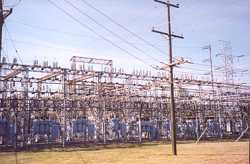 A substation in Virginia |
How do we use it?
Almost everything we use now is powered by electricity. Imagine a normal day in your life. You get up because your alarm starts playing your least favorite music. You go to the bathroom, turn on the light, flush the toilet and take a shower. You see your big brother shaving while you dry your hair with a hair dryer. In the kitchen, you open the refrigerator. You grab some raisin bread, and put it in the toaster. You want some orange juice, so you plug in the juicer. Your mom had poured some coffee from the coffeemaker but it got cold, so she warms it for a minute in the microwave oven. Your brother gets on the computer and checks his email, while listening to a CD. You phone the weather on the portable phone. It's raining and you convince your mom to drive you to school, so you open the garage door. On the way to school, you see a huge auto factory making electric cars. After school, you do a load of laundry and help cook dinner while your brother practices his electric guitar. After dinner, you use the water pick because you have braces. You print out your homework. Then you go to bed, turn your lamp on and read. After a while, you turn off your light and you can see the night light. The hum of the heat pump puts you to sleep.
How can we save it?
Here are some ways you can save electricity:
Vocabulary
Alternating current. Electric current that changes direction continually.
Capacitor. A device that stores electricity for future use.
Circuit. A path electricity follows, from a source through a connection to an output device.
Conductor. A substance that allows electricity to pass through it. Conduction occurs when electrical current passes between two points by means of a physical connection.
Coulomb. The unit of measure of electrical charge.
Direct current. Electric current that flows only in one direction, such as that supplied by a battery: it flows from the negative battery terminal, flows through the circuit, and returns to the positive terminal.
Electrical charge. The amount of electrical energy stored in a battery, capacitor, or any insulated object that can hold energy for a time.
Electricity. A form of energy associated with the presence and movements of electrical charges. Atoms contain positively charged protons in their nucleus and negatively charged electrons outside the nucleus.
Incandescent light bulb. A lamp that burns a filament in a vacuum in a glass bulb.
Induction. When an electrical current is produced without any physical connection between the two parts of the circuit.
Insulator. A material that does not conduct electricity, or in other words, doesn't allow electricity to pass through it.
Law of electric charges. Unlike charges attract each other and like charges repel each other.
Lodestone. A type of iron ore with a silvery finish, sometimes called magnetite. A lodestone has permanent poles. One end always points north and the other always points south. If lodestone is hit hard enough it loses its magnetism.
Magnetism. The push or pull of magnets, which are electrically charged with poles attracted to the North Pole or South Pole.
Ohm's Law. The relationship, in a circuit using direct current, among voltage, current and resistance: One volt of electricity (E) is needed to force one ampere of current (I) through one ohm of resistance (R). Mathematically, Ohm's Law says: E = I x R.
Static electricity. Electricity that is "at rest" or static until it is discharged. Material that is rubbed picks up negative charges from the negative electrons surrounding the positive nucleus of an atom. A sudden, tiny discharge balances the atoms again.
Volt. The unit of measure of electrical force, named after Alessandro Volta, the inventor of the battery.