What is Energy?
All around us energy is causing things to happen. Look out a window. If it's daytime, the sun is giving out light and heat energy. If it's nighttime, street lamps are using electrical energy to make light.
A car drives by your school or house. It is being powered by gasoline, a type of stored energy.
Our bodies eat food, which has energy in it. We use that food to play or study.
Energy makes everything happen. Energy can be divided into two different types, depending on whether the energy is moving or stored.
Energy that is stored is called potential energy.
Energy that is moving is called kinetic energy.
If you have a pencil on your desk, try this example that shows the two different
types of energy.
Put the pencil at the side of the desk and push it off to the floor. The pencil is moving and is using kinetic energy.
Now, pick the pencil back up and put it back on the desk. You used your own energy to lift and move the pencil. Moving it higher than the floor adds energy to it. As it rests on the desk, it has potential energy. The higher it is, the further it could fall, so the pencil has more potential energy the higher you raise it.
If you have a rubber band, stretch it out. The stretched rubber band has potential energy. If you let it go, it moves and has kinetic energy. Just don't shoot anyone with the rubber band!
Energy is measured in a couple of different ways.
One of the basic measuring blocks is called a Btu. This stands for British thermal unit.
Btu is defined as the amount of heat energy it takes to raise the temperature of one pound of water by one degree Fahrenheit, at sea level.
One Btu equals about:
- One blue-tip kitchen match
- One average candy bar
- 4/5 of a peanut butter and jelly sandwich
Energy can also be measured in joules. Joules sounds the same way as the
word jewels, like diamonds and emeralds. It takes 1,000 joules to equal a British
thermal unit. So:
1,000 joules = 1 BtuSo, it would take 2 million joules to make a pot of coffee.
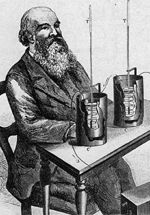 Joule is named after an English
physicist named James Prescott Joule (pictured on the left) who lived from 1818 to
1889. He discovered that heat is a type of energy.
Joule is named after an English
physicist named James Prescott Joule (pictured on the left) who lived from 1818 to
1889. He discovered that heat is a type of energy.
One joule is the amount of energy needed to lift one pound about nine inches.
Around the world, scientists measure energy in joules rather than Btus. It's much like people around the world using the metric system, meters and kilograms, instead of the English system of feet and pounds.
Like in the metric system, you can have kilojoules -- "kilo" means 1,000.
1,000 joules = 1 kilojoule = 1 Btu
A piece of buttered toast contains about 315 kilojoules of energy. With that energy you could:
- Jog for 6 minutes
- Bicycle for 10 minutes
- Walk briskly for 15 minutes
- Sleep for 1-1/2 hours
- Run a car for 7 seconds at 80 kilometers per hour (about 50 miles per hour)
- Light a 60 watt light bulb for 1-1/2 hours
Energy can only be changed into another sort of energy. It cannot be created nor can it be destroyed.
Here are some changes in energy from one form to another.
Stored energy in a flashlight's batteries becomes light energy when turned on.
Food contains energy stored as chemical potential energy. Your body uses the stored energy to do work, kinetic energy.
If you overeat, the food's energy is stored as potential energy in fat.
When you talk on the phone, your voice is changed to electrical energy. The phone on the other end changes the electrical energy into sound energy.
A car uses stored chemical energy in gasoline to move. The engine changes the chemical energy into heat and kinetic energy to power the car.
A toaster changes electrical energy into heat energy.
A television changes electrical energy into light and sound energy.
Heat Energy
Heat is a form of energy. We use it for a lot of things like warming our homes and cooking our food.
Heat energy moves in three ways:
- Conduction
- Convection
- Radiation
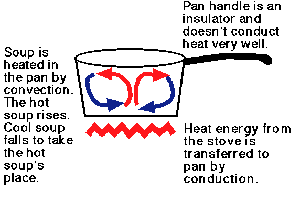 Conduction is when energy is passed directly from one item to another. If
you stirred a pan of soup on the stove with a metal spoon, the spoon will heat up.
The heat is being conducted from the hot area of the soup to the colder area of
spoon.
Conduction is when energy is passed directly from one item to another. If
you stirred a pan of soup on the stove with a metal spoon, the spoon will heat up.
The heat is being conducted from the hot area of the soup to the colder area of
spoon.Metals are excellent conductors of heat energy. Other things like wood or plastics are not good conductors of heat energy. These "bad" conductors are called insulators. That's why a pan is usually made of metal and the handle is made of a strong plastic.
Convection is the movement of gases or liquids from a cooler spot to a
warmer spot. If the soup pan above was made of glass, we could see the movement
of convection currents in the pan. The warmer soup moves up from the heated area
at the bottom of the pan to the top where it is cooler. The cooler soup then moves to
take the warmer soup's place. The movement is in a circular pattern within the pan
(see picture above).
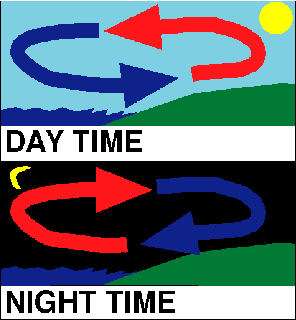 Wind is often caused by convection currents. During the daytime, cool air from over
water moves to replace the warm air over land that rises. During the nighttime, the
directions changes and the water is warmer and the land is cooler.
Wind is often caused by convection currents. During the daytime, cool air from over
water moves to replace the warm air over land that rises. During the nighttime, the
directions changes and the water is warmer and the land is cooler.
Radiation is the final form of movement of heat energy. The sun's light and heat cannot reach us by conduction or convention because space is almost completely empty. There is nothing to transfer the energy from the sun to the earth. The sun's rays travel in straight lines called heat rays. When it moves like that, it is called radiation.
When the sun light hits the earth, its radiation is absorbed or reflected. Darker surfaces absorb more of the radiation and lighter surfaces reflect the radiation. So, if you wear light or white clothes outside during the summer, you would be cooler.
Here's What We Learned
- Energy is the ability to do work.
- There are two different types of energy. Kinetic energy is energy in motion.
Potential energy is energy that is stored.
- Energy is measured in units, two of which are Btu (British thermal unit) or
joule.
- Energy cannot be created, nor can it be destroyed. It can only be changed in
form.
- Heat energy comes in three forms: conduction, convection and radiation.
*****