 When we hang laundry outside to dry in the sun, we are using the sun's heat to do
work -- drying our clothes.
When we hang laundry outside to dry in the sun, we are using the sun's heat to do
work -- drying our clothes.
The sun has always been an energy source.
Plants use the sun's light to make food. Animals eat plants for food.
And as we found out earlier, decaying plants and animals millions of years ago
produced the coal, oil and natural gas that we use today.
So, fossil fuels actually got their start as sunlight many millions of years ago.
The sun can also be used to heat water for hot water in our homes and
businesses.
Solar Hot Water
In the 1890s solar water heaters were first used in California. They proved to be a big
improvement over wood and coal-burning stoves. Artificial gas made from coal was
available too to heat water. But it cost 10 times the price we pay for natural gas today.
And electricity was even more expensive!
 Many homes used solar water heaters. In 1897, 30 percent of the homes in Pasadena,
just east of Los Angeles, were equipped with solar water heaters. As mechanical
improvements were made, solar systems were used in Arizona, Florida and many
other sunny parts of the United States.
Many homes used solar water heaters. In 1897, 30 percent of the homes in Pasadena,
just east of Los Angeles, were equipped with solar water heaters. As mechanical
improvements were made, solar systems were used in Arizona, Florida and many
other sunny parts of the United States.
By 1920, thousands of solar water heaters had been sold. But by then, large deposits
of oil and natural gas were discovered in the western United States. As these low
cost fuels became available, solar systems began to be replaced with heaters using
fossil fuels.
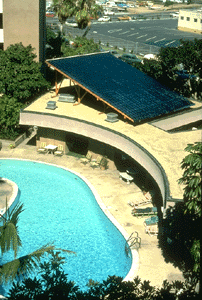
Today, solar water heaters are making a come back. There are more than half a
million of them in California alone! They heat water for use inside homes and
businesses. They also heat swimming pools like in the picture.
Panels on the roof of a building, like this one on the right, contain water pipes.
When the sun hits the panels and the pipes, the sunlight warms them.
That warmed water can then be used in a swimming pool.
Solar Thermal Electricity
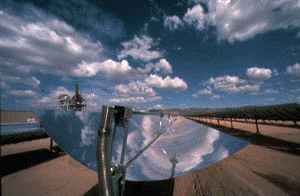 Solar can also be used to make electricity.
Some solar power plants, like the one in the picture to the right in California's
Mojave Desert, use a highly curved mirror called a parabolic trough to focus the
sunlight on a pipe running down a central point above the curve of the mirror. The mirror
focusses the sunlight to strike the pipe, and it gets so hot that it can boil water into steam. That steam
can then be used to turn a turbine to make electricity.
In California's Mojave desert, there are huge rows solar mirrors arranged in what's called "solar thermal power plants" that use
this idea to make electricity for more than 350,000 homes.
The problem with solar energy is that it works only when the sun is shining. So, on
cloudy days and at night, the power plants can't create energy. Some solar plants, are
a hybrid technology. During the daytime they use the sun. At night they use natural
gas to boil the water so they can continue to make electricity.
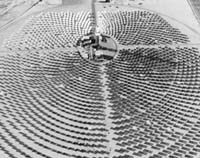 Another form of solar power plants to make electricity is called a Central Tower
Power Plant, like the one to the right.
Another form of solar power plants to make electricity is called a Central Tower
Power Plant, like the one to the right.
Sunlight is reflected off 1,800 mirrors circling the tall tower. The mirrors are
called heliostats and turn to face the sun all day long.
The light is reflected back to the top of the tower in the center of the circle where a
fluid is turned very hot by the sun's rays. That fluid can be used to boil water to
make steam to turn a turbine and a generator.
This experimental power plant is called Solar II. It is being re-built in California's
desert using newer technologies than when it was first built in the early 1980s. Solar II will use
the sunlight to change heat into mechanical energy in the turbine.
The power plant will make enough electricity to power about 10,000 homes.
Scientists say larger central tower power plants will be able to make electricity for
100,000 to 200,000 homes.
Solar Cells or Photovoltaic Energy
We can also change the sunlight directly to electricity using solar cells.
Solar cells are also called photovoltaic cells -- or PV cells for short -- and can be
found on many small appliances, like calculators, and even on spacecraft. They were
first developed in the 1950s for use on U.S. space satellites. They are made of silicon,
a special type of melted sand.
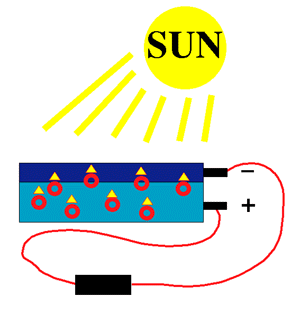
When sunlight strikes the solar cell, electrons (red circles) are knocked loose. They
move toward the treated front surface (dark blue color). An electron imbalance is
created between the front and back. When the two surfaces are joined by a
connector, like a wire, a current of electricity occurs between the negative and
positive sides.
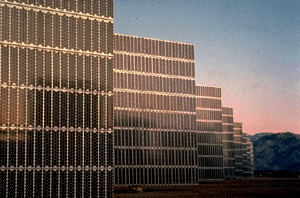 These individual solar cells are
arranged together in a PV module. Some of the modules are set on special tracking
devices to follow sunlight all day long.
These individual solar cells are
arranged together in a PV module. Some of the modules are set on special tracking
devices to follow sunlight all day long.
The electrical energy from solar cells can then be used directly. It can be used in a
home for lights and appliances. It can be used in a business. Solar energy can be
stored in batteries to light a roadside billboard at night. Or the energy can be stored in
a battery for an emergency roadside cellular telephone when no telephone wires are
around.
Some experimental cars also use PV cells. They convert sunlight directly into
energy to power electric motors on the car.
Here's What We Learned
- Sunlight has always been a source of energy for plants, animals and humans.
We use sunlight and heat from the sun to dry clothes outside.
- The sun's heat can be used to warm water flowing through pipes on a roof.
More than 500,000 solar water heating systems are used in California.
- Sunlight can also be focussed in a solar thermal system to heat water or other
fluids to make steam. The steam can be used to turn turbines to make electricity.
- Sunlight can be used directly in solar cells or PV cells to make electricity.