SATELLITES RINGS ATMOSPHERE GRS PICTURES
Jupiter is the fourth brightest object in the sky (after the Sun,
the Moon and Venus; at some times Mars is also brighter). It
has been known since prehistoric times. Galileo's discovery, in 1610, of Jupiter's four
large moons Io, Europa, Ganymede and
Callisto (now known as the Galilean moons) was the first discovery of a center of motion
not apparently centered on the
Earth. It was a major point in favor of Copernicus's heliocentric theory of the motions of
the planets; Galileo's outspoken
support of the Copernican theory got him arrested by the Inquisition. He was forced to
recant his beliefs and was imprisoned
for the rest of his life.
Jupiter was first visited by Pioneer 10 in 1973 and later by Pioneer 11, Voyager 1,
Voyager 2 and Ulysses. The spacecraft
Galileo is currently in orbit around Jupiter and will be sending back data for at least
the next two years.
The gas planets do not have solid surfaces, their gaseous material simply gets denser with
depth
(the radii and diameters quoted for the planets are for levels corresponding to a pressure
of 1
atmosphere). What we see when looking at these planets is the tops of clouds high in their
atmospheres (slightly above the 1 atmosphere level).
ATMOSPHERE
Jupiter is about 90% hydrogen and 10% helium (by numbers of atoms, 75/25% by mass) with
traces of methane, water, ammonia and "rock". This is very close to the
composition of the
primordial Solar Nebula from which the entire solar system was formed. Saturn has a
similar composition, but Uranus and
Neptune have much less hydrogen and helium.
Our knowledge of the interior of Jupiter (and the other gas planets) is highly indirect
and likely to remain so for some time.
(The data from Galileo's atmospheric probe goes down only about 150 km below the cloud
tops.)
Jupiter probably has a core of rocky material amounting to something like 10 to 15
Earth-masses.
Above the core lies the main bulk of the planet in the form of liquid metallic hydrogen.
This exotic form of the most
common of elements is possible only at pressures exceeding 4 million bars, as is the case
in the interior of Jupiter (and Saturn).
Liquid metallic hydrogen consists of ionized protons and electrons (like the interior of
the Sun but at a far lower temperature).
At the temperature and pressure of Jupiter's interior hydrogen is a liquid, not a gas. It
is an electrical conductor and the source
of Jupiter's magnetic field. This layer probably also contains some helium and traces of
various "ices".
The outermost layer is composed primarily of ordinary molecular hydrogen and helium which
is liquid in the interior and
gaseous further out. The atmosphere we see is just the very top of this deep layer. Water,
carbon dioxide, methane and other
simple molecules are also present in tiny amounts.
Three distinct layers of clouds are believed to exist consisting of ammonia ice, ammonium
hydrosulfide
and a mixture of ice and water. However, the preliminary results from the Galileo probe
show only faint
indications of clouds (one instrument seems to have detected the topmost layer while
another may have
seen the second). But the probe's entry point (left) was unusual -- Earth-based telescopic
observations
and more recent observations by the Galileo orbiter suggest that the probe entry site may
well have been
one of the warmest and least cloudy areas on Jupiter at that time.
Data from the Galileo atmospheric probe also indicate that there is much less water than
expected. The expectation was that
Jupiter's atmosphere would contain about twice the amount of oxygen (combined with the
abundant hydrogen to make water)
as the Sun. But it now appears that the actual concentration much less than the Sun's.
Also surprising was the high temperature
and density of the uppermost parts of the atmosphere.
Jupiter and the other gas planets have high velocity winds which are confined in wide
bands of latitude.
The winds blow in opposite directions in adjacent bands. Slight chemical and temperature
differences
between these bands are responsible for the colored bands that dominate the planet's
appearance. The light
colored bands are called zones; the dark ones belts. The bands have been known for some
time on Jupiter,
but the complex vortices in the boundary regions between the bands were first seen by
Voyager. The data
from the Galileo probe indicate that the winds are even faster than expected (more than
400 mph) and extend down into as far
as the probe was able to observe; they may extend down thousands of kilometers into the
interior. Jupiter's atmosphere was
also found to be quite turbulent. This indicates that Jupiter's winds are driven in large
part by its internal heat rather than from
solar input as on Earth.
The vivid colors seen in Jupiter's clouds are probably the result of subtle chemical
reactions of the trace elements in Jupiter's
atmosphere, perhaps involving sulfur whose compounds take on a wide variety of colors, but
the details are unknown.
The colors correlate with the cloud's altitude: blue lowest, followed by browns and
whites, with reds highest. Sometimes we
see the lower layers through holes in the upper ones.
THE GRS
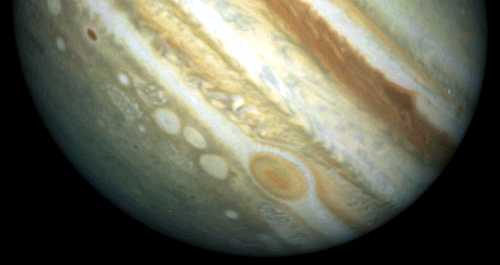
The Great Red Spot (GRS) has been seen by Earthly observers for more than 300 years (its
discovery is
usually attributed to Cassini, or Robert Hooke in the 17th century). The GRS is an oval
about 12,000 by
25,000 km, big enough to hold two Earths. Other smaller but similar spots have been known
for decades.
Infrared observations and the direction of its rotation indicate that the GRS is a
high-pressure region whose
cloud tops are significantly higher and colder than the surrounding regions. Similar
structures have been seen
on Saturn and Neptune. It is not known how such structures can persist for so long.
Jupiter radiates more energy into space than it receives from the Sun. The interior of
Jupiter is hot: the core is probably about
20,000 K. The heat is generated by the Kelvin-Helmholtz mechanism, the slow gravitational
compression of the planet.
(Jupiter does NOT produce energy by nuclear fusion as in the Sun; it is much too small and
hence its interior is too cool to
ignite nuclear reactions.) This interior heat probably causes convection deep within
Jupiter's liquid layers and is probably
responsible for the complex motions we see in the cloud tops. Saturn and Neptune are
similar to Jupiter in this respect, but
oddly, Uranus is not.
Jupiter is just about as large in diameter as a gas planet can be. If more material were
to be added, it would be compressed
by gravity such that the overall radius would increase only slightly. A star can be larger
only because of its internal (nuclear) heat
source.
Jupiter has a huge magnetic field, much stronger than Earth's. Its magnetosphere extends
more than 650 million km (past the
orbit of Saturn!). (Note that Jupiter's magnetosphere is far from spherical -- it extends
"only" a few million kilometers in the
direction toward the Sun.) Jupiter's moons therefore lie within its magnetosphere, a fact
which may partially explain some of the
activity on Io. Unfortunately for future space travelers and of real concern to the
designers of the Voyager and Galileo
spacecraft, the environment near Jupiter contains high levels of energetic particles
trapped by Jupiter's magnetic field. This
"radiation" is similar to, but much more intense than, that found within Earth's
Van Allen belts. It would be immediately fatal to
an unprotected human being. The Galileo atmospheric probe discovered a new intense
radiation belt between Jupiter's ring and the uppermost atmospheric layers. This new belt
is approximately 10 times as strong as Earth's Van Allen radiation belts. Surprisingly,
this new belt was also found to contain high energy helium ions of unknown origin.
RINGS
Jupiter has rings like Saturn's, but much fainter and smaller (right). They were
totally unexpected
and were only discovered when two of the Voyager 1 scientists insisted that after
traveling 1 billion
km it was at least worth a quick look to see if any rings might be present. Everyone else
thought that
the chance of finding anything was nil, but there they were. It was a major coup. They
have since
been imaged in the infra-red from ground-based telescopes and by Galileo.
Unlike Saturn's, Jupiter's rings are dark (albedo about .05). They're probably composed of
very small grains of rocky
material. Unlike Saturn's rings, they seem to contain no ice.
Particles in Jupiter's rings probably don't stay there for long (due to atmospheric and
magnetic drag). The Galileo spacecraft
found clear evidence that the rings are continuously resupplied by dust formed by
micrometeor impacts on the four inner
moons, which are very energetic because of Jupiter's large gravitational field. The inner
halo ring is broadened by interactions
with Jupiter's magnetic field.
In July 1994, Comet Shoemaker-Levy 9 collided with Jupiter with spectacular results
(left). The
effects were clearly visible even with amateur telescopes. The debris from the collision
was visible for
nearly a year afterward with HST.
When it is in the nighttime sky, Jupiter is often the brightest "star" in the
sky (it is second only to
Venus, which is seldom visible in a dark sky). The four Galilean moons are easily visible
with
binoculars; a few bands and the Great Red Spot can be seen with a small astronomical
telescope.
There are several Web sites that show the current position of Jupiter (and the other
planets) in the sky. More detailed and
customized charts can be created with a planetarium program such as Starry Night.
JUPITER'S SATELLITES
Jupiter has 16 known satellites, the four large Galilean moons and 12 small ones.
Jupiter is very gradually slowing down due to the tidal drag produced by the
Galilean satellites. Also, the same tidal forces are changing the orbits of the
moons, very slowly forcing them farther from Jupiter.
Io, Europa and Ganymede are locked together by tidal forces into a 1:2:4
orbital resonance and their orbits evolve together. Callisto is almost part of this
as well. In a few hundred million years, Callisto will be locked in too, orbiting at
exactly twice the period of Ganymede
and eight times the period of Io.
Jupiter's satellites are named for other figures in the life of Zeus (mostly his lovers).