INTERESTING FACTS HISTORY PICTURES
Mercury has been known since at least the time of
the Sumerians (3rd millennium BC). It was given two names by the
Greeks: Apollo for its apparition as a morning star and Hermes as an evening star. Greek
astronomers knew, however, that the
two names referred to the same body. Heraclitus even believed that Mercury and Venus orbit
the Sun, not the Earth.
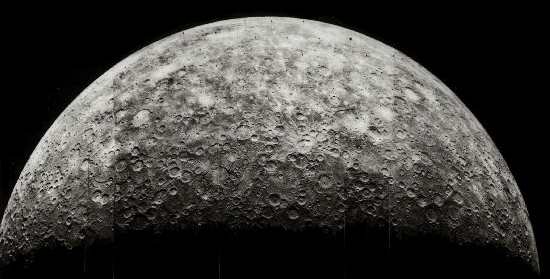
Mercury has been visited by only one spacecraft, Mariner 10. It flew by three times in
1974 and 1975. Only 45% of the
surface was mapped (and, unfortunately, it is too close to the Sun to be safely imaged by
HST).
Mercury's orbit is highly eccentric; at perihelion it is only 46 million km from the Sun
but at aphelion it is 70 million. The
perihelion of its orbit precesses around the Sun at a very slow rate. 19th century
astronomers made very careful observations of Mercury's orbital parameters but could not
adequately explain them using Newtonian mechanics. The tiny differences between the
observed and predicted values were a minor but nagging problem for many decades. It was
thought that another planet (sometimes called Vulcan) might exist in an orbit near
Mercury's to account for the discrepancy. The real answer turned out to be much more
dramatic: Einstein's General Theory of Relativity! Its correct prediction of the motions
of Mercury was an
important factor in the early acceptance of the theory.
HISTORY
Until 1962 it was thought that Mercury's "day" was the same length as its
"year" so as to keep that same face to the Sun
much as the Moon does to the Earth. But this was shown to be false in 1965 by doppler
radar observations. It is now known
that Mercury rotates three times in two of its years. Mercury is the only body in the
solar system known to have an
orbital/rotational resonance with a ratio other than 1:1.
This fact and the high eccentricity of Mercury's orbit would produce very strange effects
for an observer on Mercury's
surface. At some longitudes the observer would see the Sun rise and then gradually
increase in apparent size as it slowly moved
toward the zenith. At that point the Sun would stop, briefly reverse course, and stop
again before resuming its path toward the
horizon and decreasing in apparent size. All the while the stars would be moving three
times faster across the sky. Observers at
other points on Mercury's surface would see different but equally bizarre motions.
Temperature variations on Mercury are the most extreme in the solar system ranging from 90
K to 700 K. The temperature
on Venus is slightly hotter but very stable.
Mercury is in many ways similar to the Moon: its surface is heavily cratered and very old;
it has no
plate tectonics. On the other hand, Mercury is much denser than the Moon (5.43 gm/cm3 vs
3.34).
Mercury is the second densest major body in the solar system, after Earth. Actually
Earth's density is
due in part to gravitational compression; if not for this, Mercury would be denser than
Earth. This
indicates that Mercury's dense iron core is relatively larger than Earth's, probably
comprising the
majority of the planet. Mercury therefore has only a relatively thin silicate mantle and
crust.
Mercury's interior is dominated by a large iron core whose radius is 1800 to 1900 km. The
silicate outer shell (analogous to
Earth's mantle and crust) is only 500 to 600 km thick. At least some of the core is
probably molten.
Mercury actually has a very thin atmosphere consisting of atoms blasted off its surface by
the solar wind. Because Mercury
is so hot, these atoms quickly escape into space. Thus in contrast to the Earth and Venus
whose atmospheres are stable,
Mercury's atmosphere is constantly being replenished.
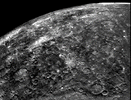
The surface of Mercury exhibits enormous escarpments, some up to hundreds of kilometers in
length
and as much as three kilometers high. Some cut thru the rings of craters and other
features in such a way
as to indicate that they were formed by compression. It is estimated that the surface area
of Mercury
shrank by about 0.1% (or a decrease of about 1 km in the planet's radius).
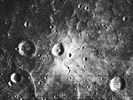
One of the largest features on Mercury's surface is the Caloris Basin (right); it is about
1300 km in
diameter. It is thought to be similar to the large basins (maria) on the Moon. Like the
lunar basins, it was
probably caused by a very large impact early in the history of the solar system. That
impact was probably
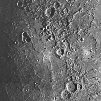
also responsible for the odd terrain on the exact opposite side of the planet (left).
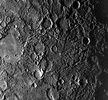
In addition to the heavily cratered terrain, Mercury also has regions of relatively smooth
plains. Some may
be the result of ancient volcanic activity but some may be the result of the deposition of
ejecta from cratering
impacts.
Amazingly, radar observations of Mercury's north pole (a region not mapped by Mariner 10)
show evidence of water ice in
the protected shadows of some craters.
Mercury has a small magnetic field whose strength is about 1% of Earth's.
Mercury is often visible with binoculars or even the unaided eye, but it is always very
near the Sun and difficult to see in the
twilight sky. There are several Web sites that show the current position of Mercury (and
the other planets) in the sky. More
detailed and customized charts can be created with a planetarium program such as Starry
Night.
Mercury's density (5.43 gm/cm3) is nearly as high
as Earth's. Yet in most other respects it more closely resembles the
Moon. Did it lose its light rocks in some early catastrophic impact?
No trace of iron has been seen in spectroscopic studies of Mercury's surface. Given its
presumably large iron core this is
very odd. Is Mercury much more completely differentiated than the other terrestrial
planets?
What processes produced Mercury's smooth plains?
Are there any surprises on the other half of the surface we've not seen? Low resolution
radar images obtained from Earth
show no surprises, but you never know.
A new discovery-class mission to Mercury has been approved. MESSENGER will launch in 2004
and orbit Mercury
starting in 2009.