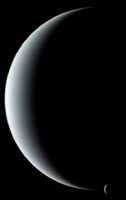
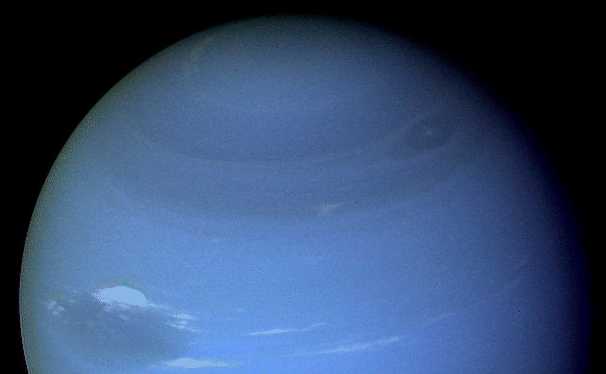
Neptune is the eighth planet from the Sun and the fourth largest
(by diameter). Neptune is smaller in
diameter but larger in mass than Uranus.
After the discovery of Uranus, it was noticed that its orbit was
not as it should be in accordance with Newton's laws. It was
therefore predicted that another more distant planet must be perturbing Uranus' orbit.
Neptune was first
observed by Galle and d'Arrest on 1846 Sept 23 very near to the locations independently
predicted by
Adams and Le Verrier from calculations based on the observed positions of Jupiter, Saturn
and Uranus.
An international dispute arose between the English and French (though not, apparently
between Adams
and Le Verrier personally) over priority and the right to name the new planet; they are
now jointly credited
with Neptune's discovery. Subsequent observations have shown that the orbits calculated by
Adams and
Le Verrier diverge from Neptune's actual orbit fairly quickly. Had the search for the
planet taken place a few years earlier or
later it would not have been found anywhere near the predicted location.
Neptune has been visited by only one spacecraft, Voyager 2 on Aug 25 1989. Almost
everything we know about Neptune
comes from this encounter.
Because Pluto's orbit is so eccentric, it sometimes crosses the orbit of Neptune making
Neptune the most distant planet from
the Sun for a few years.
ATMOSPHERE
Neptune's composition is probably similar to Uranus': various
"ices" and rock with about 15% hydrogen and a little helium.
Like Uranus, but unlike Jupiter and Saturn, it may not have a distinct internal layering
but rather to be more or less uniform in
composition. But there is most likely a small core (about the mass of the Earth) of rocky
material. Its atmosphere is mostly
hydrogen and helium with a small amount of methane.
Neptune's blue color is the result of absorption of red light by methane in the
atmosphere.
Like a typical gas planet, Neptune has rapid winds confined to bands of latitude and large
storms or vortices. Neptune's
winds are the fastest in the solar system, reaching 2000 km/hour.
Like Jupiter and Saturn, Neptune has an internal heat source -- it radiates more than
twice as much energy as it receives
from the Sun.
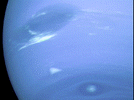
At the time of the Voyager encounter, Neptune's most prominent feature was the Great Dark
Spot (left) in the southern
hemisphere. It was about half the size as Jupiter's Great Red Spot (about the
same diameter as Earth). Neptune's winds blew the Great Dark Spot westward
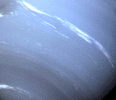
at 300 meters/second (700 mph). Voyager 2 also saw a smaller dark spot in the
southern hemisphere and a small irregular white cloud that zips around Neptune
every 16 hours or so now known as "The Scooter" (right). It may be a plume
rising from lower in the atmosphere but its true nature remains a mystery.
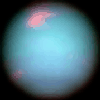
However, HST observations of Neptune (left) in 1994 show that the Great Dark Spot has
disappeared! It has either simply
dissipated or is currently being masked by other aspects of the atmosphere. A few months
later HST
discovered a new dark spot in Neptune's northern hemisphere. This indicates that Neptune's
atmosphere
changes rapidly, perhaps due to slight changes in the temperature differences between the
tops and bottoms
of the clouds.
Neptune also has rings. Earth-based observations showed only faint arcs instead
of complete rings, but Voyager 2's images showed them to be complete rings with bright
clumps. One
of the rings appears to have a curious twisted structure (right).
Like Uranus and Jupiter, Neptune's rings are very dark but their composition is unknown.
Neptune's rings have been given names: the outermost is Adams (which contains three
prominent arcs now named Liberty,
Equality and Fraternity), next is an unnamed ring co-orbital with Galatea, then Leverrier
(whose outer extensions are called
Lassell and Arago), and finally the faint but broad Galle.
Neptune's magnetic field is, like Uranus', oddly oriented and probably generated by
motions of conductive material
(probably water) in its middle layers.
Neptune can be seen with binoculars (if you know exactly where to look) but a large
telescope is needed to see anything
other than a tiny disk. There are several Web sites that show the current position of
Neptune (and the other planets) in the sky,
but much more detailed charts will be required to actually find it. Such charts can be
created with a planetarium program such
as Starry Night.