|

National History |
|
National History |
The American college system
in the early 1700's was very different from the environment that we find
today. Studies were very strict in nature, and little time was allowed
for relaxation. Students, however, yearning for interaction outside the
classroom, began to form literary societies outside of the classroom. At
the College of William and Mary one such group, called the Flat Hat Club,
would meet at the Raleigh Tavern and talk over a bowl of punch. Unbeknownstedt
to them, these men had created the first college fraternity. Other groups
soon followed their lead.
 |
In 1776, a young scholar at William and Mary named John Heath sought to join one of these societies, but was deemed unworthy. Undaunted, Heath took four friends and in the Apollo Room of the Raleigh Tavern, formed the first secret Greek-letter society - Phi Beta Kappa. Phi Beta Kappa based its founding on the commitment to moral ideals, scholastic achievement, and friendship between men. Phi Beta Kappa believed that the college experience should prepare the student for future responsibilities by preparing him socially, the edicts on which all other Greek organizations are founded. Later this year, this same room would be be the place where Thomas Jefferson, George Washington, and Patrick Henry would meet to discuss the ideals that would lead to the creation of another great society - The United States of America.
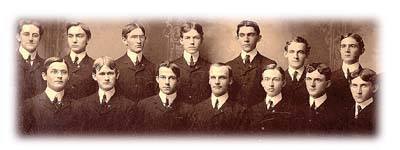
Richmond College, a Baptist school founded in 1830, was attended by
around 200 students in the early 20th century. In 1901, Carter Ashton Jenkens,
the 18-year old son of a minister, transferred to Richmond from Rutgers
University, where he had been a member of Chi Phi fraternity. Seeking companions
to take the place of those he left, he and five men who had become friends
applied for a charter of Chi Phi at Richmond. Their attempt was denied,
however, because Chi Phi felt the college was too small to support a chapter.
Undaunted, the six men (Jenkens, Benjamin Gaw, William Carter, William
Wallace, Thomas Wright, and William Phillips) decided to form their own
fraternity.
Of the six men, only Jenkens knew what a fraternity was, so the plans
for drawing up the new fraternity fell to him. Early on, Jenkens thoroughly
searched the Bible for a philosophy upon which the new fraternity could
be built. He discovered in the Bible the "Greatest truth the world has
ever known". While still forming the new fraternity, the original
six founders discovered six more men who sought the same friendship they
did. In October of 1901 the twelve men met in Ryland Hall to discuss organization
of the fraternity they were originally going to call "Sigma Phi". The fraternity
was founded on November 1, 1901. The group then moved for recognition from
the university and, upon changing the name to Sigma Phi Epsilon, were recognized.
SigEp within five years had expanded to 14 colleges; by 1924, SigEp was
at fifty colleges.
Today Sigma Phi Epsilon has established chapters in every state, totalling over 270 chapters nationwide. Over 225,000 men have become brothers in our great Fraternity.
|
|
|
|
Site maintained by Kevin Allen
