Technical Stuff
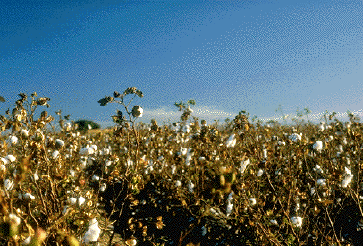
Where is cotton grown?
The largest cotton producing countries in the world year ('99) are:
1. China 4.2 (million metric tons)
2. USA 4.01
3. India 2.8
4. Pakistan 1.9
5. Uzbekistan 1.25
6. Turkey 0.73
Others: 0.73
World Total: 20.03
How much cotton will be produced in the world next year?
The projection for 2000 is 20.77 million metric tons.
Is cotton picked by hand?
Yes it is in China, Uzbekistan and most African countries.
Are there special requirements for the cotton or yarn used in denim fabrics ?
Since weavers require specific yarn strength, spinners have to use a specific grade of
cotton that will allow their yarn to meet the weavers needs.
Who makes indigo Dyestuffs?
Mitsui Touatsu in Japan, and the international giants Ciba Geigy, ICI and BASF are the
major producers of indigo dyestuff.
How is indigo yarn dyed ?
The dyer has a crank which controlled a hook that held yarn. The dyer would then lower the crank so that the yarns would drop into an indigo bath let the yarn sit in the dye for about 20 seconds and then lift the yarn out of the bath and squeeze out the indigo liquid and let the dyestuff oxidize. The more dips, the darker the color.
There are 3 ways to dye indigo industrially.
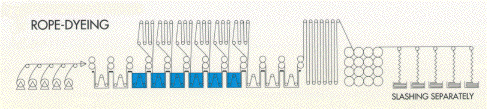
Rope Dyeing: A group of undyed yarns (360 yarns) are twisted together and dyed as a single unit (rope like). This system allows all the yarns to be treated identically. The rope runs through a long machine where the yarn is dipped into indigo, taken out and allowed to oxidize and redipped again into the bath. Most rope dye machines allow 6 or 8 dips.
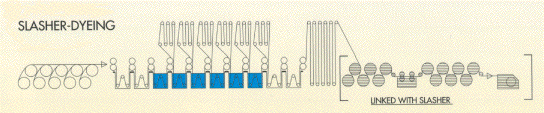
Slasher Dyeing: Each yarn is laid beside one another across a cylinder or beam and each yarn moves through the dye process individually.
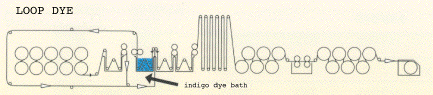
Loop Dyeing: Instead of 6 Indigo dye baths with
many thousands of litres of liquor, six squeezers and six skyings, only 1 reduced volume.
What is the difference between ring spun and open end spun yarns ?
Fibres must first be straightened and laid parallel by combing; then
they must be drawn out into a continuous yarn by spinning. The spindle is the earliest
spinning tool, and the spinning wheel (which first appeared in Europe about 1400) is its
earliest mechanization. It was only during the late 18th century, with the invention
(1767) of the spinning jenny, a machine that operated a number of spindles at one time,
that yarn could be produced in appreciable volume. Richard Arkwright's spinning frame
(1769) and Samuel Crompton's "mule" (1779) increased yarn production to the
point at which one worker could operate 1,000 spindles at one time.
The ring frame, invented (1828) by the American John Thorp, was based on Arkwright's
spinning frame. Ring spinning allowed for high spindle speeds and became the most
widely used spinning method. Many natural fibers are now spun by the open-end
system, where the fibers are drawn by air into a rapidly rotating cup and pulled out on
the other side as a finished yarn.
You generally need better quality cotton fibre for Ring Spinning, you can spin finer
counts and give the yarn higher twist: the end result is a yarn which has superior
quality, better appearance (sometimes randomly irregular), higher performance. Open End
yarn is, on the other hand, cheaper to produce and more regular.
Ring Spinning Frame 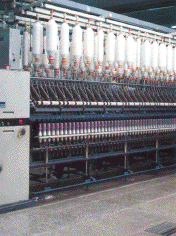
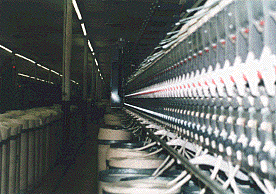 Open End spinning (Legler,
Italy)
Open End spinning (Legler,
Italy)
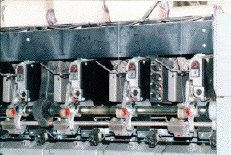
Open End spinning (close up)
Why did spinners switch to open end yarn during the 1970's if ring is stronger and softer?
P r i c e .
How is the fabric made ?
The cotton is spun into yarn, the yarn is dyed indigo, the yarn is spread out onto a
cylinder beam for warping, the yarn has size put on it for stability during weaving and
the beam is taken to the loom for weaving. After weaving the fabric is desized, sanforized
for shrinkage control, preskewed and put on rolls. The rolls are inspected for faults and
packed for shipping.
Why is left hand denim softer than right hand denim?
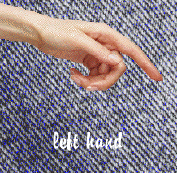
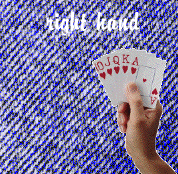
It has to do with the way yarns are spun. If yarns are "Z" twisted (like they
normally are) and are woven in a right hand twill, the weave will "close" the
yarn and make it very compact. If the same yarns are woven in a left hand twill, the yarn
will "open" and the hand will feel softer.
Do laundries really wash jeans with stones?
Yes. They use pumice stones, ceramic stones, rubber balls, plastic balls, golf balls,
tree bark, sand. We even heard that people washed jeans with old skateboard wheels. Have
any ideas?
What is sand blast and why does it cost so much more?
Jeans are put on a rack and a person takes a sand hose and blasts sand on specific
areas of jeans to make them look used. Lately many companies are using chemicals instead
of sand.
What are your favourite jeans and why?
We love the old jeans made before the mid 1970's when the mills used darker indigo shades (more contrast when wearing), used ring spun yarns (softer and irregular looking) and finer yarns with tighter densities (not so bulky or heavy to wear).
Levi's, Lee's, Wranglers from this era are undoubtedly our favourites. They just don't make denim now like they used to - although the Japanese textile mills come as close as you can get.

HomePage