What do tigers eat? Tigers and their young Fact Sheet
Tigers are the largest cat family. Found in most of Asia, sadly this magnificent animal is on the brink of extinction.
The tiger's tell tale stripes are its most prominent feature. Its stripes are perfect camouflage in the tall grass, where it awaits its prey.
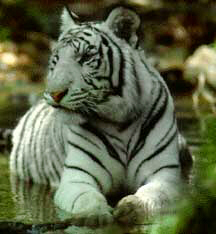
The Siberian tiger has a thick fur coat for the colder climate. The colour of its coat consists of dark stripes on yellow fur. The Bengal tiger has a rich tawny colour with practically black stripes, it has a smoother coat than the Siberian. The Sumatran tiger is smaller and darker than the two previous types. The white tiger is actually a colour variation of the tiger, and is extremely rare to find in the wild.
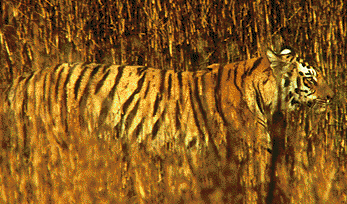
The tiger is one of the ultimate hunters, its large muscular limbs make it the most powerful of the big cats. Generally, tigers sleep by day and hunt by night. A popular ambush site is by the water. There it hides, then selects its victim. It charges, followed by seizing its prey by using its jaws and claws. The tiger kills its prey with a bite to the neck, then drags it to a quiet spot to eat.
Deer
Buffalo
Goats
Pea fowl
Wild hog
Antelope
Hares
Tigers can have cubs at all times of the year, but in the colder regions it bears them in the spring. Gestation averages to approximately 113 days. The tiger usually yields two to three cubs, which the female solely raises for about two years. During the time spent with the mother, the cubs learn lessons in survival. The most important of the lessons is hunting prey. Only when the cubs are independent does the female mate again.
When the cubs leave the litter, they stay with their siblings for awhile, until the young tigers attain their own territories.
Tigers love lying in the shade of a tree or bathing in the water. A tiger is a good swimmer and it is so powerful that it can drag an adult antelope through the water. It mainly inhabits grassland, swamp, and forest areas.
There are a number of reasons for the tiger's decline. As the tiger has no natural enemies, it is our fault it is endangered. Tigers are hunted by people for their valuable coats and the large demand for tiger byproducts used in chinese medicine. Large-scale hunting reduced Bengal tiger numbers to 1,800 in 1972. Luckily, in the 1970s a conservation movement began, called "Project Tiger", in the hope of saving the different subspecies of tigers. In 1986, the Bengal tiger population rose to 4,000.
Another reason for dwindling numbers is from lost of habitat. A century or two ago, the tigers had a vast area to roam. Now with people infringing into the tigers territory, many cannot find food and rely on the domestic livestock as their chief food source. Sometimes, when the tigers are sick or old, and unable to hunt, they become"man-eaters" out of desperation.
The only way the tiger can be saved, is if we stop destroying its habitat and start to replenish what we have destroyed.
| Scientific Name: | Panthera tigris |
|---|---|
| Subspecies: | Siberian, Bengal, Indo-chinese, Sumatran (Javan, Bali and Caspian are extinct) |
| Habitat: | South-East Asia, Siberia, Nth Korea, Central and Southern India |
| Length: | Siberian- 1.4m-2.8m long(w/out tail), Bengal- 3m long(with tail) |
| Weight: | Siberian- 180-306 kg, Bengal- 180-258kg |
| Endangered Status: | All subspecies |