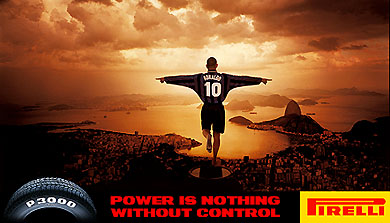
 Navigate into the story of
the phenomenon of the times
Navigate into the story of
the phenomenon of the times Everybody called him Dadado. At that time, Nelio Junior was only 3 years old. Big and strong, but too young to pronounce the name of his younger brother: R-o-na-l-do, Ronal-do... Mummy that is so difficult! Better to just say Dadado: immediately finding the solution, as only a child can do. Dadado come here, Dadado play with me, Dadado Mummy wants to see you ". Can you imagine it? The Pelé of the year 2000, on the dusty streets of a suburb in Rio; for everyone he was Dadado. Why then doesn't the whole world know him as Dadado?
Mummy
Sonia, with bright eyes and a tender smile, never let the
arms down. She raised Ronaldo almost alone , after her
husband Nelio, employee of the local telephone company,
abandoned home and family. "He did not accept being
called Dadado" he remembers while imitating the
sighs of his son. Family and friends knew him under this
name and still today I call him Dadado... But when the
Cruzeiro took him on, Ronaldo called us for a meeting,
and seriously explained:
From now on, that's enough. I am today a professional
football player and my name is Ronaldo. Please, forget
Dadado: he doesn't exist anymore ". He was 16 years
old.
He became Ronaldinho, because Brazilians adored him. He was almost a son to everyone.The village of Bento Ribeiro, is in the north-west area of Rio de Janeiro.An hour by car from the shopping center. This is where the adventure of Ronaldo begins , some twenty years ago. Houses, old and burned by the sun, are red masonry constructions without doors nor windows, with numerous small playing balls scattered on the streets. The old railway station remains the main meeting place for the villagers.
The village of Bento Ribeiro-whos namesake originates from an old monarchical senator-was founded at the end of the eighteenth century, when Don Pedro II ordered the construction of the railroad. Spontaneously houses were erected amidst the red blazing earth and patches of green vegetation. On the village's outer limits, another well known area, Quintino. Zico was born here, between the cement and the «pelada». Now let's take a furtive glance at the street. Who are these onlookers in the yellow taxi, notebook in hand asking "Where is Ronaldo's home? The champion has played here?". Somebody tells them: " Don't ask too many questions, people think you are with the police". The smile of the boy escapes the suspects. His name is Carlos Pexiotto, 18 years old, 2 years younger than the champion and, hand on heart, declares proudly: " I am a friend of Ronaldo. We played «pelada» together on the street, until the age of 13, then he moved. «Pelada» is football on streets: its name originates from the ball which when rolling over the cement wears out. Barefoot and with scratched knees, is the way Ronaldo began to knock ball after ball.. "It was almost unbearable" tells Carlos laughing. He gathered the boys together and organized games. All free spaces were like football fields for him.
Carlos
points out a cast iron fence, on General Cesar Obino
street, an unknown sloping little street. The main door
to a house opens and a boy arrives. He has a dark
carnation that seems familiar, a sad smile and wears Psv
Eindhove's blue sweater. Fabio Shine, 19 years old, is
the inseparable cousin of Ronaldo. Behind him, the house
where the champion was born, on september 22nd, 1976: The
yard is barren with tossed soil, a very little house and
some trees ( Ronaldo's favorite being the mango tree and
its fruit) . Fabio Shine searches for exact words to
share his souvenirs. " We grew up together. Ronaldo
was timid and reserved. His lucky break was his encounter
with Jairzinho who, having seen him with the San
Cristovao team, understood he was more than good and
presented him to the Cruzeiro. His trainer Carlos Alberto
Silva helped him to become a champion.
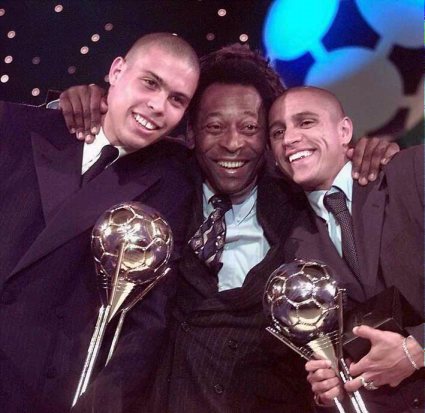 Timid? Frightened even! Fabio Shine
laughs as he remembers the fear of his cousin. "He
believed in witches and was frightened by them. He wanted
to be protected by his mother. He had his first
girlfriend at only 13 years old, her name was Veronica.
She was very beautiful, and they were in love, a
beautiful couple. She went to see the football games.
Ronaldo was not a big boy, he was rather thin, but this
was not because he did not eat. " He liked
everything: rice dishes, beans and fish were his favorite
meals, or even steak and french fries. Each morning, a
lot of bread, milk and coffee "Then he would leave
to run on the streets. He was already great. But nobody
would have imagined Ronaldo becoming number one. I swear
it ". Then arrived Edoardo Dudu, 17 years old,
another cousin; he also shared his souvenirs with us.
"When he left to move to San Cristvao, he left me
his sweaters and his pants. Not the shoes, because he did
not have any: the game for him was to run barefoot.
Football. Footvolley. Footsal.
Timid? Frightened even! Fabio Shine
laughs as he remembers the fear of his cousin. "He
believed in witches and was frightened by them. He wanted
to be protected by his mother. He had his first
girlfriend at only 13 years old, her name was Veronica.
She was very beautiful, and they were in love, a
beautiful couple. She went to see the football games.
Ronaldo was not a big boy, he was rather thin, but this
was not because he did not eat. " He liked
everything: rice dishes, beans and fish were his favorite
meals, or even steak and french fries. Each morning, a
lot of bread, milk and coffee "Then he would leave
to run on the streets. He was already great. But nobody
would have imagined Ronaldo becoming number one. I swear
it ". Then arrived Edoardo Dudu, 17 years old,
another cousin; he also shared his souvenirs with us.
"When he left to move to San Cristvao, he left me
his sweaters and his pants. Not the shoes, because he did
not have any: the game for him was to run barefoot.
Football. Footvolley. Footsal.
He began playing football at five, first for Valcheri then for the Social Ramos: he was particularly unbeatable in the smaller playing spaces. The house is small, somber, with low ceilings and dirty walls. Behind the door, the logo of a Barcelona team sweater, the number 9. In the living room some armchairs, a sound system and a Christmas tree. A messy kitchen , a bedroom. It still feels like poverty, even if today they know what money and popularity are. Just the amusement park helped the three friends to forget: " Ronaldo liked the roller coaster and, overcoming his fear, he felt himself obliged to enter in the horror tunnel.
He did not
have money. He had even become a pro at taking the train
without a ticket: on the way Ronaldo would dodge out of
the chief engineer's and the controller's sight as
quickly as he did on the field. He would finally arrive
in Rio without having paid. He also had another great
passion: cars. They were even becoming an obsession. He
absolutely wanted to drive so when he was with the
Cruzeiro, he bought a car and began to drive even without
having his driver's license (he only got it one year
later). What a crazy guy!".
Suzi is a little more than twenty years old and is the mother of a two week old little girl. Jockingly, she gave her a nickname: Ronaldinha. Suzi is also a cousin of Ronaldo's, the oldest one: she saw him becoming a teenager and then a young man. He liked funky music, Gabriel ' o pensador ', went to dance at the Play House and the Rio Saniba. One day, he decided to learn samba and took lessons at the Salgueiro. At first glance, one rapidly saw that he danced better with a ball between his feet. At the discotheque no whiskey, no cigarettes, only Coca- Cola. The day he left for Holland we were all so sad. Through his phone calls, we understood he was suffering for two reasons. The weather and the food. Then little by little he got used to the climate but never to Dutch cooking. Ever. He even got beans from Rio. Yes, he's always one of us, the "garoto", the lifelong friend. And when he comes back to Brazil, he comes immediately here, in the old house, to salute us. Then, he goes down the street to play football with friends; does some shopping at the market; goes to the beach and swims with other youths"
Football with the Social Ramos became insufficient and too limited for Ronaldo. He was 13 years old and really wanted to go ahead. He told everybody: " I will become the best in the world, I will be rich and I will help my family ". Paulo Roberto and Rogerio" Zillo " Correia, two observers took him to the San Cristvao. It's a transfer to a new district. In the city at last, he moved to 391 Lopes Ferraz street, in a house where the front wall was covered with posters representing Ronaldo with his green and gold sweater. For the youths of San Cristovao, Ronaldo became simply Ronaldo. Alexandre Martins and Reinaldo Pita (who would become his two agents together with Giovanni Branchini and Carlo Pallavicino began to take care of the boy: he was not a phenomenon yet, but everyone knew how to procced to achieve this goal.
San Cristovao is in the vicinity of the imperial palace. There is no depressing atmosphere here as there was at Bento Ribeiro; the houses are cleaner and more decent. Mrs. Yara Homem, Paulo Roberto's wife, was almost a second mother to Ronaldo and a very close friend of his own mother. " Poor Sonia worked all day long and could hardly take care of her own child.
She was
preoccupied because Ronaldo did not have any interest in
books. He didn't like to go to school and he tried to
escape as soon he got in. Then I became a bit of a spy, I
controled him. What scenes between Sonia and her son! For
me, Ronaldo was another son, as Tiago who is now 12 years
old and who adored him. He blamed me for the Coca-Cola I
drank: You are going to be fat " he told me. However
he did not deprive himself of Cola! "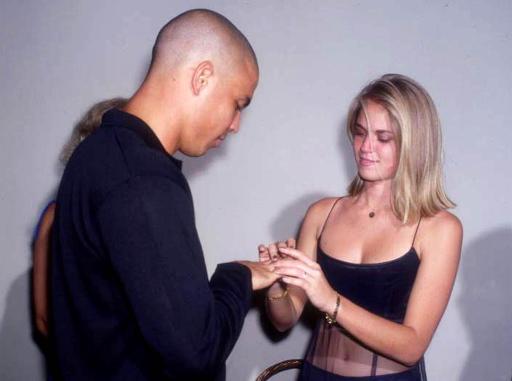
The great
adventure of Ronaldinho does not end here. The San
Cristovao was a springboard for the Cruzeiro and the
Brazilian championship: professionalism, popularity, 12
goals in 14 games, admiring observers declared:
"Even (prénom) Bald, at 16 years old, did not do
what he does". The under 15's, then the under 17's,
the boy is so good he has no time to climb levels one at
a time:
even moreso with the under 20's and under 23's, it was
immediately the national A, the convocation for US 94,
organized by Romario e Bebeto, the World Cup at 17 years
old (without having played a minute) as «O rei». Then
at last his first salary and a life that changed
unexpectedly.
Mummy Sonia is a chatterbox, but is so nice. Up to a few days ago, she lived in the village of Tijuca, a residential district of Rio. She is now at Jacarepaguà, in a new residential complex; in the same zone where they are constructing the Ayrton Senna avenue, close to the velodrome. The new house is surrounded by vegetation and a covered pool. However criminality is always looming. The surveillance is continuous but discreet, the fear of kidnapping is strong. But the desire to speak of her "garoto" is stronger than anything. Mummy Sonia has to confess something: I did not want Ronaldo playing football. By all means I tried to raise that passion as an objection. I could not accept the fact that my son thought only of a ball. What future would he have? I found him playing «pelada» when he was supposed to be at school. I know, I've lost my battle, but I am happy thus: I don't believe it still. Everything happens so rapidly, it's just great ".
Of course, there was someone who believed in that project from the beginning: his Papa Nelio, who nevertheless left the family very early. Mummy Sonia loses the thread of her ideas for an instant. "Ronaldo likes his father so much. When there is a birthday, Nelio is always with us. We are all there, as a whole family. Nelio did everything for Ronaldo: he brings him to the games, defended him when I was angry".
On the table in the living room, about ten pictures of Ronaldo. On the walls, close to the television, the most beautiful Dutch newspaper covers. Sonia looks at them, touches them and feels herself close to her Ronaldo. " When he was young, sometimes he discouraged me. He also was a sleepwalker: at night, from time to time, he got up and walked with his eyes closed from one room to another. We had to leave lights switched on, to follow him and to avoid him hurting himself. Then he was frightened by darkness. Of course he went out with his friends in the evening, and before coming into the house he would stop and call me:
Mummy, Mummy!" It's only after I answered and he could see me, that he found the courage to come into the darkness of the house.
Yes: the
terror of defenders, the best paid player in the world,
the new Bald, is a boy like others, very close to his
family, simple, an introvert. "Educated and
respectful. Quiet when he's in the presence of strangers.
But at home he overflowed with energy and vitality, it
was one joke after another: grimaces, tricks, games with
children. It was not so easy to live with this fury.
" I worked for the ice merchant, from three in the
afternoon up to three at night. Twelve hours non stop.
Ronaldinho needed somebody to take care of him: luckily
my daughter Yone, 4 years older than Ronaldinho, coddled
her brother as her own son. And then Nelio junior, who
protected him and defended him on the street against more
aggressive children ".
 Mummy Sonia reminds
us of a very painful day. It was in 1990, the Flamengo
did not choose the young Ronaldo, and this not because of
his poor performance. The problem was money. "He did
a trial for them; playing for that team was his dream.
Everthing went well but the managers did not accept him:
at that time, we still lived in Bento Ribeiro, Ronaldo
should have taken the bus to go to training and the
Flamengo did not have the money to pay the ticket. A day
of misfortune: Ronaldinho came back home crying. "
What happened my little boy? ", I asked him. That
morning he went to buy his first watch. When he came back,
on the train, he met two bad boys who robbed the new
watch from him. He cried and cried.
Mummy Sonia reminds
us of a very painful day. It was in 1990, the Flamengo
did not choose the young Ronaldo, and this not because of
his poor performance. The problem was money. "He did
a trial for them; playing for that team was his dream.
Everthing went well but the managers did not accept him:
at that time, we still lived in Bento Ribeiro, Ronaldo
should have taken the bus to go to training and the
Flamengo did not have the money to pay the ticket. A day
of misfortune: Ronaldinho came back home crying. "
What happened my little boy? ", I asked him. That
morning he went to buy his first watch. When he came back,
on the train, he met two bad boys who robbed the new
watch from him. He cried and cried.
It was Martins and Pitta who discovered Ronaldo. In Brazil there is a dictum: "Whoever does not have a sponsor, dies a pagan". It's the reason why the Flamengo did not choose him: Ronaldo did not know anybody. For these reasons San Cristovao gave him a good reception: Reinaldo Pitta put a lot into Ronaldo's career, seeking to correct negative sides of the boy who came from a poor family. Otherwise Ronaldo never would have become the champion he is today. He also had another merit: he wanted to work. Not as the other talented Brazilian boys who are great players without being athletes. Ronaldo worked, sweated and trained"
Then
unexpectedly Holland called him. Ronaldo was 17 years old,
his mother had more fear than he had. " I feared he
felt too much alone. When he called me from Eindhoven I
understood he had problems. Then I took a plane and left
for Holland. I found him a nice new house, I cooked his
favorite dishes: especially the «macarro», pasta and
sauce. Then he began to eat fish, even though he had
hated it in Brazil. I stayed 8 months with him. Now that
he's with the Barcelona team, I would live more in Spain
than in Brazil. My Ronaldinho is only 20 years old, he's
still young and needs his mother ".
As a professional
he began to play for the SociaI Ramos Club in the '90-91
season; the next year he moved to San Cristovao and in '93
he was transferred to the Cruzeiro di Belo Norizonte ( 54
goals in 54 games). In '94, he arrived in Europe to play
for the PSV Eindhoven (cost 6.5 millions$ US, 42 goals in
42 presences). This year he plays for the Barcelona team
(for 20 millions$ US). Until now, he has scored 13 goals
in 18 games between the championship, the Supercup and
the Cup of Cups. At 17 years old, he began with Seleao (24
March ' 94, Brazil-Argentina 2-0, replacing Bebeto in the
last 10 minutes), and scored a goal on his second
presence (Brazil-Iceland 3-0, 4 May '94) . In 15 games,
he scored 9 times plus the 5 goals marked with the
olympic team at the Atlanta games. In addition to the
World Cup in '94 (even though he was a member of the
National, he never played), he won the Holland Cup in '96
with the PSV ( was second for the championship in '95],
bronze medalist in Atlanta, and only 20years old for the
America Cup in '95.
Brazilian touch but a German physique
By observing Ronaldo in action, one finds in him the mobility of Dl Stefano, the power and the athletic force of Bald, the sprint of Cruijff, the control of the ball displayed by Maradona and the elegance of Van Basten. He also has the elasticity of Eusebio and the dribble of Romario. For the moment, he has one more advantage: he is only 20 years old, and there will always be time to see that we are in presence of the best player ever, by admitting that some comparisons are justified.
Ronaldo
has whole advantages to mark this period, if we refer to
the prototype of the player of the year 2000: a symbiosis
between a magician and a Rambo, a player who, with this
magic, is able to measure the game by himself,
transforming it in an exercise of pure physical forces.
With 1.83m high and 75 kg, he grew 3 centimeters in the
last twelve months and, according to specialists, his
development won't be completed before another two years.
From his Brazilian roots, Ronaldo possesses the technique,
the fantasy, the natural of the gesture and especially
the neuro-muscular coordination, hence, the rapidity of
transmission of a message from the brain to the legs.
As for the rest, lungs or for his energy capacity, he seems to be German. When one sees him running on the field, one thinks of a panther that advances to the samba rhythms. Sinuous and devastating. One can say he is a super athlete, with the cyclist's acceleration, the sprinter's power and the marathon runner's resistance. His singular genetics could probably make him a champion in other athletic disciplines. From a tactical point of view, he's not in fact the typical striker of the penalty area, but he maintains an average of one goal by game.
His acceleration and his progression help him to sprint from far and to surprise defensmen. With an extraordinary coordination and a rare skill in his footplay, he can nip in and out around his adversaries, moreover he can outplay them totally by changing the rhythm of his running. He flies, with the ball stuck to his feet: and that is his best advantage. He knows how to play with force, finesse and precision, and what he prefers best is to thwart the goaler and to lead the ball up to an empty net. His only fault, until now, is his head work. But nobody is perfect, not even Ronaldo.