
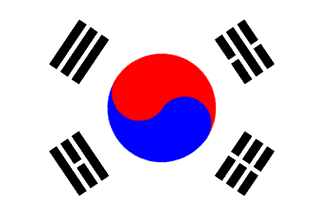
Korea is sandwiched between Japan and China, which is why many Korean martial arts look a little like the arts of both neighbors. Many of the high kicks seen in tae kwon do resemble the high kicks of China’s northern shaolin, while tae kwon do punches look very close to Japan’s karate punches.
Martial arts in Korea were extensively recorded during the Three Kingdom era (approximately 100 BC-AD 900). The Three Kingdoms were Koguryo, Paekche and Silla. Koguryo was the largest kingdom, consuming the bulk of the Korean peninsula. Koguryo was a strong military power that sponsored martial arts based on military skills, such as archery, ornate swords and swordsmanship and empty hand grappling techniques.
Paekche Kingdom, sharing the southern tip of the Korean peninsula with Silla, was more of a cultural and religious society than its large northern cousin, Koguryo. Paekche had a trading partner – Japan. Fine Paekche swords were exported to Japan, leading some martial art historians to believe that some of Japan’s superior sword making technology came from the Paekche Kingdom.
Another military-oriented kingdom, Silla got its start as a tribal group seeking to rule itself as a kingdom. Eventually, Silla leaders formed a treaty with Tang Dynasty China and adapted Chinese methods of warfare. One result of the heavy emphasis on Chinese military philosophies was a code called hwarang-do, a military-religious school for young noblemen. Translating to way of the flower of manhood, hwarang-do is thought by some to be the foundation of Japanese bushido. Hwarang warriors were the military and martial art elite of ancient Korean.
Modern day Korean martial arts show a special creativity, not seen as much in the arts of other countries. For instance, Korean martial arts like hapkido are a clever combination of advanced throwing, joint locking and kicking techniques, which make hapkido a well balanced self defense art.
Tae Kwon Do is the largest martial art in Korea. There are differing stories about tae kwon do’s origins, however all agree that tae kwon do places 70 percent of its technique emphasis on kicking techniques. Tae kwon do has recently become an Olympic medal sport, making it one of the most popular martial arts in the world.
However, tae kwon do isn’t the only martial art in Korea. There is tang soo do, a martial art said to have its origins in China. Hapkido, a popular defense-oriented art that includes intricate kicks, got its start in an aiki-jitsu school in Japan. Kuk sool won is a modern combination of ancient Korean martial arts, being one of the few Korean fighting arts that incorporates weapons training along with unarmed combat techniques.
Although tae kwon do is the best known and most popular Korean martial art, there are over 30 other Korean martial art systems. Korean arts, such as Tae Kwon Do and Hapkido, also use uniforms similar to Japanese gis to train in, and colored belts to show rank, as do the Japanese. Kuk sool won uses uniforms that resemble ancient Korean generals’ uniforms to identify black belt members.