|
About Jamaica | |

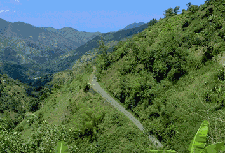
Geography: Jamaica is the third largest Caribbean island, measuring 146 miles at its widest point. Primarily of volcanic origin, the lush island features a mountain ridge that peaks at Blue Mountain which is 7,402 feet high. Many white-sand beaches and clear seas ring the island.
Population: The population of Jamaica was 2.4 million in 1990, with an average annual rate of growth of 1.1% from 1980 to 1990. Approximately 45% of the people are 19 years or under, and a little less than 8% are above 65. Based on the census of 1982, at least 48% of the population was urban; in 1943, the census estimated the urban population at that time to be 15%.
Climate: In winter, the average temperature is 75 degrees; in summer it's about 80. Year-round, temperatures are usually five to 10 degrees cooler in the mountain. Typically sunny year-round, Jamaica has rainy months in May, June, September and October. Jamaica's 4-day weather forecast.
Sovereign: Queen Elizabeth II (1952)
Governor-General: Howard F. H. Cooke (1991)
Prime Minister: Percival J. Patterson (1992)
Area: 4,411 sq. mi. (10,990 sq. km)
Population (1999 est.): 2,652,443 (average annual rate of natural increase: 1.48%); birth rate: 20.2/1000; infant mortality rate: 13.9/1000; density per sq. mi.: 601
Capital and largest city (1991 est.): Kingston, 104,000
Monetary unit: Jamaican dollar
Languages: English, Jamaican (Broken English)
Ethnicity/race: African 76.3%, Afro-European 15.1%, East Indian and Afro-East Indian 3%, white 3.2%, Chinese and Afro-Chinese 1.2%, other 1.2%
Religions: Protestant, 55.9%; Roman Catholic, 5%; other, 39.1%
Literacy rate: 98%
Economic summary: GDP/PPP (1998 est.): $8.8 billion; $3,300 per capita.
Real growth rate: –2%.
Inflation: 9.9%.
Unemployment: 16.5% (1997 est.).
Arable land: 14%.
Agriculture: sugarcane, bananas, coffee, citrus, potatoes, vegetables; poultry, goats, milk.
Labor force: 1.14 million (1996); services, 41%; agriculture, 22.5%; industry, 19% (1989).
Industry: tourism, bauxite, textiles, food processing, light manufactures.
Natural resources: bauxite, gypsum, limestone.
Exports: $1.7 billion (1997): alumina, bauxite, sugar, bananas, rum.
Imports: $2.8 billion (1997): machinery and transport equipment, construction materials, fuel, food, chemicals.
Major trading partners: U.S., EU, Canada, UK 13.4%, Norway, Caricom. Latin America.
Flag: Colors: Black= Hardships, Green=Prosperity, Gold=SunMotto for Flag: "Hardships there are, but the land is green and the sun shineth"
I PLEDGE MY HEART
The Ackee, an edible fruit brought from West Africa in the 18th century. The botanical name is Blighia sapida, for Captain William Bligh who introduced the plant to the English scientific community in 1793.
Ackee and Saltfish, salted codfish
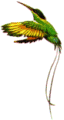
The Streamertail Hummingbird or Doctor Bird, Trochilus polytmus 252 varieties of birds have been identified on the island, 24 of which are found nowhere else in the world. Birdwatch upclose at Lisa Salmon's Bird Santuary in Hanover. (picture at top of page)
The blue flower of the Lignum vitae (tree of life) has been used in folk medicine. The hard Lignum vitae wood is used for furniture and sculpture.
The Blue Mahoe.
A full-flaired skirt made of Madras bandana (predominantly red plaid cotton) material worn usually with a white blouse edged with matching bandana. Headwear varies from bandana wrapped in a special design to straw hat decorated with flowers.

back