History of Jamaica
History of Jamaica |
|

 |
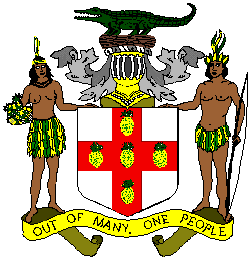
The original Coat of Arms granted to Jamaica in 1661, was designed by the then Archbishop of Canterbury, William Sanderoft. Apart from a partial revision in 1957, it remaines virtually the same as it was originally designed. The Arms shows a male and female Arawak, standing on either side of the shield which bears a red cross with five golden pineapples on it. The Crest is a Jamaican crocodile looking out on the Royal Helmet and Mantlings. The original Latin motto, "Indus Uterque Serviet Uni", has been changed to one in English: "Out of many, one people."
|
* Pre-Jamaica
Before the arrival of Christopher Columbus
in 1494, Jamaica was inhabited by Arawaks, living in simple communities based on fishing,
hunting, and small scale cultivation of cassava. The impact of the contact with the
Spanish was traumatic, and these communities disappeared in 70-80 years. Plunder,
disruption of economic activities, new diseases, and migration destroyed the small
population. Only a few artifacts, which are on display at the small museum at White Marl,
and a few Spanish names of places (such as Ocho Rios) remain from this period. Otherwise,
there is no Arawak influence on further development of life on the island.
In 1655, Jamaica was captured by the British expedition led by Admirals Penn and Venables, following their unsuccessful invasion of Hispaniola. By this time, the island was of little significance to the Spanish crown, and very little was done to defend it against the British. As with the previous period, the influence of the Spanish settlement on the social, economic and political life of the island was small . Apart from remnants of buildings with the distinct Spanish colonial architectural styles, and names of places, there is very little visible evidence of the Spanish occupation.
* The Slave Economy, 1655-1838The plantation dominated economic life in every sense. It occupied the best lands, the laws supported the slave system, and in general all commercial and other economic activity depended on the activity of the plantation. Some slaves ran away from the estates to live in small bands in the mountains as Maroons.
In recognition of her leadership in the Maroon wars against the British, Nanny (see National Heroes at bottom) was eventually named a national hero. Except for the Maroons, all agricultural activity took place on the plantations. The towns served as the commercial sites for the export of sugar and the importation of the inputs for production.
The political system consisted of a governor and his executive council, and an assembly of representatives elected on a limited franchise determined by property ownership. The politics of this period were characterized by an alliance between the governor as the representative of the crown, and the Assembly of planters, against the slaves. Frequently, the alliance broke down, mostly over taxation of the plantations.
By the close of the 18th century, sugar was losing its economic importance because of competition from beet sugar as well as rising production costs. In 1838, the slaves were Emancipated and the plantations had to begin paying wages to its workers. One of Jamaica's national heroes, Rev.Sam Sharpe ( see National Heroes at bottom) after whom Montego Bay's city square is named, is celebrated for his leadership role in the famous Christmas rebellion of slaves in 1831, a few years before Emancipation.
*The Development of the Peasantry. 1838-1938Struggles over land were main themes in the history of this period, in which two of Jamaica's national heroes, George William Gordon and Paul Bogle (see National Heroes at bottom) paid with their lives.
In this period, sugar continued to decline in its importance, but peasant exports of logwood, coffee, and eventually bananas grew steadily. In this way, the economy began to be diversified away from its traditional dependence on sugar alone.
*The National Movement and Decolonization, 1938-1962The period 1944- 1962 not only saw major political changes, but also major transformations of the structure of the economy. From a one crop export economy, the economy became diversified around the export of sugar, bananas and other agricultural commodities, the export of bauxite and alumina, and the tourist industry. These brought about a construction industry. The USA displaced the UK as Jamaica's principal trading partner. There was also a tremendous migration of labor to the UK and the USA which needed labor for the post-war reconstruction and expansion of their economies.
*The First Decade of Political Independence, 1962-1972
The post-war boom in the economy continued through the 60's, though it gradually slowed down, with the completion of the investment cycle of the bauxite/alumina industry. By the end of the decade, there were well established mining, tourism, manufacturing, and construction sectors, alongside the traditional agricultural and distribution sectors.
*The Second Decade of Political IndependenceRelated to this was an ideology of social reform to protect the weakest sections of the population, and to promote the welfare of the poor through subsidized food, housing, education, health, and other important social services. In international affairs, Jamaica opened up relations with many non-capitalist countries, and promoted the solidarity of the Third World in international negotiations with the advanced countries.
The international economy was quite unfavorable for a number of reasons. The main ones were the weakness of the aluminum market, and hence, the bauxite industry, the inflation of oil and food prices, and the decline and reversal of capital inflows for private investment.All of this contributed to the decline in the economy, with the problems of unemployment, inflation, and growing external indebtedness. By the end of the decade, the government sought assistance from the IMF and the World Bank, and since then these two institutions, along with the USAID, have determined the policy framework of the government.
*The Third Decade of Political IndependenceThe eighties saw the development of Free Zone manufacturing especially of garments for export to the USA, the gradual recovery of bauxite/alumina production, and the rapid growth of tourism from North America. In the process, the traditional international economic relations, particularly with the USA, were strengthened at the expense of regional relations, such as Caricom trade.
The eighties also saw large volumes of emigrants, primarily to the USA, swelling the ranks of established overseas Jamaican communities, and creating new ones. Jamaicans are contributing in every sphere of human activity, and distinguishing themselves in cultural activities, such as music, and sports. In addition, Jamaicans have been accumulating significant quantities of wealth in assets in the USA and other countries.

back