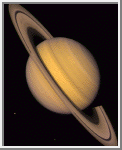
equatorial diameter of 119,300 kilometers (74,130 miles). Much of what is known about
the planet is due to the Voyager explorations in 1980-81. Saturn is visibly flattened at the
poles, a result of the very fast rotation of the planet on its axis. Its day is 10 hours, 39
minutes long, and it takes 29.5 Earth years to revolve about the Sun. The atmosphere is
primarily composed of hydrogen with small amounts of helium and methane. Saturn is the
only planet less dense than water (about 30 percent less). In the unlikely event that a large
enough ocean could be found, Saturn would float in it. Saturn's hazy yellow hue is marked
by broad atmospheric banding similar to, but fainter than, that found on Jupiter.
The wind blows at high speeds on Saturn. Near the equator, it reaches velocities of 500
meters a second (1,100 miles an hour). The wind blows mostly in an easterly direction. The
strongest winds are found near the equator and velocity falls off uniformly at higher latitudes.
At latitudes greater than 35 degrees, winds alternate east and west as latitude increases.
Saturn's ring system makes the planet one of the most beautiful objects in the solar system.
The rings are split into a number of different parts, which include the bright A and B rings
and a fainter C ring. The ring system has various gaps. The most notable gap is the Cassini
[kah-SEE-nee] Division, which separates the A and B rings. Giovanni Cassini discovered
this division in 1675. The Encke [EN-kee] Division, which splits the A Ring, is named after
Johann Encke, who discovered it in 1837. Space probes have shown that the main rings
are really made up of a large number of narrow ringlets. The origin of the rings is obscure. It
is thought that the rings may have been formed from larger moons that were shattered by
impacts of comets and meteoroids. The ring composition is not known for certain, but the
rings do show a significant amount of water. They may be composed of icebergs and/or
snowballs from a few centimeters to a few meters in size. Much of the elaborate structure of
some of the rings is due to the gravitational effects of nearby satellites. This phenomenon is
demonstrated by the relationship between the F-ring and two small moons that shepherd
the ring material.
Radial, spoke-like features in the broad B-ring were also found by the Voyagers. The
features are believed to be composed of fine, dust-size particles. The spokes were observed to form and dissipate in the
time-lapse images taken by the Voyagers. While electrostatic charging may create spokes by levitating dust particles above the
ring, the exact cause of the formation of the spokes is not well understood.
Saturn has 18 confirmed moons, the largest number of satellites of any planet in the solar system. In 1995, scientists using the
Hubble Space Telescope sighted four objects which might be new moons.
