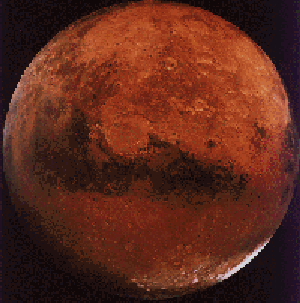
Since the nineteenth century (or even before then) man has been fascinated by Mars. Since Galileo made the first telescope observation of Mars in 1610, new discoveries have constantly been made about Mars. In 1877, Giovanni Schiaparelli discovered canals on Mars, starting a controversy that would continue for decades. In 1965, the Mariner 4 spacecraft returned with the first close-up pictures of Mars. In 1969, Mariner 6 and 7 produced more pictures. In 1971, the Mariner 9 and the Soviet spacecrafts -- Mars 2, 3, 4, 5, and 6 -- took over 7,000 pictures of Mars. In 1976, two Viking landers landed on Mars. By 1979, the Viking landers had taken over 50,000 pictures of the planet and discovered a wealth of information.
In 1953, Wernher vom Braun published The Mars Project. This book was a revelation. It consisted of complex designs and mathematical tables programming a manned mission to Mars. In 1956, von Braun published a revised version of The Mars Project. The most important thing his books did was demonstrate the technical feasibility of a manned Mars mission. In 1969, von Braun proposed a Mars mission that would depart in 1981, reach Mars in 1982, then return to Earth in 1983. It included building a space station and a shuttle. Two other options were proposed that year. The second option postponed the Mars mission until the late 1980's. The third option was to just build the space station and the shuttle. President Nixon rejected all three options and decided to just build the space shuttle. Nixon's decision in 1969 greatly damaged the space program.
The year is 1995. It has been over 25 years since man first walked on the moon.
Now the United States, Russia, and many other major countries of the world are suffering
from economic problems. It now looks like a manned mission to Mars will most likely not occur in
our lifetime.