PROTOTYPING
KINDS OF INFORMATION SOUGHT
Prototyping of information systems is a worthwhile technique for quickly gathering specific information about
users' information requirements. As will become evident in the second section
of this chapter, there are four basic approaches to prototyping. Generally
speaking, effective prototyping should come early in the systems development
life cycle, during the requirements determination phase. However, prototyping
is a complex technique that requires knowledge of the entire systems
development life cycle before it is successfully accomplished. Prototyping is
included at this point in the text to underscore its importance as an
information‑gathering technique. When using prototyping in this way, the
systems analyst is seeking initial reactions from users and management to the
prototype, user suggestions about changing or cleaning up the prototyped
system, possible innovations for it, and revision plans detailing which parts
of the system need to be done first or which branches of an organization to
prototype next. Figure 8.1 shows the four kinds of information that analysts
seek during prototyping.
INITIAL USER REACTIONS
As the systems analyst presenting a prototype of the
information system, you are keenly interested in the reactions of users and
management to the prototype. You want to know in detail how they react to
working with the prototype and how good the fit is between their needs and the
prototyped features of the system. Reactions are gathered through observation,
interviews, and feedback sheets (possibly questionnaires) designed to elicit
each person's opinion about the prototype as he or she interacts with it.
Through such user reactions, the analyst discovers many perspectives on the
prototype, including whether users seem happy with it and whether there will
be difficulty in selling or implementing the system.
User Suggestions
The analyst is also interested in user and management suggestions about refining
or changing the prototype that has been presented. Suggestions are garnered
from those experiencing the prototype as they work with it for a specified
period. The time that users spend with the prototype is usually dependent on
their dedication to and interest in the systems project. Suggestions are the
product of users' interaction with the prototype as well as their reflection on
that interaction. The suggestions obtained from users should point the analyst
toward ways of refining, changing, or "cleaning up" the prototype so
that it better suits users' needs. I
Innovations
Innovations for
the prototype (which, if successful, will be part of the finished system) are
part of the information sought by the systems analysis team. Innovations are
new system capabilities that have not been thought of prior to the time when
users began to interact with the prototype. These innovations go beyond the
current prototyped features by adding something new and innovative.
Revision Plans
Prototypes preview the future
system. Revision plans help identify priorities for what should be prototyped
next. In situations where many branches of an organization are involved,
revision plans help to determine which branches to prototype next.
Information gathered in the
prototyping phase allows the analyst to set priorities and redirect plans
inexpensively, with a minimum of disruption.
Because
of this feature, prototyping and planning go hand in hand.
APPROACHES TO PROTOTYPING
Kinds of Prototypes
The word prototype is used in many
different ways. Rather than attempting to synthesize all of these uses into one
definition or trying to mandate one correct approach to the somewhat
controversial topic of prototyping, we will illustrate how each of several
conceptions of prototyping may be usefully applied in a particular situation.
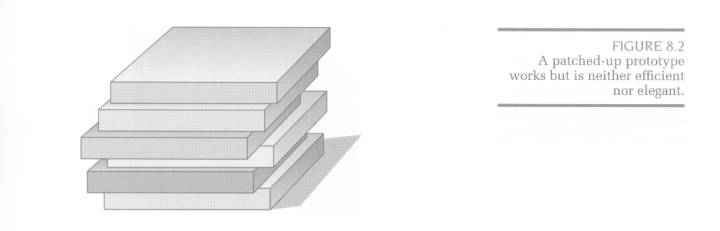
PATCHED‑UP PROTOTYPE. The
first kind of prototyping has to do with constructing a system
that works but is patched up or patched together. In engineering this approach
is referred to as bread boarding‑creating a patched‑together,
working model of an (otherwise microscopic) integrated circuit.
An example in information systems is a working model
that has all the necessary features but is inefficient. In this instance of
prototyping, users can interact with the system, getting accustomed to the
interface and types of output available. However, the retrieval and storage of
information may be inefficient, since programs were written rapidly with the
objective of being workable rather than efficient. A patched‑up prototype
may be envisioned as something like the illustration shown in Figure 8.2. Another
example of a patched‑up prototype is an information system that has all
the proposed features but is really a basic model that will eventually be
enhanced.
NONOPERATIONAL PROTOTYPE. The second conception of a
prototype is that of a nonworking scale model which is set up to test certain
aspects of the design. An example of this approach is a full‑scale model
of an automobile which is used in wind tunnel tests. The size and shape of the
auto are precise, but the car is not operational. In this case only features of
the automobile essential to wind tunnel testing are included.
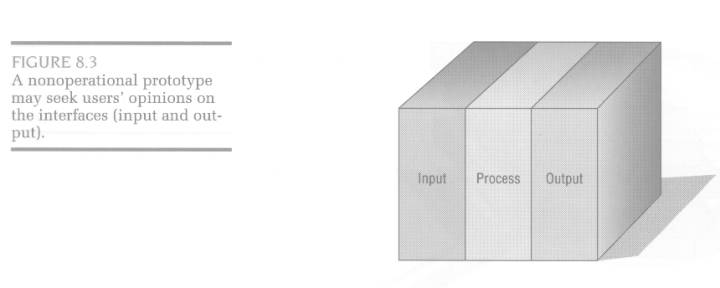
A nonworking scale model of an information system
might be produced when the coding required by the applications is too extensive
to prototype but when a useful idea of the system can be gained through the
prototyping of the input and output only. This kind of prototype is shown
conceptually in Figure 8.3. In this instance processing, because of undue cost
and time, would not be prototyped. However, some decisions on the utility of
the system could still be made based on prototyped input and output.
FIRST‑OF‑A‑SERIES PROTOTYPE. A third conception of
prototyping involves creating a first full‑scale model of a system,
often called a pilot. An example is prototyping the first airplane of a series.
The prototype is completely operational and is a realization of what the
designer hopes will be a series of airplanes with identical features.
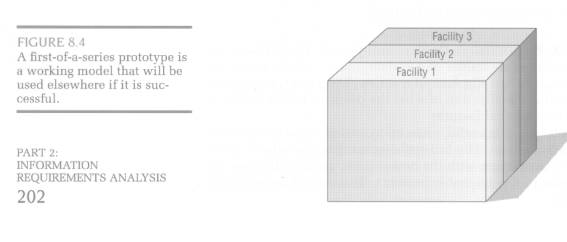
This type of prototyping is useful when many
installations of the same information system are planned. The full‑scale
working model allows users to experience realistic interaction with the new
system, yet it minimizes the cost of overcoming any problems that it presents.
This sort of prototype is depicted in Figure 8.4.
For example, when a retail grocery chain intends to
use EDI (electronic data interchange) to check in suppliers' shipments in a
number of outlets, a full‑scale model might be installed in one store in
order to work through any problems before the system is implemented in all the
others. Another example is found in banking installations for electronic funds
transfer. A full‑scale prototype is installed in one or two locations
first, and if successful, duplicates are installed at all locations based on
customer usage patterns and other key factors.
SELECTED FEATURES PROTOTYPE. A fourth conception of
prototyping concerns building an operational model that includes some, but not
all, of the features that the final system will have. An analogy would be a new
retail shopping mall that opens before the construction of all shops is
complete. In a newly opened retail mall, essential functions such as being able
to purchase some goods, eating in a fast‑food restaurant, and parking
nearby are possible, although not all space is occupied and not all goods that
will ultimately be for sale are available when the complex first opens. Nonetheless,
from initial contact with the retail complex, it is possible to gain a good
understanding of what future visits will be like. When prototyping information
systems in this way, some, but not all, essential features are included. For
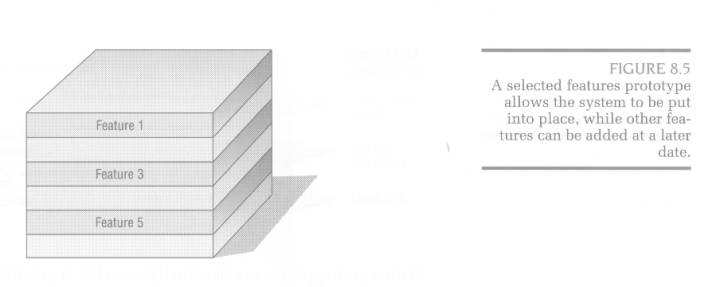
example, a system menu may appear onscreen that lists six features: add a
record, update a record, delete a record, search a record for a keyword, list a
record, or scan a record. However, in the prototyped system, only
three of the six may be available for use, so that the user may add a record
(feature 1), delete a record (feature 3), and list a record (feature 5), as illustrated in Figure 8.5.
When this kind of prototyping is done, the system is
accomplished in modules, so that if the features that are prototyped are evaluated as successful, they can be incorporated into the
larger, final system without undertaking immense work in interfacing.
Prototypes done in this manner are part of the actual system. They are not just
a mock‑up as in the first definition of prototyping considered
previously.
Prototyping as an Alternative to the Systems Development Life Cycle
Some analysts argue that
prototyping should be considered as an alternative to the Systems development life, cycle (SDLQ. Recall that the SDLC, introduced
in Chapter 1, is a logical, systematic
approach to follow in the development of information systems. Complaints about
going through the SDLC center around two main concerns, which are interrelated.
The first concern is the extended time required to go through the development
life cycle. As the investment of ana1yst time increases, the cost of the delivered
system rises proportionately. The second concern about using the SDLC is that
user requirements change over time. During the long interval between the time
that user requirements are analyzed and the time that the finished system is
delivered, user requirements are evolving. Thus, because of the extended
development cycle, the resulting system may be criticized for inadequately
addressing current user information requirements.
It is apparent that the concerns are interrelated,
since they both pivot on the time required to complete the SDLC and the problem
of falling out of touch with user requirements during subsequent development
phases. If a system is developed in isolation from users (after initial
requirements analysis is completed), it will not meet their expectations.
A corollary of the problem of keeping up with user
information requirements is the suggestion that users cannot really know what
they do or do not want until they see something tangible. And in the traditional SDLC, it often is too late to change an unwanted system once it is
delivered.
To overcome these problems, some analysts propose
that prototyping be used as an alternative to the systems development life
cycle. When prototyping is used in this way, the analyst effectively shortens
the time between ascertainment of information requirements and delivery of a
workable system. Additionally, using prototyping instead of the traditional
systems development life cycle might overcome some of the problems of
accurately identifying user information requirements.
With a prototype, users can actually see what is
possible and how their requirements translate into hardware and software. Any
of the four kinds of prototyping discussed earlier might be used.
Drawbacks to supplanting the systems development
life cycle with prototyping include prematurely shaping a system before the
problem or opportunity being addressed is thoroughly understood. Also, using
prototyping as an alternative may result in producing a system which is
accepted by specific groups of users but which is inadequate for overall system
needs.
The approach we advocate here is to use prototyping
as a part of the traditional systems development life cycle. In this view
prototyping is considered as an additional, specialized method for
ascertaining users' information requirements.
DEVELOPING A PROTOTYPE
In this section guidelines for developing a
prototype are advanced. The term prototyping is taken in the sense of the last
definition that was discussed that is, a selected‑features prototype
that will include some but not all features, one that, if successful, will
eventually be part of the larger, final system that is delivered. When
deciding whether to include prototyping as a part of the systems development
life cycle, the systems analyst needs to consider what kind of problem is
being solved and in what way the system presents the solution. Different types
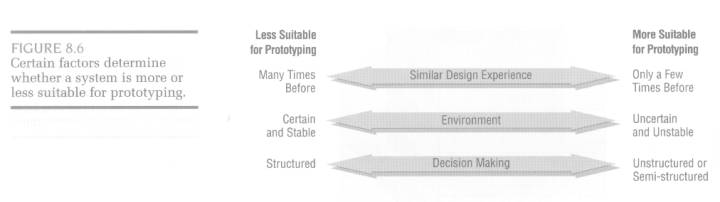
of systems and their suitability for prototyping are depicted in Figure 8.6. A straightforward payroll or
inventory system which solves a highly structured problem in a traditional
manner is not a good candidate for prototyping, because the outcome of the
system as a solution is well‑known and predictable.
Rather, consider the novelty and complexity of the
problem and its solution. A novel and complex system that addresses
unstructured or semi structured problems in a nontraditional way is a perfect
candidate for prototyping. Decision support systems, which are the subject of
Chapter 12, are personalized information
systems that support users in semi structured decision making. As such, DSSs
are well‑suited to prototyping.
The systems analyst must also evaluate the
environmental context for the system when deciding whether to prototype. If the
system will exist in an environment that is stable for long periods,
prototyping may be unnecessary. However, if the environment for the system
changes rapidly, then prototyping should be seriously considered. By their
nature prototypes are evolutionary and can absorb many revisions.
The prototype system is actually an operational
portion of the eventual system that you will build. It is not a complete
system, since you will
strive to build it quickly; only some essential
functions will be included in the model. However, it is important to envision
and then build the prototype as part of the actual system with which the user
will interact. It must incorporate enough representative functions to allow
users to understand that they are interacting with a real system.
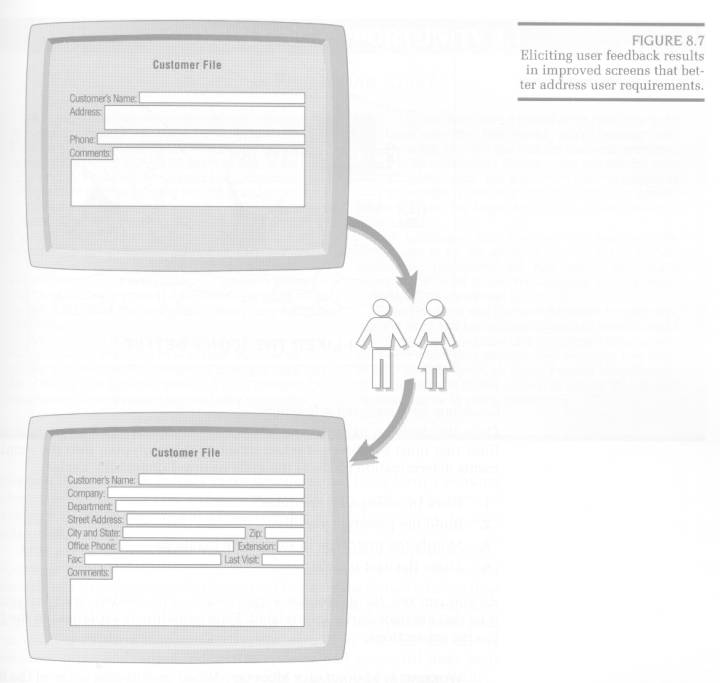
Prototyping is a superb way to elicit feedback about
the proposed system and about how readily it is fulfilling the information
needs of its users, as depicted in Figure 8.7.
The first step
of prototyping is to estimate the costs involved in building a module of the
system. If costs of programmers' and analysts' time, as well as equipment
costs, are within the budget, then building of the prototype can proceed.
Prototyping is an excellent way to facilitate the integration of the
information system into the larger system of the organization.
Guidelines for Developing a Prototype
Once the decision to prototype has been made, there
are four main guidelines that must be observed when integrating prototyping
into the requirements determination phase of the systems development life
cycle:
1. Work in manageable
modules.
2.
Build the prototype rapidly.
3. Modify the prototype in
successive iterations.
4. Stress the user interface.
As you can see, the guidelines suggest ways of
proceeding with the prototype that are necessarily interrelated. Each
guideline is explained in the following subsections.
WORKING IN MANAGEABLE MODULES. When prototyping some of the
features of a system into a workable model, it is imperative that the analyst
work in manageable modules. One of the distinct advantages of prototyping is
that it is not necessary or desirable to build an entire working system for prototype
purposes.
A manageable module is one that allows users to interact with
its key features yet can be built separately from other system modules. Module
features that are deemed less important
are purposely left out of the initial prototype.
BUILDING
THE PROTOTYPE RAPIDLY. Speed is essential to the successful prototyping
of an information system. Recall that one of the complaints voiced against following the traditional
systems development life cycle is that the interval between requirements
determination and delivery of a complete system is far too long to effectively
address evolving user needs.
Analysts can use prototyping to shorten this gap by using traditional
information‑gathering techniques to pinpoint salient information require‑
ments and then they can quickly make decisions that
bring forth a working model. In effect the user sees and uses the system very
early in the systems development life cycle instead of waiting for a finished
system to gain hands‑on experience.
After a brief analysis of information requirements
using traditional methods, such as interviewing, observing, and researching
archival data, the analyst constructs working models for the prototype. The
prototype should take less than a week to put together; two or three days is
preferable and possible. Remember that in order to build a prototype this
quickly, you must use special tools, such as an existing database management
system, as well as software that allows generalized input and output,
interactive systems, and so on. All these tools permit speed of construction
that is impossible with traditional programming.
It is important to emphasize that at this stage in
the life cycle, the analyst is still gathering information about what users
need and want from the information system. The prototype becomes a valuable
extension of traditional requirements determination. The analyst assesses user
feedback about the prototype in order to get a better picture of overall
information needs.
Putting together an operational prototype both
rapidly and early in the systems development life cycle allows the analyst to
gain valuable insight into how the remainder of the project should go. By
showing users very early in the process how parts of the system actually
perform, rapid prototyping guards against over committing resources to a
project that may eventually become unworkable.
MODIFYING THE PROTOTYPE.
A third
guideline for developing the prototype is that its construction must support
modifications. Making the prototype modifiable means creating it in modules
that are not highly interdependent. If this guideline is observed, less resistance
is encountered when modifications in the prototype are necessary.
The prototype is generally modified several times,
going through several iterations. Changes in the prototype should move the
system closer to what users say is important. Each modification necessitates
another evaluation by users.
As with the initial
development, modifications must be accomplished swiftly, usually in a day or
two, in order to keep the momentum of the project going. However, the exact
timing of modifications depends on how dedicated users are to interacting with
modified prototypes. Systems analysts must encourage users to do their share by
evaluating changes rapidly.
The prototype is not a finished system. Entering the
prototyping phase with the idea that the prototype will require modification is
a helpful attitude that demonstrates to users how necessary their feedback is
if the system is to improve.
STRESSING THE
USER INTERFACE. The user's interface with the prototype (and eventually the system) is
very important. Since what you are really trying to achieve with the prototype
is to get users to further articulate their information requirements, they must
be able to interact easily with the system's prototype. For many users the
interface is the system. It should not be a stumbling block. For example, at
this stage the goal of the analyst is to design an interface that both
allows the user to interact with the system with a minimum of training and
allows a maximum of user control over represented functions. Although many
aspects of the system will remain undeveloped in the prototype, the user
interface must be well developed enough to enable users to pick up the system
quickly and not be put off. On‑line, interactive systems using GUI
interfaces are ideally suited to prototypes. Chapter 18 describes in detail the
considerations that are important in designing the user interface.
Many of the intricacies of interfaces must be
streamlined or ignored altogether in the prototyping phase. However, if
prototype interfaces are not what users need or want or if systems analysts
find that the interfaces do not adequately allow system access, then they, too,
are candidates for modification.
Disadvantages of Prototyping
As with any information‑gathering technique,
there are several disadvantages to prototyping. The first is that it can be
quite difficult to manage prototyping as a project within the larger systems
effort. The second disadvantage is that users and analysts may adopt a
prototype as a completed system when it is in fact inadequate and was never
intended to serve as a finished system.
The analyst needs to weigh those disadvantages
against the known advantages when deciding whether to prototype, when to
prototype, and how much of the system to prototype.
MANAGING THE
PROJECT. All
of the systems analysts' management skills that you learned in Chapter 3 come
into play again as your systems analysis team constructs and modifies a
prototype. All of the possible problems that project management is subject to are
relevant here.
Although several iterations of the prototype may be
necessary, extending the prototype indefinitely also creates problems. It is
important that the systems analysis team devise and then carry out a plan
regarding how feedback on the prototype will be collected, analyzed, and
interpreted. Set up specific time periods during which you and management
decision makers will use feedback to evaluate how well the prototype is
performing. Even though the prototype is prized for its evolutionary nature,
the analyst cannot permit prototyping to overtake other phases in the systems
development life cycle.
Elicit feedback from users periodically, not just
once, and ask them if previous suggestions for improvements or changes have
been acted upon satisfactorily. Feedback is directed to the members of the
systems analysis team for their reaction and possible modification of the
prototype to better-fit user needs. Recall that modifications to the prototype
should be managed on a tight schedule of only a day or two each throughout the
successive iterations.
ADOPTING AN INCOMPLETE SYSTEM AS COMPLETE. A second major disadvantage
of prototyping is that if a system is needed badly and welcomed readily, the
prototype may be accepted in its unfinished state and pressed into service
without the necessary refinements. While superficially, this may seem to be an
appealing way to short‑cut the development effort, it works to the
business' and team's disadvantage.
Users will develop interaction patterns with the
prototype system that are not compatible with what will actually occur with the
complete system. Additionally, a prototype will not perform all necessary
functions. Eventually, when users discover the deficiencies, user backlash may
develop if the prototype has been mistakenly adopted and integrated into the
business as if it were a complete system.
Advantages of Prototyping
Prototyping is not necessary or appropriate in every
systems project, as we have seen. However, the advantages should also be given
consideration when deciding whether to prototype. The three major advantages of
prototyping are: the potential for changing the system early in its
development, the opportunity to stop development on a system that is not
working, and the possibility of developing a system that more closely addresses
users' needs and expectations. All three advantages are interrelated.
CHANGING THE SYSTEM EARLY IN ITS DEVELOPMENT. Successful prototyping
depends on early and frequent user feedback, which can be used to help modify
the system and make it more responsive to actual needs. As with any systems
effort, early changes are less expensive than changes made late in the
project's development.
Since the prototype can be changed many times and
since flexibility and adaptation are at the heart of prototyping, the feedback
that calls for a change in the system is often the action taken. Feedback will
help tell you if changes are warranted in the input, process, or output areas,
or if all three need adjustment.
When changing a prototype, analysts do not need to
worry about wasting many man‑hours of their efforts and those of
programmers who have developed a full‑blown system only to find that it
needs modifications. Although the prototype represents an investment of time and
money, it is always considerably less expensive than a completed system.
Concomitantly, system problems and oversights are much easier to trace and
detect in a prototype with limited features and limited interfaces than they
are in a complex system.
SCRAPPING UNDESIRABLE SYSTEMS. A second advantage of using
prototyping as an information‑gathering technique is the possibility of
scrapping a system that is just not what users and analysts had hoped it would
be. Once again, the issue of time and money arises. A prototype represents much
less of an investment than a completely developed system.
Permanently removing the prototype system from use
is done when it becomes apparent that the system is not useful and does not
fulfill the information requirements (and other objectives) that have been
set. Although scrapping the prototype is a difficult decision to make, it is
infinitely better than putting increasing sums of time and money into a project
that is plainly unworkable.
DESIGNING A SYSTEM FOR USERS' NEEDS AND
EXPECTATIONS. A
third advantage of prototyping is that the system being developed should be a
better fit with users' needs and expectations. Many studies of failed
information
systems indict the long interval between
requirements determination and the presentation of the finished system; these
systems failed precisely because it is
common for
systems analysts to develop systems while sequestered away from users during
this critical period.
It is a better practice to
interact with users throughout the systems development life cycle. If your
team makes a commitment to ongoing user involvement in all phases of the
project, then the prototype can be used as an interactive tool that shapes the
final system to accurately reflect users' requirements.
Users who take early ownership of the information
system work harder to ensure its success. One way to foster early user support is to involve users actively in prototyping.
If your evaluation of the prototype indicates that
the system is functioning well and within
the guidelines that have been set, the decision should be to keep the prototype
going and continue expanding it to include other functions as planned. This,
then, is considered an operational prototype. The
decision is made to keep the prototype
functioning if the prototype is within the budget set for
programmers' and analysts' time, if users find the system worthwhile, and if it
is meeting the information require‑
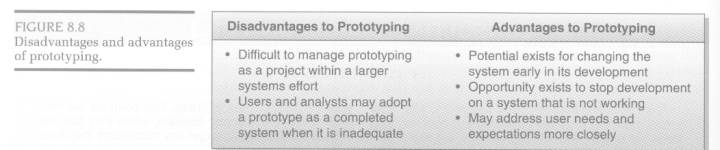
ments and objectives that have been set. A list
comparing disadvantages and advantages of prototyping is given in Figure 8.8.
USERS'ROLE IN PROTOTYPING
The users' role in prototyping can be summed up in
two words: honest involvement. Without user involvement there is little reason
to prototype. The precise behaviors necessary for interacting with a prototype
can vary, but it is clear that the user is pivotal to the prototyping process.
Realizing the importance of the user to the success of the process, the
members of the systems analysis team must encourage and welcome input and
guard against their own natural resistance to changing the prototype.
Interaction with the Prototype
There are three main ways a
user can be of help in prototyping:
1. Experimenting with the
prototype
2. Giving open reactions to the
prototype
3. Suggesting additions to
and/or deletions from the prototype
All of the foregoing stem from the users' initial
and successive interactions with the prototype.
EXPERIMENTING
WITH THE PROTOTYPE. Users should be free to experiment with the prototype. In contrast to a
mere list of systems features, the prototype allows users the reality of hands‑on
interaction. Mounting a prototype on an interactive Web site is one way to
facilitate this interaction. Limited functionality along with the capability to
send comments to the systems team can be included.
Users need to be encouraged to experiment with the
prototype. The final system will be delivered with documentation stating how
the system is to be used, and this in effect constrains experimentation. But in
the prototyping stage, the user is free from all but minimal instruction on
how to use the system. When this is the case, experimentation becomes necessary
to make the prototype work.
Analysts need to be present at least part of the
time when experimentation is occurring. They can then observe users'
interactions with the system, and they are bound to see interactions they never
planned. A form for observing user experimentation with the prototype is shown
in Figure 8.9. Some of the variables you should observe include user reactions
to the prototype, user suggestions for changing or expanding the prototype,
user inno‑
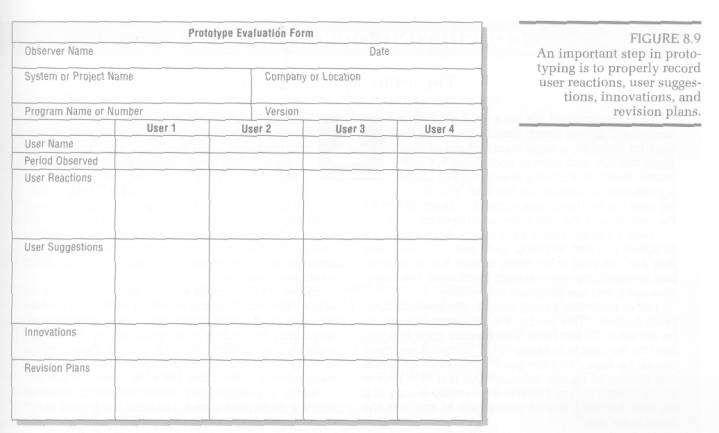
vations for using the system in completely new ways,
and any revision plans for the prototype that aid in setting priorities. When
revising the prototype, analysts should circulate their recorded observations
among team members so that everyone is fully informed.
GIVING OPEN REACTIONS TO THE PROTOTYPE. Another aspect of the users'
role in prototyping requires that they give open reactions to the prototype.
Unfortunately, this is not something that occurs on demand. Rather, making
users secure enough to give an open reaction is part of the relationship between
analysts and users that your team works to build.
Additionally, if users feel wary about commenting on
or criticizing what may be a pet project of organizational superiors or peers,
it is unlikely that open reactions to the prototype will be forthcoming.
Providing a private (relatively unsupervised) period for users to interact with
and respond to the prototype is one way to insulate them from unwanted
organizational influences. An exclusive Web site set up for users and analysts
can also help in this regard.
SUGGESTING CHANGES TO THE PROTOTYPE. A third aspect of the users'
role in prototyping is their willingness to suggest additions to and/or
deletions from the features being tried. The analysts' role is to elicit such
suggestions by assuring users that the feedback they provide is taken
seriously, by observing users as they interact with the system, and by
conducting short, specific interviews with users concerning their experiences
with the prototype.
Although users will be asked to articulate
suggestions and innovations for the prototype, in the end it is the analyst's
responsibility to weigh this feedback and translate it into workable changes
where necessary. Users need
to be encouraged to brainstorm about possibilities
and to be reminded that their input during the prototyping phase helps
determine whether to save, scrap, or modify the system. In other words users
should never be resigned to accepting in the prototype stage something less
than what they want. Systems analysts must remember to stress to users and
management alike that prototyping is the most appropriate time for system
changes.
In order to facilitate the prototyping process, the
analyst must clearly communicate the purposes of prototyping to users, along
with the idea that prototyping is valuable only when users are meaningfully
involved.
Prototyping and the "Year 2000
Crisis"
It seems so easy to type in a year as 97 or 98 instead of entering 1997 or 1999. It also saves a lot of
valuable space in a database and everything fits better oil a computer screen.
This was the standard way of thinking in the early
days of computing and is still the case even now. Banks encouraged the practice
by putting 19 on checks so their customers wouldn't have to write in the 19.
In the late 1990s programmers started to question whether this was a
good idea. After all, what happens in the year 2000. Will users want to see the 00 appear on the screen
or report?
When we calculated a person's age in 1996, we took 1996 ‑ 1975 = 21. That is, if you were born in
1975 you turned 21 on your birthday in 1996. If we only stored the last 2 digits, the calculation was 96 ‑ 75 = 21 years old.
Let's try the same in the year 2000. Take 2000 ‑ 1979 and the answer is also 2 1, but take 00 ‑ 79 and the answer is ‑ 79
or minus 79 years old. This is part of
the year 2000 crisis as well.
Prototyping can help determine problems such as
this. When you develop a prototype, make sure you encourage users to give
constructive criticism. In this way some problems, like the year 2000 crisis, may be averted.
SUMMARY
Prototyping is an information‑gathering
technique useful for supplementing the traditional systems development life
cycle. When systems analysts use prototyping, they are seeking user reactions,
suggestions, innovations, and revision plans in order to make improvements to
the prototype and thereby modify system plans with a minimum of expense and
disruption. Systems that support semi structured decision making (as decision
support systems do) are prime candidates for prototyping.
The term prototyping carries several different
meanings, four of which are commonly used. The first definition of prototyping
is that of constructing a patched‑up prototype. A second definition of
prototyping is a nonoperational prototype that is used to test certain
features of the design. A third conception of prototyping is creating the first‑of‑a‑series
prototype that is fully operational. This kind of prototype is useful when many
installations of the same information system (under similar conditions) are
planned. The fourth kind of prototyping is a selected features prototype that
has some, but not all, of the essential system features. It uses self‑contained
modules as building blocks, so that if prototyped features are successful, they
can be kept and incorporated into the larger, finished system.
The four major guidelines for developing a prototype
are to: (1) work in manageable modules, (2) build the prototype rapidly,
(3) modify the prototype, and (4) stress
the user interface.
One disadvantage of prototypes is that managing the
prototyping process is difficult because of the rapidity of the process and its
many iterations. A second disadvantage is that an incomplete prototype may be
pressed into service as if it were a complete system.
Although prototyping is not always necessary or
desirable, it should be noted that there are three main, interrelated
advantages to using it: (1) the
potential for changing the system early in its development, (2) the opportunity to stop
development on a system that is not working, and (3) the possibility of developing
a system that more closely addresses users' needs and expectations.
Users have a distinct role to play in the
prototyping process. Their main concern must be to interact with the prototype
through experimentation. Systems analysts must work systematically to elicit
and evaluate users reactions to the prototype. Sometimes this can be
accomplished by mounting the prototype on an interactive Web site that permits
users to see limited functionality and to enter comments for the systems team.
Analysts then work to incorporate worthwhile user suggestions and innovations
into subsequent modifications.