
Stars:
V
A star is a big ball of gas which
gives off both heat and light. So where do stars come from? What happens to them as they
grow older?
A galaxy contains clouds of dust and gas, as well as stars. It is in the clouds of dust
and gas that stars are born. As more and more of the gas (which is mostly hydrogen) is
pulled together by gravity into a cloud, the cloud starts to spin. The gas atoms start to
bump into each other faster and faster. This creates heat energy. The cloud gets hotter
and hotter. Finally, it gets so hot within the cloud that something called "nuclear
fusion" happens. The cloud begins to glow. The glowing cloud of gas is now known as a
protostar. The protostar continues to grow. Once it stops growing, it is known as a main
sequence star. A main sequence star can shine for millions of years or more. The amount of
time it lives is determined by
how big it is.
Medium stars
In medium size stars, after the nuclear fusion has used up all the fuel it has, gravity
will pull the remaining material closer together. The star will shrink. In fact, it may
get to be only a few hundred kilometers wide! The star is then called a "white
dwarf". It can stay like this for a long time. Eventually, it will stop producing any
light at all. It is then called a "black dwarf" and it will stay that way
forever.
Massive stars
In large size stars, nuclear fusion will continue until iron is formed. In stars, iron
acts like an energy sponge. It soaks up the star's energy. This energy is eventually
released in a big explosion called a supernova. The little bit of matter that used to be
at the center of the star before the supernova will then be either a neutron star or a
black hole. Which object it becomes depends on the size of the original star. A star that
is 1.5 to 4 times larger than our Sun will become a neutron star. Stars that are even
bigger than that will become black holes.
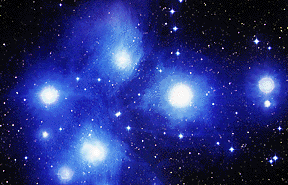
A picture of stars.