Joints are reasonably continuous
and through-going planar fractures, commonly on the scale of centimeters
to ten or hundred of meters in length, along which there has been imperceptible
"pull apart" movement more or less perpendicular to the fracture. Joints
are products of brittle failure and they form when the tensile strength
of stressed rock is exceeded. Joints form to permit minor adjustments to
take place as the regional rock bodies within which they are found change
in location, orientation, size, and/or shape in response to such actions
as burial and compactation; heating and expansion; uplift, cooling and
contraction; and tectonic loading, causing shortening or stretching.
In compression, joints develop in the conjugate shear directions (the orientation
of symmetric fracture planes) making the lower angle with the major principal
stress direction. Shear joints are often grooved, striated, polished or
slickensided by even small amounts of shear displacement.
In tension, joints develop by stretching
normal to the tensile stress direction which is usually the minor principal
stress. Tension joints are rough (unless subsequently weathered). In coarse
grained rocks such surfaces may be very rough.
Shear Fractures
Shear fractures are of the same
size and scale as joints, and they too occur in sets of planar parallel
fractures. Some joint like fractures are actually shear fractures.
However, if some of the fractures are shear fractures and not joints, they
will eventually be recognized by the presence of slickenlines, which reflect
a shearing movement parallel to the surface as opposed to dilation of opening
perpendicular to the surface. The slickenlines on shear fractures
are most commonly fine scale, delicate ridge-in-groove lineations developed
the adjoining fracture surfaces.

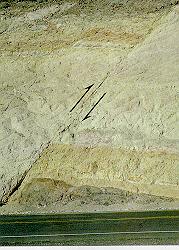
Faults are fractures along which
there is a visible offset by shear displacement parallel to the fracture
surface. Faults can occur as single discrete breaks, but where the rock
has been repeatedly faulted, or where the rock is especially weak, no discrete
break may be evident. What forms instead is a fault zone composed of countless
sub parallel and interconnecting closely spaced fault surfaces. Faulting
is fundamentally a brittle mechanism for achieving shear displacement.
Faults range in length and displacement form small breaks with offsets
wholly contained within individual hand specimens or outcrops, to regional
crustal breaks extending hundreds to more than 1000 km and accommodating
offsets of tens to hundreds of kilometers.
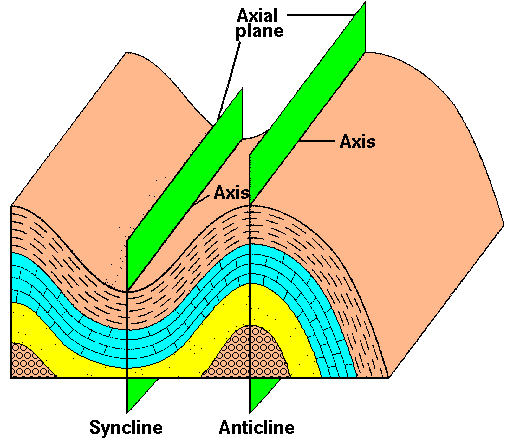
Folds are visually the most spectacular
of Earth's structures. They are extraordinary displays of strain, conspicuous
natural images of how the original shapes of rock bodies can be changed
during deformation. The physical forms and orientations of folds
seem limitless. some are upright; some lie on their sides; some are inclined.
Some show neatly arranged, uniformly thick layers; others are sloppy.
Fold sizes varies too, form anticlines that fit into the palm of a hand
to regional folds best seen through the eyes of a satellite. Mapping the
forms of folds, is pure pleasure, unless of course the fold turn intro
a geometric nightmare. Constructing cross sections of folded terrains becomes
a fundamental tool for structural geology.