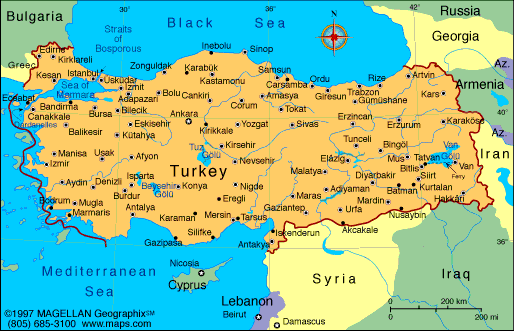
Turkey
Republic of Turkey
National name: Türkiye Cumhuriyeti
President: Süleyman Demirel (1993)
Prime Minister: Bülent Ecevit (1999)
Area: 300,947 sq. mi. (incl. 9,121 in Europe) (780,580 sq. km)
Population (1999 est.): 65,599,206; average annual rate of natural increase 1.57%; birth rate: 20.9/1000; infant mortality rate: 35.8/1000; density per sq. mi.: 218
Capital (1996 est.): Ankara, 2,890,025
Largest cities: Istanbul: city proper (1996 est.) 8,203,329; metro. area (1995 est.) 7,817,000; Izmir, 1,920,807; Adana, 1,010,363; Bursa, 949,810; Gaziantep, 683,557
Monetary unit: Turkish lira
Language: Turkish
Ethnicity/race: Turkish 80%, Kurdish 20%
Religion: Islam (mostly Sunni), 98%
Literacy rate: 81%
Economic summary: GDP/PPP (1998 est.): $425.4 billion; $6,600 per capita.
Real growth rate: 2.8%.
Inflation: 70%.
Unemployment: 10%.
Arable land: 32%.
Agriculture: tobacco, cotton, grain, olives, sugar beets, pulse, citrus; livestock.
Labor force: 22.7 million (April 1998) note: about 1.5 million Turks work abroad (1994); agriculture 42.5%, services 34.5%, industry 23% (1996).
Industry: textiles, food processing, autos, mining (coal, chromite, copper, boron), steel, petroleum, construction, lumber, paper.
Natural resources: coal, chromite, copper, borate, sulfur, petroleum.
Exports: $31 billion (f.o.b., 1998): textiles and apparel, foodstuffs, iron and steel products.
Imports: $47 billion (f.o.b., 1998): machinery and equipment, fuels, minerals, foodstuffs.
Major trading partners: Germany, U.S., Russia, U.K., Italy, France.