LOGARITHMS AND MULTIPLICATIVE EFFECTS
Multiplicative Symmetry: A Second Look
In our discussion of histograms earlier in
this chapter we showed that some variables have multiplicatively svmmetric
distributions. We stated, without any justification, that the logarithmic
transformation of some variables has a distribution that exhibits ordinary
symmetry. The reason for this is not hard to Understand if you recall one
key fact about logarithms; the logarithm of the product of two or more
numbers is the sum of their logarithms.
Thus, for example, log(a*b*c) = log(a) + log(b)
+ log(c) .
This is true whether you are using so-called
natural logarithms (logarithms to the base e, where e - 2.71828, approximately),
or logarithms to the base 10. You should convince yourself, using a spreadsheet
or a calculator, that
log(2+3*4) = log(2) + log(3) - log(4)
for both natural logarithms and logarithms
to the base 10.
Distributions that are multiplicatively symmetric
often arise when value of each observation is the product of a number of
small random effects. The logarithm of such a value will then be the sum
of a number of small random effects and the distribution of such a set
of values is lNely to be symmetric. Thus, logarithms convert or transform
multiplicative effects into additive effects.
Multiplicative Seasonals and Constant Growth
Rates
If you turn backto Figure 1.7, the graph of
retail sales over time, you will notice that the amplitude of the swings
behvesm the December peak and the JanuaryFebruary trough seems to get larger
over time. One possible explanation is that the seasonal effect is multiplicative.
Supposse, for example, that every December tends to be 20% above normal
and every January 15% below normal, then the difference between December
and January will be larger for high levels of sales, and smaller for low
levels. Because the level of sales has been increasing over time, the differences
will therefore get larger over time. If the seasonal effect of each months,
in fact, a constant multiple of some Normal level of sales, then a graph
showing a time series of the logarithm of sales will depict seasonal effects
that add to or subtract from normal the same constant amount for each month:
on the logarithmic scale, the seasonal effects will not change with tile
level of the series. Figure 1.14 shows such a graph, it seems to confirm
the multitalicative-seasorial hypothesis.

A constant . growth rate means that successive
values in a time series are constant multiples of preceding values. For
instance, if a variable increases by 5% per year, each year's value will
be 1.05 times the preceding year's. If this is so, the logarithm of the
values in the time series will have values that are constant increments
above preceding values, and therefore a graph of the logarithmic series
will have a shape close to a straight line. The U.S. population, the consumer
price index, gross national product, and electric power generation all
exhibit patterns of multiplicative growth over sufficiently long periods
of time. The values increase at an increasing rate, often described as
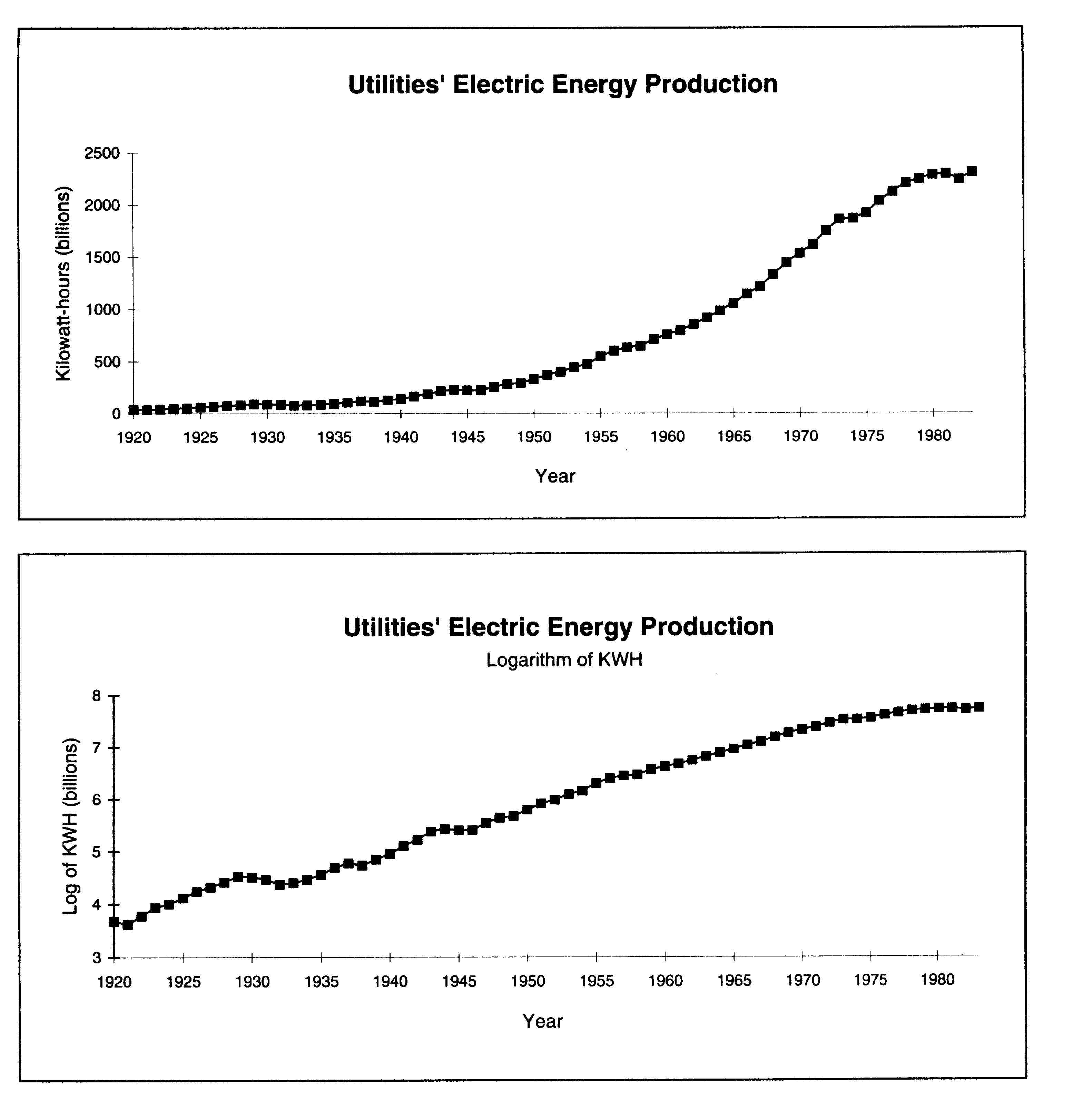
exponential growth. Figure 1.15, a graph of electric energy production
in the United States from 1920 to 1983, exhibits this kind of exponential
growth, at least through the mid-1970s. Figure 1.16, a graph of the logarithm
of the series, is more nearly linear. Notice that by "linearizing" the
series we can more easily detect the effects of the 1930s depression, the
end of World War 11, and the OPEC oil crisis of the 1970s on energy production.
Multiplicative Effects in Cross-Sectional Data
Even in cross-sectional data, the values of
a variable may depend on the values of other variables in a multiplicative
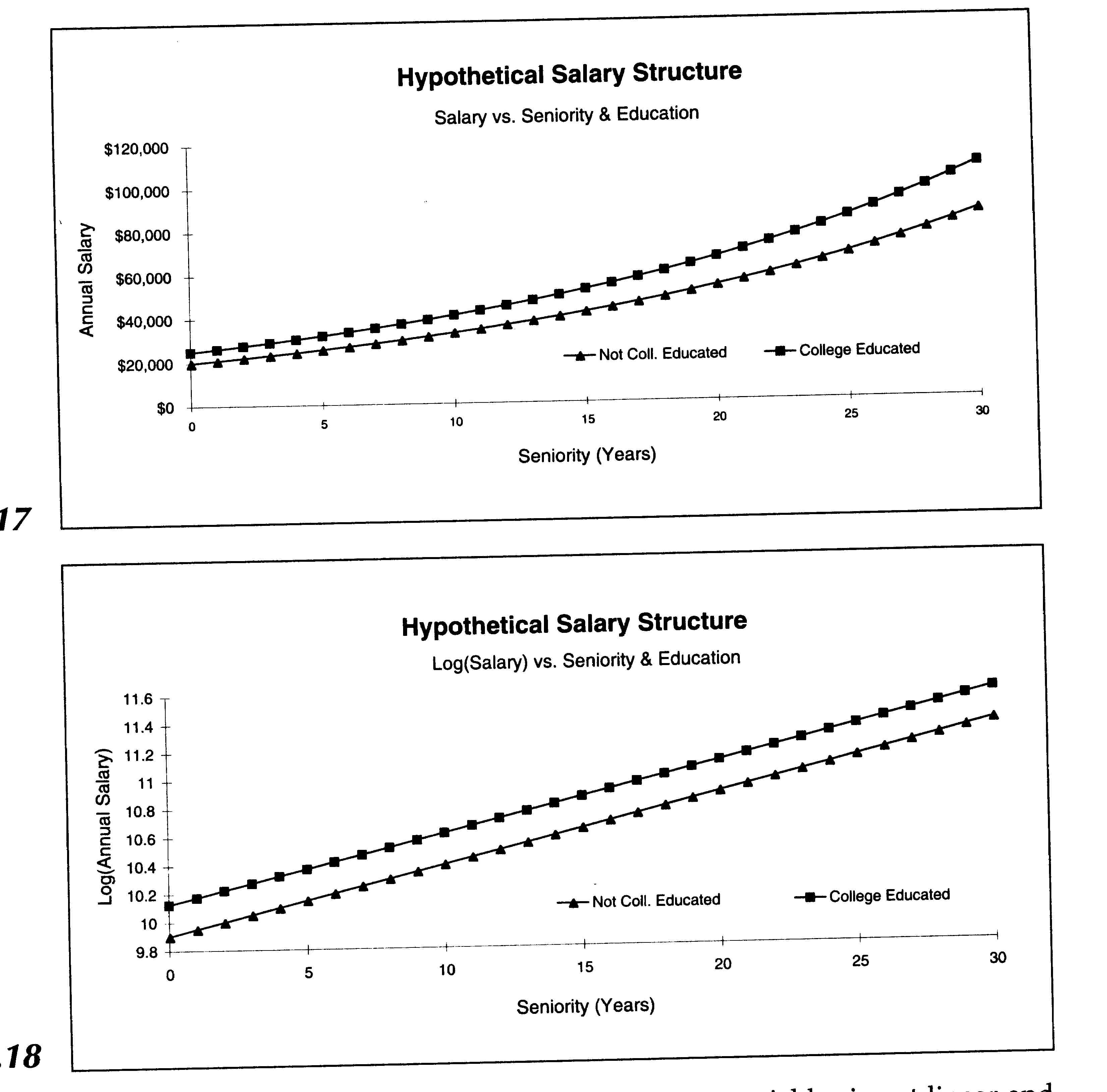
way. A companys salary structure may reward seniority and education, among
other things. Suppose that in a given year starting salary for a person
without a college education is $20,000, that college-educated employees
earn 25% more than employees with comparable seniority, and that each year
of seniority confers 5% more salary. Figure 1.17 shows what salaries would
be if there were no additional factors affecting salary. Figure 1.18 shows
the effects of seniority and education on log(salary). For a given level
of seniority, education adds the same amount to log(salary), no matter
what the level of seniority; we say that the effect of education on log(salary)
is multiplicative. When we look at the effect of seniority on log(salary)
for either level of education, we observe that it is linear, and this implies
that the effect of seniority on salary is multiplicative.
In general, when the relationship between two variables is not linear
and the dependent variable is measured on a ratio scale, it is a good idea
to see whether effects can be more simply explained by looking at graphs
of the logarithm of the dependent variable. A logarithmic transformation
of a ratioscale dependent variable may:
* produce a symmetric, rather than a skewed, distribution of the
dependent variable.
* produce a linear and additive relationship between the independent
variables and the transformed dependent variable, if the effects on the
natural dependent variable were multiplicative.
In performing transformations on our data, such as a log transform,
we trade off complexity to get simplicity in the form of straight lines
and additive effects.
Graphs with Logarithmic Scales
Ordinary graphs are plotted on an arithmetic scale, so that each
increment on an axis represents equal distance (i.e., the distance from
1 to 2 is the same as the distance from 2 to 3). Sometimes graphs are plotted
on a ratio or logarithmic (log) scale, in which equal distances represent
equal percent changes (i.e., the distance from 1 to 2 is the same as the
distance from 2 to 4).

Figures 1.19A-C show three different ways of plotting monthly values
of the Standard,and Poors 500 Stock Index, from January 1968 through January
1993. Part A shows values of the Index on an arithmetic scale, B shows
values of log (Index) on an arithmetic scale, and C shows values of the
Index on a log scale.13 Both B and C are essentially the same graphs: when
you want to capture multiplicative effects of a ratio-scale variable graphically,
graphs of either sort are equally appropriate.
Notice that both the B and C graphs convey a great deal more information
about stock-market fluctuations than does A. Looking at A, for example,
it appears that the major stock-market declines occurred during the crash
of 1987 and prior to the Gulf War in late 1990. Both B and C show, however,
that the percentage decline from 1969 to 1970 was as severe as-though more
protracted than-the 1987 crash, while the decline from late 1972 to late
1974 was substantially more severe than the crash.