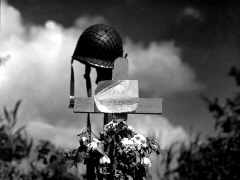
This global military conflict that, in terms of
lives lost and material destruction, was the most devastating war in human history. It
began in 1939 as a European conflict between Germany and an Anglo-French coalition but
eventually widened to include most of the nations of the world. It ended in 1945, leaving
a new world order dominated by the United States and the USSR.
More than any previous war, World War II involved the commitment of nations' entire human
and economic
resources, the blurring of the distinction between combatant and noncombatant, and the
expansion of the battlefield to include all of the enemy's territory. The most important
determinants of its outcome were industrial capacity and personnel. In the last stages of
the war, two radically new weapons were introduced: the long-range rocket and the atomic
bomb. In the main, however, the war was fought with the same or improved weapons of the
types used in World War I. The greatest advances were in aircraft and tanks.
With the invasion of Poland, the Allied forces declared war on Germany and the Axis
forces. Eventually, the main Allied forces would consist of Great Britain, France, the
United States, China, and after Hitler broke his treaty, the Soviet Union. The Soviet
forces ended up inflicting over 80% of the casualties in Hitler's armies. The main Axis
forces consisted of Germany, Japan, and Italy, but Germany's Allies at times became more
of a hindrance than a help.
Wake Island was the site of a U.S. naval and submarine base during World
War II, and was invaded by the Japanese immediately after the attack on
Pearl Harbor on December 7, 1941. They were able to fight off the
Japanese against overwhelming odds until December 23. The United States
regained the island in 1945 when the Japanese surrendered, and it is now
under the control of the United States Air Force.