This text was originally written for a lecture from students
for students at the university of cologne. It does not contain results
of own scientific work, but it contains the results of extensive recherché
in different books and journals. Though I worked as carefully as possible,
I cannot guarantee the correctness of the information. I refuse responsibility
for possible errors. Since I´m not a native speaker, there may
be some mistakes in syntax or grammar. For corrections please mail to:
[email protected]
Deposits of amber
Introduction
Amber (or succinite) is a fossil resin. Most important are the deposits
of Baltic and Dominican amber. They both are of tertiary age (40-50 Ma
respectively 25-40 Ma). Commonly amber has yellow to redbrown color, but
blue or green varieties are existing, too. Its hardness on the Moh´s
scale of hardness amounts to 2 to 2,5. It is a bit harder than gypsum.
Its density lies around 1.05 to 1.09g/cm3 which is close to
the density of water. Deviation up and downs are possible. Since the density
lies so close to that of water, it has an important influence on the behavior
during transportation and the formation of deposits. Amber is combustible
and shows lumineszens under UV-light.
The chemical compound consists of a mixture of non-uniform components.
It builds a polyester similar to modern synthetic resin. Most components
belong to the group of terpenes.
Known varieties with own names:
-
Gedanite is a brittle variety of Baltic amber.
-
Rumanite is a brittle variety, coming from Romania. Rumanite has become
heated during deposition. It is probably of the same origin as Baltic amber.
-
Cedarite is a Canadian variety of Cretaceous age. The name refers to the
place where it was found: Cedar Creek.
-
Recent and subfossil resins are known as copal. Copal has a different behavior
(e. g. under UV-light) compared with true amber. It contains recent live
forms as inclusions.
Amber is commercially used as gemstone. Usually it is formed to necklaces
or inserted into rings. Some bigger works of art as chests, caskets or
model ships are known, too. The most famous work of art is probably the
"Bernsteinzimmer", the amber room, which is lost since the second world
war. Carved work of amber exists since the younger stone age. Trading is
known from that time on, too. Amber was distributed along so called amber-roads
all over Europe.
There is a lot of deposits of amber all over the world, may be 300 or
more. Deposits of amber containing fossil inclusions are much less, circa
30, but becoming more.
Origin of Baltic amber
The deposit of Baltic amber is the most important known up to date. It
has yield the largest amount of amber. Most scientific work on amber has
been done on Baltic amber.
Baltic amber can be found on the shores of East and North sea and in
the Samland (near Kaliningrad) in the "Blue Earth".
The Baltic amber was built in the Paleogene about 40-50 Ma ago in an
area in middle Sweden and Finland. The exact borders of this area are unknown,
since some events in the history of the earth have destroyed all primary
(or autochthon) deposits.
The source of the resin was pinus succinifera, a collective
name for resin producing types of pines. The resin leaked out of the pines
when the bark was wounded, dried and grew hard.
Some different modes of fluxion are known, for example drops, mass
flows or "Schlauben" (schlaubes). These schlaubes developed by "drop on
drop" flows of resin. They are especially interesting for paleontologists,
as they bear the most inclusions in Baltic amber. Every drop exposed a
gluey surface, where insects could land and stick to. After that, a new
drop of resin could overflow the first drop and enclose the sticked insect.
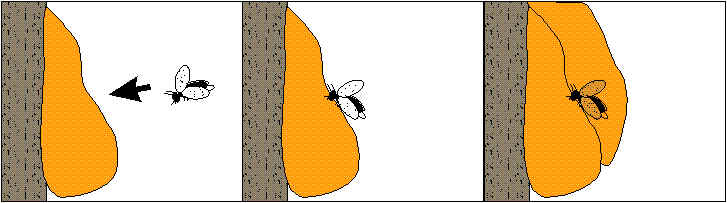
Building of schlaubes: 1. A drop of resin is running down the
tree. An insect is attracted by its shiny surface. 2. The insect lands
on the surface and sticks to it. 3. A second drop of resin overflows the
first.
Additionally schlaubes are mostly clear, other types of Baltic amber are
commonly dim due to microscopically little bubbles of air. The clearness
of the schlaubes is explained as the result of heating by sunlight, that
made it possible for the bubbles to escape. The resin hardened in a short
time, became copal and finally amber.
Baltic amber was displaced a short time after origin. The sea flooded
the "amber forest" part by part from the West. Possibly some parts of amber
were washed into the sea by rivers earlier. The amber could only be deposited
under still-water-conditions, because of its low density. Possible places
for deposition in general were:
-
intracontinental depressions as lakes and swamps
-
submarine depressions
-
lagoons
First the amber was deposited in flat lagoons. The deposit built under
these conditions is known as "Blaue Erde", as Blue Earth: The amber is
lying in a clay and Glauconite containing sand. It is especial rich in
amber and other fossils.
After that the sea retreated. The blue earth, now lying on the surface
was washed away by rivers and brooks and deposited again together with
fine light coloured sand. The sand contains relicts of lignite and is for
that called "Braunkohlensand", lignite-sand. Amber was deposited in nests.
Once more amber was displaced during the ice age. Blue earth and lignite
sand were pushed away by the forward pressing ice. For that reason, amber
can be found in all kinds of glacigen ice depositions in Middle Europe.
Relicts of all three kinds of deposits are conserved up to our time,
partly under the (particular the East-) sea. Amber can be found on the
beach, when huge storms have disturbed these deposits and washed the amber
on the shore.
The enormous production of resin by the "amber-pine" was caused by desease.
The advancing sea and conjuncted changes in climate destroyed the environment
of the amber forest. The pines were damaged and retreated. In the periphery
the pines reacted on these changes with morbid flows of resin. Damaged
pines were more exposed to varmints and reacted likewise with raise in
resin production.
Beside the pines some other plants can be producers of amber-building
resin. Hymanea is supposed to be the producer of resin for Dominican and
Mexican amber.
For different deposits of Dominican amber the age of deposition is
between 25 and 40 Ma.
Methods of investgation
There are two common methods of investgation of amber:
-
The optical method
-
Infrared-spectroscopy
The first method is used to investgate the embedded fossils. The amber
is embedded in synthetic resin with the same refraction index as the amber.
Then the whole thing is polished. The inclusion can now be viewed without
disturbance by light reflection.
The second method is used to identify the amber and its bolological
relatioship.between different pieces of amber or to modern plant resins.
You create a absorption spectrum of the contained chemical components.
Quality of conserved inclusions
The conditions of conversation of fossils is brlliant. Even the smallest
details are often conserved. Microfossils can be found, too. Conservation
of colour is rare, but possible. The special Quality of conservation in
amber is the fact, that the embedded fossil insect keep their form in 3D.
In all other cases of conservation of insect, they were platted during
diagenesis.
It seems possible that ancient DNA can be conserved in amber. Some
scientists claim,they have found and identified fossil DNA, other scientist
aire more sceptical. So the discussions may go on some time.
The exact process of conservation is not completely understood yet.
More scientific work needs to be done for this.
Content of fossils
Common inclusions in Baltic or Dominican amber
The most common in inclusions in both types of amber are insects. They
occur with lots of species and with lots of individuals.
In Baltic amber:
-
Doliochopods ( Species of flies with long legs)
-
Trichopteras (Looking like moths)
-
Aphids (Plant louse). They often occur in tribes. Their total lack in domincan
amber might be caused by poison in the trees as it is produced in the recent
"amber trees".
-
Ants, looking like the recent ones, very uniform in appearence.
-
"Starhairs", microscopically small hairs of oaks. Very typical for baltic
amber.
-
Lots of species of flies
In Dominican amber:
-
Ants, with a big variety in appearence
-
Platypodiaes (varmints for trees)
-
termites (as warriors, workers and so on...)
-
cicadas
-
Parts of the amber tree
Special inclusions all over the world
-
Feahters: Known in Baltic and D0omonican amber. Very interesting is a feather
found in Libanon: With an age of 130 Ma it belongs to the first known birds
or even to the Archaeopteryx.
-
Ants, rescuing their breed, proofing their social behavior in that time
(in Dominican amber).
-
A symbiontic society living on a mushroom (Dominican amber).
Looking for more information?
last updated: 14.1.´99
My adress:[email protected]
 Back to home page