|
|
The Information Highway that Was
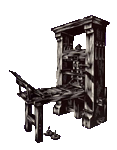
The printing press in the late fifteenth century was in many ways the
equivalent of the computer and the Internet today. It suddenly expanded
the availability of information and fostered a new definition of and a
new imperative for "literacy." Johannes Gutenberg and others on the
continent were responsible for the development of the moveable type press.
However, William Caxton brought printing to England.
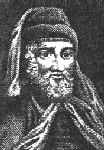
William Caxton, the first English printer, was born in the Weald of
Kent. In 1438, he became apprenticed to Robert Large, a leading textile
merchant who became the mayor of London the following year. After Large's
death in 1441, Caxton moved to Bruges, the formost center for trade between
the English and the Flemish, and built up a thriving textile business.
He attained such prominence as a merchant that by 1463 he was acting governor
of the Merchant Adventurers in the Low Countries. In 1464, he attempted
unsuccessfully to renew a wool treaty with Phillip, Duke of Burgundy. Four
years later, Caxton successfully completed the trade negotiations with
Charles the Bold, Phillip's successor. Shortly thereafter, Caxton was hired
as an advisor to Charles' new duchess, the former Princess Margaret of
York, sister of Edward IV.
It was at the request of the duchess Margaret that he resumed his abandoned
translation of a popular French romance, The Recuyell of the Historyes
of Troye from the French of Raoul le Fèvre. After spending
a year in Cologne learning the art of printing, Caxton returned to Bruges
and set up a printing press, where he published his translation of The
Recuyell, the first printed book in the English language, around 1474.
His next publication, The Game and Play of Chess Moralised (1476),
was a translation of the first major European work on chess, and was the
first printed book in English to make extensive use of woodcuts.
In 1476, he returned to England and set up a printing shop at Westminster
at the sign of the Red Pale. Here, Caxton published such major works as
Troilus
and Creseide, Morte d'Arthur, The History of Reynart the
Foxe, and The Canterbury Tales. Over the course of 14 years,
he printed more than 70 books, 20 of them his own translations from the
Latin, French, and Dutch.
The typefaces used by Caxton were all varieties of "black letter" or
"gothic" type. His earlier works were set in an early form of French
lettre bâtarde. By 1490, he had acquired a more round and open typeface,
a textura originally used by the Parisian printer Antoine Verard and later
favored by Caxton's successor, Wynkyn de Worde. |