 Advanced
Dragon Description
Advanced
Dragon Description

[General Physiology][The Skeleton][The Muscular System][The Scales]
[Coloring][Dragons- David or Goliath?][Classification and Evolution]
Advanced
Dragon Description
[General Physiology][The
Skeleton][The Muscular System][The
Scales]
[Coloring][Dragons- David or
Goliath?][Classification and Evolution]
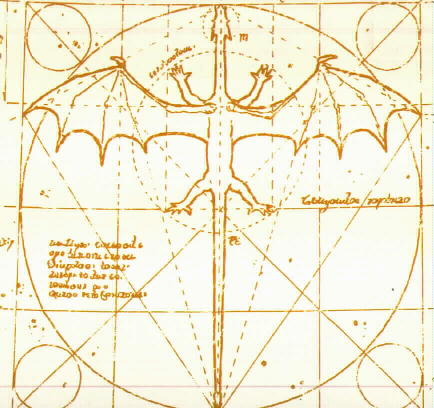 |
The dragon is a homiothermic reptile. In other words, he is a warm-blooded creature and his body temperature is controlled internally. This characteristic enables him to adapt to the different climates of his very extensive habitat and to maintain his activities both day and night throughout the year, as he is not dependent on the warmth from the sun like the other reptiles. The dragon generally has wings, and his bones are hollow, for lightness. There are dragons, usually ancient survivor from the distant past, with stumpy legs and no wings. These rare survivors of a remote era are intelligent and fairly aggressive, and belong to a single species known as "worm of the deep", a species on the verge of extinction. This creature lives for a very long time. There are |
| records of dragons who have lived for five hundred and even a thousand years, but there are no knows cases of dragons who have died from old age. On the other hand, they died from accidents, certain diseases, or as a result of the actions of their most relentless enemy: MAN. |
| The dragon is the largest known flying creature. To maintain his enormous
bulk in the air, his physical structure has had to be different from that of other
reptiles whom many persons inaccurately associate dragon with these. His wing bones fit on to broad shoulders which support the powerful wing muscles; these require an extraordinary articulator system unknown in other species. The bones were tougher than reinforced concrete and much lighter. It is important to note that the bones of a dragon are hollow like bird reducing their mass, scientifically: any creature with the physiology of a dragon can flight well and at great speed. |
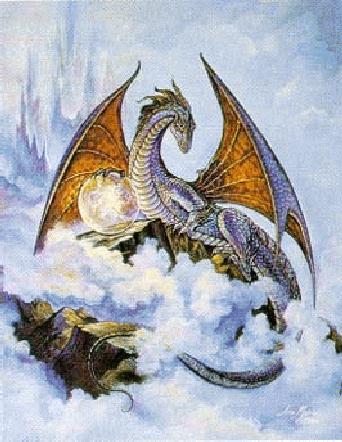 |
| The dragons muscular system is one of the most fascinating... and one of
the most complicate. We can evaluate the power in the bite of a dragon to put to an
average of 2 ton per cm cube (in comparison it could easily gnaw steel). As a matter of fact, dragons are very powerful. Their leg and "arm" can support great charge without much difficulty but this only applies on ground movement because in the air, a dragon could not maintain more than half of is weight for a long period of time. If you have vision keen you probably notice something at the looking of the muscular picture and the skeleton picture... with the observation of the front and the rear paws, I come to the conclusion that dragons COULD NOT run, their muscles of the leg and arm were not developed for this matter. This doesn't means they could not walk, this only means that they could not reach great speed at ground. |
 |
The dragon's body is completely covered with
tough, shiny scales. Dragon usually doesn't have this scaly armor on the neck or stomach,
possibly due to his habit of burrowing underground, not all dragonologist are agreed about
this. To protect his "soft" abdomen (at least weaker than the rest of his body)
the dragon often wears jeweled breastplate. Using his saliva, which has powerful adhesive
properties, and which he secretes on an empty stomach, the dragon often sticks precious
stones on his neck and stomach, for protection as well as adornment. The scales are pentagonal, and shaped like a teardrop, with two long sides and two shorter ones, |
| and a very short fifth side attached to the skin. The dragon can make
them stand on end whenever he likes to preen them. Remember, the dragon is a very clean
creature and takes great care always to keep his skin and scales clean and immaculate. In their normal position, the scales overlap very neatly and, thanks to a tiny cavity in the surface, they fit into each other to allow perfect freedom of movement. If we study a scale closely, we observe the following characteristics: the innermost part is composed of a compact hairy formation firmly rooted in the epidermis. On the hair follicle there are some tiny glands which secrete a substance that adheres firmly to the skin. This substance is rich in minerals, which determine the hardness and the color of the dragon's scales. The external surface has a horny, translucent texture, which gives the scales their habitual luster. |
| It is impossible to list the enormous variety of hues that make up the
dragon's brilliant coloring, but they can be divided into three broad color groupings: Blues, ranging from dark blue to silver and mother-of-pearl. Red, ranging from copper-red to dark red and reddish-black. Greens, which include every imaginable shade of green and yellow and even dark brown, emerald green and burnished gold. Although these three principal color groups are not usually mixed, a dragon's coloring is rarely uniform. In general, his scales are several hues from one of the main color categories, with a metallic luster which is hard to define. When the scales have a pale, opaque appearance, it is a sure sign of ill health. |

| For many of you, the word "dragon" means huge, enormous or
imposing creature but out of any reasonable doubts, the facts are different from the fairy
tale. Dragons are probably small creatures (from 1 foot to 10 feet long). For this we need
to look at fundamental principle of physics called "Physics of Proportion" or
more commonly called "Physics of Lilliput". First, you look at a cube (1cm x 1cm x 1cm) and you decide to double the length and you want to keep the proportion. You will have a bigger cube (2cm x 2 cm x 2cm). The length of the enlarged cube will be multiplied by 2, the surface will be multiplied by 4 and the weight/volume will be multiplied by 8. For example, let say that a bird needs to have a wing span equal to his body length to fly, enlarge this bird ten time. There will be 100 time more surface... However he will weight 1000 time more and since his wings give him the power to fly and that these rely on the surface and not on the volume, he will be unable to fly for his lack of lift power. We have proof now that a large creature could have some difficulties to fly, but we haven't proof they cannot exist. The second thing is the structure of the dragon. Some persons send me theories that dragons could have cartilage instead of bones but this could only be possible in very small creature: The shark for example, live in water and in water your apparent weight is much lighter than in air that explain why an animal like this could live with only cartilage. Look at your nose and you ears, these are made in cartilage but as you have surely notice, this isn't very strong and it's could not support the weight of your entire body. Now if they cannot be made with cartilage, they are obviously made with flesh and bones but the fact with bone is that they rely on the surface (i.e. diameter and not surperficies) to be strong and large bone increase the mass and thus make the flight much more difficult. This is more realistic to say that dragons are small creatures if you consider that they can fly otherwise, they will follow the same principle in the structures of these huge magnificient reptiles: the dinosaurs (in this case their wings would be absolutely useless). |
| Many can wonder in which class the dragons can be categorized. The
dragons cannot be considerer as reptiles because they are active and they are warm
blooded, and they cannot either be mammals [because they lay eggs (Monotrème
like "Echiné à bec droit", are the only exeption to the rule because it are
only the mammals to lay eggs) and they do not produce milk ] and even less
be birds (because they have scales and six members). However, the dragons have elements of
each of these classes (reptiles, birds and mammals): Birds: hollow bones, lay eggs Thus, the dragons would be categorized in their own class... It would be a mistake to consider them in the current class because they do not answer the physical criteria requiered to belong to one or the other. |