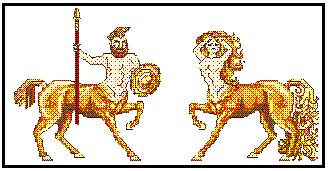
The Centaur
|
A centaur is a mythical creature with the head and torso of a man joined to the body of a horse at about where the horse's head and neck should be. The centaur probably began as a horse totem of a tribe of early Greeks in prehistory. The earliest drawings of hippocentaurs (a kind of demon given human form) show men wearing fetishes of hindquarters of horses joined to their waists. These fetishes, common (in varying form) to European crop and fertility rituals, only later became depictions of human torsos joined to actual horse bodies. There is another hypothesis that the centaur represents a terrified tribal reinterpretation of a horse and rider. |
| The Greek love for the horse led to the ennoblement of the centaur in
myth and legend. The Centaur Chiron was known for his wisdom and healing abilities. Other
centaurs did not fare so well in myth: Nessus was killed by Hercules for trying to rape
(variously) his wife or a woman under his charge, and other centaurs were renowned for
their weakness for drink. The centauromachy - the depiction of one or more of the fights
between humans and centaurs in myth - became a popular feature of Greek art. In the Medieval period, the centaur fared more poorly, often becoming a demonic image. Nevertheless, the centaur remained a popular character in art and in legend, no doubt due to the vast influence of Greek art and literature on Western culture. |