 |
The Chimera is first mentioned in Book VI of the Iliad. There Homer writes
that it came of divine stock and was a lion in its foreparts, a goat in the middle, and a
serpent in its hindparts, and that from its mouth it vomited flames, and finally was
killed by the handsome Bellerophon, the son of Glaucus, following the signs of the gods. A
lion's head, goat's belly, and serpent's tail is the most obvious image conveyed by
Homer's words, but Hersiod's Theogony describes the Chimera as having three heads, and
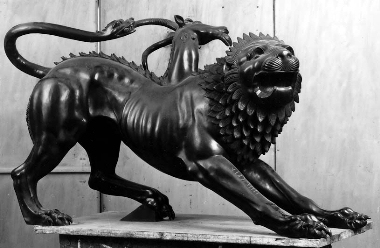
this is the way it is depicted in the famous Arezzo bronze that dates from the fifth
century. Springing from the middle of the animal's back is the head of a goat, while at
one end it has a snake's head and at the other a lion's. |