 William Tecumseh Sherman
"You might as well
attempt to put out the flames
|
|
William Tecumseh Sherman
"You might as well
attempt to put out the flames
|
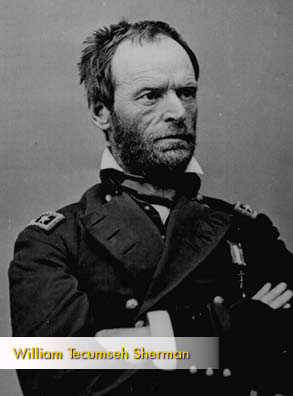 |
| William Tecumseh Sherman,
or Cump, was born on February 8, 1820 in Lancaster, Ohio to Charles and
Mary Sherman. He was the sixth child in the Sherman family.
William was named after the great chieftain Tecumseh, who fought with the
British in 1812. William's father, Charles Robert Sherman, was appointed
to the Supreme Court which forced him away from home for long periods of
time. While away from home on a business trip, Charles R. Sherman
became ill and died.
After Charles died, Mary Sherman was left to raise eleven children on her own. The two oldest children could take care of themselves, but this still left nine children for Mary to raise on her own. Charles's closest associate/friend, Thomas Ewing, decided that his family would take in one child. William Tecumseh Sherman was picked. Mrs. Ewing said that before William, whose name did not include William, must be baptized. When the priest discovered that "Cump" was named for a Indian Chief, he said that he must have a Christian name as well. Hence William Tecumseh Sherman. When Sherman turned sixteen, he entered the United States Military Academy at West Point through contacts with his foster father, now a United States Senator. For the first three years, he ranked in the top ten of his class. In the forth and final year, the cadets started turning their studies to Military Science. For Mr. Sherman, this did not prove difficult after three years of even more difficult studies. In 1840, he graduated sixth in his class of forty-three. Because of his high standing, Sherman was free to choose which branch of the service and what regiment in which he would be assigned to. He picked artillery and was quickly assigned to a regiment in the southern part of Florida, were fighting was heavy between Union Soldiers and the Seminole Indians. In the autumn of 1841, he received a promotion to First Lieutenant, which only took eighteen months instead of the usual five years. While stationed in the south, he was forced to stay where he stood on the slavery issue. Since he had many close friends from the south and had witnessed conditions first hand, he decided that slavery wasn't as bad as many, or all, 'Northern Radicals' made it out to be. And to a point, he believed in white supremacy. When war broke out with Mexico, Sherman was sent to California. By the time he got there, California had been wore from the defeated Mexicans, and all was peaceful. Later after being stationed in California, William received six months worth of leave. He quickly went to marry Ellen Ewing, whom he had been in contact with since leaving West Point. It was during the leave he was given after graduating from West Point, that Ellen and Sherman discovered that there was something more than friendship between them. And it was when Sherman was on his way to California, that Thomas Ewing found out about the love between his daughter Ellen and first suggested Sherman taking up a civilian profession and leading a more peaceful and less hectic life. Sherman resigned in 1853 and worked for a bank in California until it went bankrupt. He then went to New York City and worked for the same cooperation, until that bank went bankrupt. Thinking that he had brought bad luck with him, he went back to Ohio thinking he could help his brother-in-law in his business. But then he had a chance to become a lawyer and even though he had never went to school for that profession, he took it in stride and was learning fast. Before the Civil War broke out between the North and South, Sherman was a superintendent of a military school in Louisiana. He then made his way north and commissioned colonel. His first battle of the Civil War was the first battle of the Civil War, Bull Run. After Grant had taken Fort Henry and moved his forces to Tennessee, he ordered Sherman to take command of a division at Shiloh. At dawn on August 6, 1862, the Confederate army, under Johnston and Beauregard, attacked Sherman's lines. This attack was the opening assault of the Battle of Shiloh. The Union forces wee caught off guard. Sherman immediately rode to the front lines to direct his troops to the best and easiest place to hold ground, and if possible, in a counterattack. But when he arrived, he saw many Union forces retreating because of the ferocity of the Confederate attack. To encourage his men, he exposed himself to the hottest fire. During the battle, he suffered a buckshot through the hand and had a rifle ball graze his shoulder. General Sherman, exposing himself to the heavest fire, also took its toll on four different horses that he mounted during the battle. Because Sherman and his men held and then, in an organized fashion, gave up ground slowly. Reinforcements under command of Bull, arrived along with the rest of Grants army, had been given time to rest and organize an attack. Slowly, the Confederate army retreated. Both sides had an average loss of 200 dead, missing, or wounded in every 1,000 soldiers. Because of Sherman's buying time for the rest of the Union army, he was recommended for the promotion to major general. He was, against his will, being drawn up to a position that would fit his abilities that suit him. The promotion to major general took place on May 1, 1862. In the summer of 1862, Sherman was sent to Memphis, Tennessee. His job was to take command and make sure that it was adequately defended. He started out by treating the pro-slavery/pro-confederate occupant's with courtesy and consideration. Despite his best efforts to stop the anger that the war had brought upon the occupants of Memphis, they still housed bands of Confederate guerillas. These bands of guerillas ambushed Small bands of Union soldiers and ships. When these ambushes kept increasing, so Cump ordered that all houses inside the believed area of operation of the guerillas, to be burned to the ground. After he felt that he had struck fear needed to stop the ambushes, he revoked the order. Grant decided that Vicksburg must fall , so he devises a plan which sent Sherman straight down the Mississippi to attack. While Grant and the rest of his army moved into position, the Confederate cavalry cut off his supply line. Grant was forced to turn back. Sherman was not given any news of Grants failure to reach Vicksburg, so Sherman attacked Vicksburg on the 29th of December. The Union troops stormed the Confederate positions on Chickasaw bluffs, and made small progress. By night fall, the attack had petered out. In early 1863, McClelland arrived at Milliken's Bend to take control of Sherman's men. Sherman was enraged that he and his men were to be under the control of a politically appointed general. While McClelland and Sherman waited for grant to return, they sent an expedition to attack the Confederate garrison at Fort Hindman on the Arkansas River. Fort Hindman fell to Union troops in mid January, giving Cump and his men a boost of spirits. Because of the heavy rains that year, Grant ordered the army to a dry point in which they could attack the city. In April 1863, conditions improved, so that Grant could try a new plan. He sent Union gun boats and transports downstream at night pass the Confederate batteries. The army would march down the west bank well south of the city. The transports would be waiting to transport the armies to the east bank. From there they would march to the interior of Mississippi. Grant new the Mississippi countryside could easily support an army. In mid April, a small Union fleet ran the guns at Vicksburg to set the army southward. By April 30th, the first troops were crossing the Mississippi. Grant aim was to prevent the joining of General Joseph Johnston's' 15,000 man army from joining General Pemberton's 40,000 man army. Combined, the Confederate army would outnumber Grant's. Union troops quickly occupied Jackson, Mississippi. Sherman's men destroyed the railroads, arsenals, and factories. The Union now turned eastward. The Union troops met and defeated Pemberton and his troops in two battles. Pemberton retreated to Vicksburg, where he was quickly surrounded. Pemberton's supplies and communication was quickly cut off. The Union army now lay siege to the city, which lasted the rest of May, all of June, and the beginning of July. On the morning of July 4, 1863, Grants men marched into Vicksburg. On May 5, 1864, Sherman moved his men out of Chattanooga. Sherman now had Generals Thomas, McPherson, and Schoefield along with their armies , the Cumberland, Tennessee, and the Ohio under his command. With this sizable force Sherman marched South toward Atlanta. The Union army met little opposition from Johnston until they reached the Confederate positions at Dalton. Sherman ordered a flanking maneuver which forced the Rebels to withdrawal. When the Union army reached Kennesaw Mountain Sherman sent two divisions to attack the mountain. The Union troops were forced to retreat. Sherman now ordered a flanking maneuver. The occupants of Atlanta grew alarmed, they new that if Sherman reached Atlanta it would be burned. Before Sherman reached Atlanta Confederate General Johnston had been replaced by a General who would attack the 'Yanks', General John Hood. Hood made the mistake of attacking the larger Union force at Peach Tree Creek. The victories Union army now surrounded Atlanta on three sides. On September 5, 1864, Sherman captured Atlanta. Sherman got permission from Grant to march out of Atlanta and live of the land. On October 16th, 1864, Sherman left Atlanta for Savannah. In his wake he left a path of destruction forty to sixty miles wide. On December 13th, Cump contacted the Union Fleet standing off shore in Savannah. On the 15th of December, the Confederates in Savannah left. Sherman's troops now marched in. Since Sherman left Vicksburg, his men had marched four hundred miles through hostile territory, in the heart of the Confederacy. After the war, William Tecumseh Sherman served as a commander in the Western Territories and later served as a commander of the United States Army. In 1891, he turned seventy-one. A few week after his birthday, he caught a chill in New York. He died quietly on February 14, 1891. He is buried in St. Louis by his wife.
|
|
|
|
|