
|
|
|
When an ill-fated soldier was wheeled in with any type of gaping injury to his arm or leg, the surgeon would simply say, "cut it off." The procedure that was soon to follow is exactly the reason why soldiers would have rather died in battle than survive in a military hospital. The often screaming victims were laid on tables about breast high. Surrounding the tables were hasty surgeons and assistants stripped to the waist and covered in the blood of many patriotic men. First the assistants cut off the limb using a tourniquet. Then the surgeon sliced through the muscle and tissue using a very sharp knife. Prior to the limb was doused in Chloroform, an anesthetic. Next, they used a hacksaw-like tool to cut through the bone with frightful rapidity. Afterwards the lifeless limb was thrown into a pile. The entire procedure took about fifteen minutes. The surgeons ran like an assembly line. As soon as one patient was finished, the surgeon wiped his bloody knife off on his shirt and began cutting away on the next patient. In the Battle of the Wilderness, Union Surgeons amputated limbs steadily for four days and two nights. After being amputated, patients faced another problem, infection. Hospitals were unsanitary and no one during this time knew anything about infection or bacteria. Many patients died when diseases or bacteria entered the binding wound. Gangrene was one of the most common infectious diseases. It starts when the wound is moist, warm, and unsterile. Many unnecessary deaths occurred because of malnutrition and infection. To die in a hospital after an amputation was an agonizing and unfortunate fate.
|
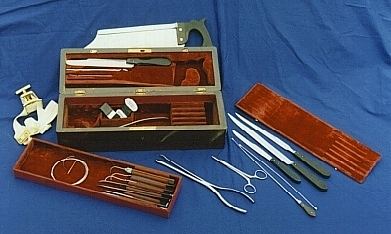 Amputation
kit used in hospitals during the Civil War. Amputation
kit used in hospitals during the Civil War. |