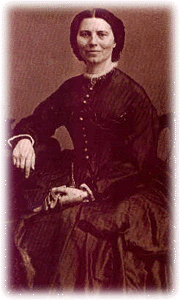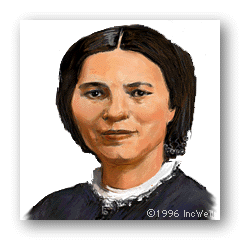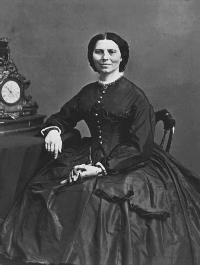
Clara Barton (Clarissa Harlowe Barton)  was born in North Oxford, a town in central Massachusetts, on Christmas day, 1821.  She had two brothers and two sisters.  Dorothy, Sally, Stephen, and David they were at least ten years older than her.
     Her father, Captain Stephen Barton was a farmer, horse breeder, and a respected member of the community.  Her mother, Sarah Barton managed the household and taught Clara the importance of cleanliness.  Dorothy taught her Spelling, Stephen taught her Arithmetic, Sally taught her Geography, and David coached her in Athletics.  With their help, Clara received a vast and diverse education.  She started school at the age of four, ( she could already spell three syllable words.  Clara found school to be quite easy and studied such subjects as Philosophy, Chemistry, and Latin.
     Clara Barton became a teacher at the age of seventeen (in district 9, located in Worchester County.)  Between the ages of seventeen and twenty -three she taught in several different schools, before establishing her own school in North Oxford. 
 

     Soon after Clara established her own school, she served as a copier in the United States Patent Office, in Washington D.C., before she dedicated her life to voluntary work at the age of forty. 
     At the out break of the Civil War, Clara resigned from the Patent Office to work as a volunteer.  She advertised for supplies and distributed bandages, socks, and other goods to help the wounded.
 

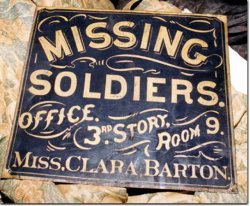
     During the Civil War Clara had a room on the third floor of 437-441 7th street, Northwest in Washington D.C.  (In 1997 these rooms were discovered and are now open to the public.)
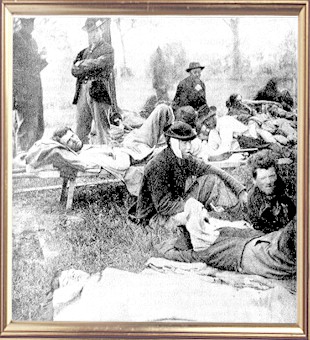
     Clara Barton's Civil War activities consisted of two main types of work, she collected supplies during the war and took the supplies to the troops on the battlefield, often facing great personal dangers in her efforts to assist the wounded soldiers. 
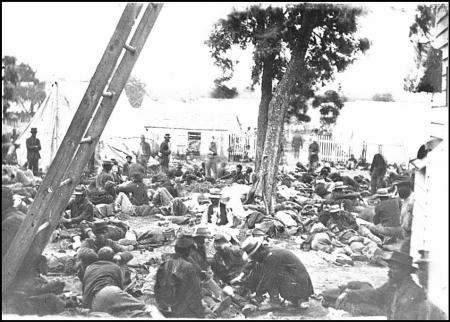
     During the Civil War Clara served as an independent volunteer on the Union side, helping by nursing and feeding  people.  By the end of the war, Clara's generosity was legendary.
     Clara Barton helped the wounded by cradling the heads of suffering soldiers.  She took the wounded water and prepared food for them( wounded soldiers ) in the local farmhouses.
 

    Clara Barton ran a Missing Solider office (from 1865-1868.)  Clara was technically the first woman to run for a government office.  She opened this office at her own expense, and ran this office in her room on 7th street Northwest.  Through this period of time she was eventually paid $15,000 by the government because of her efforts. 
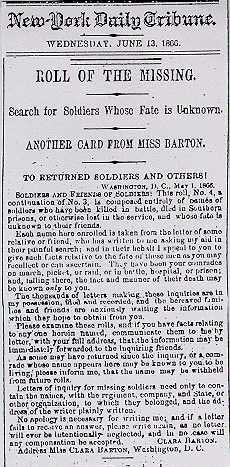
Her office was well known, many people sent her office letters searching for lost soldiers which tier names were put on a list and published in newspapers and other places where public could see.
     By June of 1865 Clara's list contained 20,000 names.
     Clara Barton continued her grateful activities until 1868 when she presented her final report in congress.  From her act of helping find lost soldiers, she had received 63,182 letters, had sent 41,855 replies, and distributed 99,057 copies of her masters list.  In all 22,000 (approximately) of 62,000 missing soldiers had been identified.


     Dorthea Dix and Clara Barton were the leaders of a national effort to organize a nursing  corps to care for the wounded and sick.  Clara worked on parallel lines, she was also a Massachusetts school teacher.  After the war she was instrumental in the creation of the American branch of the International Red Cross.  In 1861 she determined to care for the wounded soldiers who had returned to Washington.  She helped women function in hospitals and on the battlefield.
     Clara Barton is best known for being the founder of the American Red Cross, she is a nurse who tended to countless wounded soldiers on the Civil War battlefields.  Her work was tireless and compassionate during the battle of Antietam ( in the Civil War) would inspire praise of her as being," the true heroine of the age, the Angel of the Battlefield." She is well remembered for her work.
     She volunteered as an indecent relief worker in Strasbourg, because she was not permitted to work with the International Red Cross ( because she was a woman.)
 

     During the years following the war, Clara lectured about her war experiences.  By 1869, Clara Barton had worked her self into a physical breakdown.  She followed her doctors orders and traveled to Europe to rest and regain her health.  She returned to the U.S. in 1873.  Due to her efforts, the United States signed the Geneva Agreement in 1882.  Clara served as the Red Crosses' first president.
     She wrote the American Amendment to the Red Cross constitution, which proved for disaster relief during peace as well as war.  She remained the Red Cross president until 1904, in 1904 she was forced to resign her position of president.  On May 12,1904 she resigned.  For the next eight years she lived in her home in Glenecho, Maryland.
     Clara Barton died on April 12,1912 from complications of a cold. The mission of her life summed up in her own words,"You must never so much as think whether you like it or not, whether it is bearable or not you must never think of anything except the need, and how to meet it."

 
     Clara Barton kept a diary in which she wrote in only sporadically.  She usually never wrote about things that happened that day, she only wrote down names of people that she had tended to.  When the war was over she wrote more regularly often referring to her rooms on 437-441 7th street north-west.  Her rooms on 7th street were surrounded by stores that sold clothing, shoes, wallpaper, and furniture.  Clara lived and worked in room 488 1/2 7th street from June 1861-1868.

Famous Quotes;

     Clara said,'' I remember, four long months ago, one cold , weary day, I dragged me out from a chilly street-car that had found me ankle-deep in the mud of 6th street wharf, and up the slippery street and my long flights of stairs into a room, cheerless, in confusion, and alone. Looking in most respects as I had left it some months before''
      ''If I tell you that I to see that everyone of the many hundreds has the prior nourishment each day, and to answer every want that reaches me stand beside the three or four death beds which number themselves with us each day- and stand by each lonely grave as the earth is thrown in where some wheaping mothers ,wives, or sisters would stand if she might, you will say that great justice that is my duty to do these things.''


Bibliography

Amanda Martinek and
Casie Cooper