|
The Battle of Gettysburg | |
|
The Battle of Gettysburg | |
 |
|
vs. | |
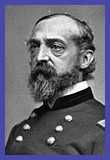 |
| George G. Meade-
George G. Meade (1815-1872) the victor of Gettysburg, George G. Meade does not rank with the great captains of the Civil War in part because of his eclipse in the last year of the conflict by the presence of grant with his army. Robert E. Lee-
|
| This most famous and most important
Civil War battle occurred over three hot summer days, July 1, 2, and 3,
1863, around the smallest market town of Gettsyburg, Pennsylvania. It began
as a confrontation but by its end 10,000 Americans were involved. Before
the battle, major cities in the north were under threat of attack from
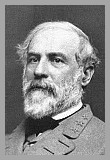
the Confederate army led by Robert E. Lee (shown to the upper left)
of north Virginia which has crossed the Potomac River and marched into
Pennsylvania.
The Union army of the Potomac under General George Meade (shown to the upper right) marched to intercept Lee. |
 3 3 |
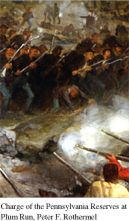
| Day1- The great battle of Gettyburg Began with confederate troops attacking Union troops on McPherson Ridge, west of town. Outnumbered, the Union forces managed to hold until the afternoon when they were overpowered and driven back through town. In the confusion, thousands of Union soldiers were captured before they could rally on cemetery hill, south of town. Long into the night Union troops labored over there defenses while the bulk of Meade's army arrived and took position. |
 |
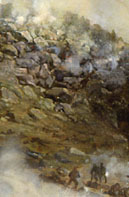
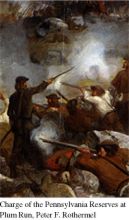
| Day2- On July 2 , the battle lines were drawn up in two sweeping arcs. The majority portions of both armies were nearly a mile apart on two parallel ridges; Union forces on cemetery ridge facing Confederate forces on Cemetery Ridge to the west. Lee order an attack agianst both Union flanks. James Longstreet's thrust on the Union left broke though D.E. Sickels advanced lines at the peach orchard, left the wheat field strewn with dead and wounded, and turned the base of Little Round top into shambles. R.S. Ewell's attack proved futile against the entrance of Union right on east Cemetery Hill and Culps Hill. |
 |
| Day3- On July 3, Lee's artillery opened the bombardment that for a time engaged the massed guns of both sides in the thundering duel for supremacy, but did little to soften up the Union center of Cemetery Ridge. The climax of the battle came when Major General George E. Pickett, in the desperate attempt to recapture the partial success of the preceding day, spearheaded a mass forty of some 12,000 Confederate troops across the open field toward the Union center on Cemetery Ridge. Raked by artillery and rifle fire, Pickett's men but failed to brake the Union line and the magnificent effort ended in disaster. In 50 minutes, 10,000 in the assault had died, and the attack forever to be known as Pickett's charge. |
 |
| Aftermath-With
the failure of the charge, the battle was over - the Union was saved. There
were 51,000 casualties making Gettysburg the bloodiest battle of American
history.
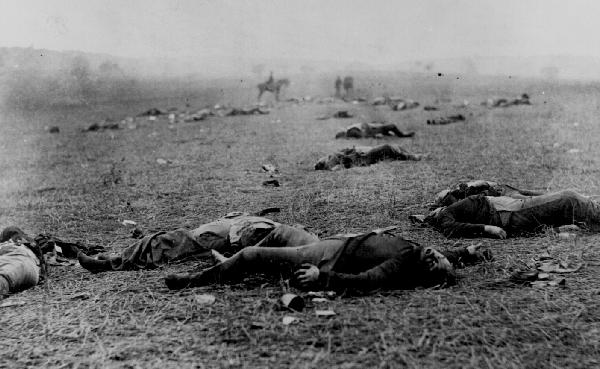
Over 172 men and 634 cannons were positioned in a 25 spuare mile area. An estimated 596 tons of ammunition were expended and when the battle had ended, 5,000 dead horses and the other wreckage of war presented a scene of terrible devastation. The Confederate army that staggered back from the fight was physically and spiritually exhausted. Lee would never again attempt an offensive operation of such proportions. Meade though criticized for not immediately pursuing Lee's army, had carried the day in the battle that's known as the High Water Mark of the Confederacy. The war ragged for two more terrible and tormenting years but the Confederacy never recovered form the loses of Gettysburg. And through the deepening twilight of Confederate military might, all who had been to Gettysburg, would remember.
|
| Jason Herrin &
Christopher Graves |