|
|
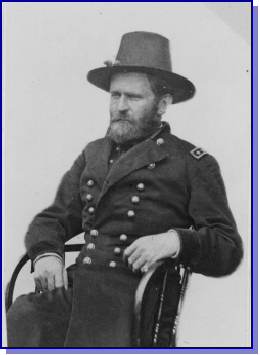 |
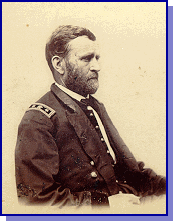
| Ulysses S. Grant was an outstanding military figure and a savior of the Union during the Civil War. Grant was a democrat but when the South succeeded he had no trouble making up his mind that he was going to support the Union cause. On April 7, 1861, President Lincoln appointed Grant brigadier general of volunteers. In February 1862, after much persuasion by Grant General Henry W. Halleck (Grants superior officer) authorized him to move against Forts Donelson & Henry. The Confederate positions guarding the Cumberland & Tennessee Rivers. With 17,000 men and many gunboats under the command of Commodore Andrew Foot. Grant captured Fort Henry on February 6 and promptly moved against Donelson twelve miles away. | 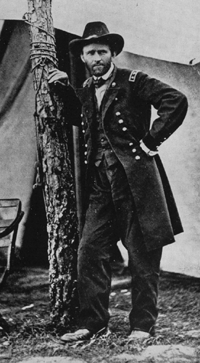 |
| When
the Confederate commander there General Simon B. Buckner, asked for terms
Grant said, "No terms except an unconditional surrender can be excepted.
I propose to move immediately upon your works." On February 16, Buckner
surrendered with over 14,000 men. The capture of Fort Henry & Donelson,
the first major Union victory, in a way opened up Tennessee to the Federal
armies. For the first time "Unconditional Surrender" Grant became
prominent on the national scene. Despite Halleck's jealousy, Lincoln
made him major of volunteers. Grant's next important battle was Shiloh
or Pittsburgh Landing Tennessee. On April 6-7, 1862 early in the morning
on April 6 General Albert S. Johnston's Confederate army bursts through
the unfortified Union lines near Shiloh meeting house. They
threatened to drive Grants men back to the Tennessee River. On April
7 the Union drove the Confederates back to the Tennessee River. Grant
was surprised and not ready, but the arrival of Major General Don Carlos
Buell's army saved the day. On April 7 the Union forces recaptured
the initiative and drove the Confederates back in great disorder.
People were mad at Grant because of false lies, but Lincoln said, "I can't
spare this man he fights." On April 11, General Halleck arrived at
Pittsburgh Landing and took command of the army. But Halleck was
called to Washington in July so Grant got the army again. He had
few troops but still drove Major General Earl Von Dorn at Cornith on October
3-4.
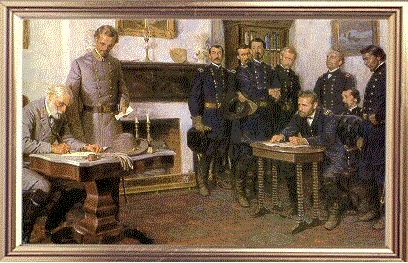
Vicksburg On October 25, 1862, Grant was made commander of the Department of Tennessee and was ordered to take Vicksburg, Mississippi. Grant only took 30,000 to battle at Vicksburg. Grant's main supply was supply was stopped in a battle and Sherman's was stopped at Chickasaw Bayou. Grant didn't want to pull back after the defeats instead he said "There was nothing left to do but go forward to a decisive victory." That was precisely what he did, in a plan of brilliant conception as in execution. On July 4, 1863, General John C. Pemberton's troops was happy to surrender his 30,000 men. It was a key victory in the Civil War, because it eliminated a major Confederate army from the conflict. It cut out the Trans Mississippi States from the rest of the Confederacy. After a great victory over Lee at the Battle of Wilderness Grant was ready for the final push. Lee was obliged to abandon Richmond and Petersburg and to march west, hoping to join the army of general Joseph E. Johnston. Grant cut off his retreat and a series of running battles made it clear that further resistance would be useless. On April 9, 1865 at Appomattox Court House Lee surrendered. Seventeen days later Johnston surrendered his army to Sherman, and the Civil War was over.
|