Obituaries
Crispus Attucks, 47, died
March 5, 1770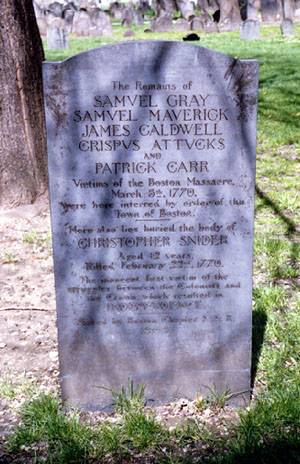
during the Boston Massacre.
Crispus's occupation was
a sailor on a
whaling ship, or at least a worker
of around the
wharves of Boston. This strong
and intimidating
mulatto, in 1770, joined a group
of Boston men and
youths whom were trying to enforce
new tax laws.
The exact date and location
of his birth is
unknown, yet it is believed he
was born sometime
during the year of 1723.
He excepted slavery in 1750.
Notices were
sent out for his return, but he
never was found.
March 5, 1770, the date of
the Boston
Massacre, Attucks begun throwing
snowballs at a
British soldier whom was guarding
the State House.
This scared the soldier into calling
for backup. The
crowd began to throw stones, the
threatened soldiers
fired, hitting eleven colonists,
out of the five killed
on the spot; Crispus was one of
them.
Later in 1888, being known
as a hero, a
statue of Attucks was sculpted
and dedicated on
Boston Common.
Nathan Hale, 21, New
London, died June 6,
1775, hung by British.
Lt. Capt. Hale served his
country as a
Lieutenant to the commission from
the Connecticut
Assembly. Then later as a
captain to the
Continental Army.
Nathan was born sometime
in1755 in
Cobentry, Connecticut, as the sixth
surviving
sibling of his Richard Hale and
Elizabeth Strong.
As a child Hale fought sickness,
but
eventually grew into a strong,
heathly child.
Education was encouraged by his
family, so he was
tutored by Rev. Dr. Joseph Huntington,
who was a
great influence.
At age 14 and 16, Nathan
and his brother,
Enoch, were sent to Yale.
There they were prepared
for ministry. Nathan was
also exposed to
cosmopolitan atmosphere of New
Haven and to new
and interesting thoughts of time.
This young man sadly never
had enough
time to start a family, yet his
career was obviously
was chosen over his personal life.
Button Gwinett, 42,
Savannah, Georgia,
died May 19, 1777 at Savannah,
because of the
wounds resulting from a duel on
May 16 between
Gen. Lachlan McIntosh and himself.
He was a good politician
of the Revolution,
governor of Georgia, member of
the Continental
Congress, and the Georgia Assembly.
Exact date of birth is unknown,
but
sometime during the year of 1735,
and in
Gloucestershire, England.
During his life Gwinett accomplished
much,
besides being a politician, governor,
and member to
so many groups, Button also was
a representative of
Georgia in the signing of the Declaration
of
Independence.
Jessie Lutackas & Dani Broughton