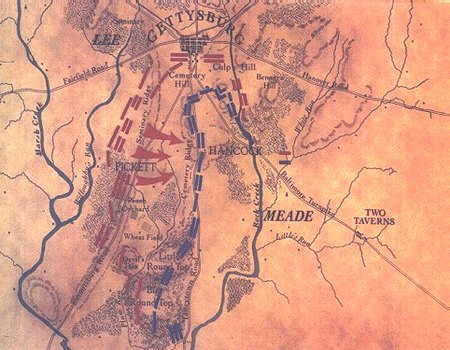
On July 3, 1863 the army of Northern
Virginia would make a final attack on the Union lines at Gettysburg.
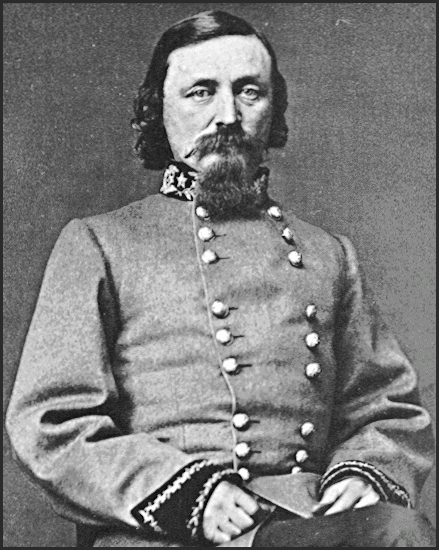
Using the division of George Pickett, Pender's Division, commanded by Isaac
Trimble, and Heath's Division, commanded by Isaac Trimble, and Heath's
Division, commanded by Johnston Pettigrew, the Confederates were to break
the Union line at the center, and turn and roll up the line, forcing the
Union to retreat. The attack, Lee hoped, was to be the last great
victory for the South, ending the war, and ensuring the continued existence
of the Confederate States of America. What happened would become
one of the most gallant and heartbreaking events of the War Between the
States. Sometimes called the Charge of Pickett and Pettigrew, and
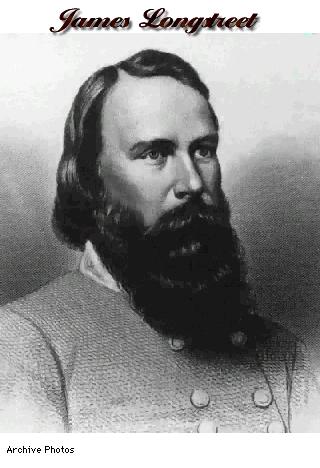
more accurately known as "Longstreet's assault" the Confederate assault
on the Union lines will be forever known in history as "Pickett's Charge"
The day was hot, nearly ninety degrees, the humidity nearly as high, a
typical summers day in Pennsylvania. The order to march would mean
a walk of a mile, over open ground, all the while in range of the terrible
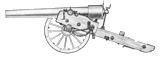
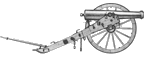
cannons on Cemetery Ridge with their long range ordinance, percussion,
and solid shot. As the line grew closer, there would be short range
ordinance, grape, the deadly canister, along with a solid wall of men in
blue firing their muskets into the advancing army. And yet they came,
they obeyed, they walked into hell itself. The lines of men, row
upon row, battle flags raised high, the line stretched across for more
than a mile, they came, they obeyed, they walked across the open field
into immortality.
The sight of so many men, walking in perfect parade order, all the while
under fire from artillery, was a sight that impressed both Union and Confederate
alike. "Beautiful, gloriously beautiful, did that vast array appear
in the lovely little valley", wrote a soldier of the 126th New York.
"Right as they move, as with one soul, in perfect order, without impediment
of ditch, or wall or stream, over ridge and slope, through orchard and
meadow and cornfield, magnificent, grim, irresistible." writes Lieutenant
Frank Haskell, an aid to Union General Gibbon. Even General Lewis
Armistead himself was heard to exclaim "See, look at my brigade, did you
ever see a more perfect line than that on dress parade?" |