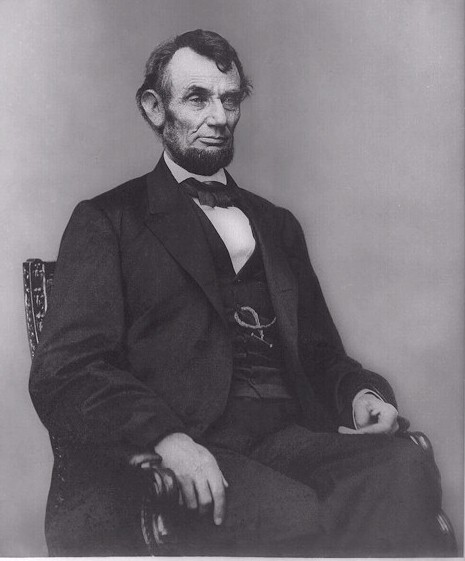
| Lincoln speaks about the Dred
Scott Decision on June 26, 1857. On May 18, 1860 he was nominated
to be the Republican candidate For the President of the United States.
He was elected and received 180 out of 303 possible electoral votes, and
40% of the popular votes. After a brief farewell to friends in Springfield,
Lincoln leaves for Washington and receives a warning of possible assassination
during the trip on Feb. 11, 1861. Lincoln delivers his first Inaugural
Address on March 4, 1861.
The Civil War begins at 4:30 on April 12, 1861 when Confederates opened fire on Fort Sumter. A Proclamation Calling Militia and Convening Congress was issued by Lincoln April 19, 1861. Lincoln issues a Proclamation of Blockade against Southern ports April 15, 1861. June 3, Stephen Douglas unexpectedly dies of acute rheumatism. The Union suffered a defeat at Bull Run in Northern Virginia on July 21, 1861 and the union troops fell back to Washington and the Lincoln realizes the war will be long. George B. McClellan is appointed commander of the Potomac on July 27, 1861. On August 6, 1861 signs a law that will free the slaves that the Confederates are using. The 12th of August in 1861 issues a National Day of Fasting. Lincoln revokes an unauthorized military Proclamation of Emancipation in Missouri , made by General John C. Fremont. He appointed McClellan as commander of the Union after Winfield Scott resigned Nov. 1. Abe issued General War Order calling for the advance of the Union to begin Feb. 22. Lincoln's son Willie dies at age 12 Feb. 20, 1862. Lincoln takes direct command of the Union armies after relieving McClellan as general-in-chief. He signs an Act abolishing slavery in the District of Columbia. He gave 160 acres of publicly owned land to anyone who will claim, then work the ground for five years, he called this the Homestead Law. Lincoln relieves John Pope of Union commander after a loss in the second Battle of Bull Run. A preliminary Emancipation Proclamation freeing the slaves is issued by the president. Ambrose Burnside was named as commander of the Potomac, replacing McClellan. A bill is signed by Lincoln admitting West Virginia to the Union in December 31. Lincoln issues final Emancipation Proclamation freeing al the slaves in territories held by the Confederates. Lincoln then appoints Joseph Hooker replacing Burnside as commander of the army of the Potomac. On August 18, 1863 Lincoln writes to his wife about Tad's lost goat. The 10th of August 1863 he met with abolitionist Frederick Douglas which pushes for full equality for negro troops. On November 19, 1863 Lincoln delivers the Gettysburg Address at a ceremony dedicating the battlefield for a national cemetery. Grant is appointed General-in-Chief of all the Federal armies. William T. Sherman succeeds Grant as commander in the West. Grants costly mistake on June 3, 1864 resulted in 7,000 Union casualties in twenty minutes during an offensive against entrenching Rebels at Cold Harbor, Virginia. June 8, 1864 Lincoln was nominated for president by coalition of Republicans and War Democrats. Sept. 2, 1864 Atlanta is captured by Sherman's army. Lincoln is re-elected president defeating Democrat George B. McClellan on nov. 8, 1864 and getting 212 of the 233 available electoral votes and 55% of the popular vote. President Lincoln delivers his second Inaugural Address in March 4, 1865. In April General Robert E. Lee surrenders his Confederate army to General Ulysses S. Grant at the village of Appomattox Court House in Virginia. Lincoln makes his last speech on the 11th of April 1865. Dec. 6, 1865 the 13th Amendment to the United States Constitution is passed by Congress on Jan. 31, 1865 is finally ratified. Slavery is abolished. |