
By Kepler Ryan and Dylan Roberts.
Who discovered antimatter?
In 1930, man by the name of Paul Dirac predicted a particle should have an equivalent anti-particle. This was followed by the discovery of such a thing by Carl Anderson in 1932. When he was examining tracks produced by cosmic rays in a cloud chamber, he came across a strange particle. It made tracks like that of an electron, but other things suggested it was positively charged like a proton. He named this anti-particle a positron. This was the first anti-particle to be discovered by man and led to other such anti-particles and antimatter to be uncovered by scientists. It is now a known fact that every particle has a corresponding antiparticle. 1
What is the world made of?
This is the question that many scientists have been contemplating for a very long time. Basically the world is made of matter and for every type of matter particle people have found, there also exists a corresponding anti-matter particle or anti-particle.
Anti-particles look and conduct themselves just like their corresponding matter particles, except they have opposite charges. For instance, a proton is electrically positive where as an antiproton is electrically negative. Gravity affects matter and antimatter the same way because gravity is not a charged property and a matter particle has the same mass as its antiparticle. 2
Tell me more about antimatter.
Well although from a distance matter and antimatter would look fundamentally identical, there appears to be very little antimatter in our universe. This conclusion is partly based on the low observed amount of antimatter in the cosmic rays, which are particles that continuously rain down on us from outer space. All of the antimatter present in the cosmic rays can be accounted for by radioactive decays or by nuclear reactions involving standard matter.
Particles related to Antimatter.
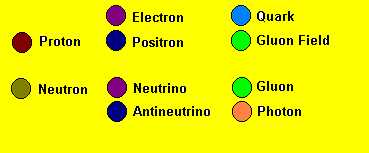
Electron: A particle with a negative electric charge that orbits the nucleus of an atom
Neutron: An uncharged particle, similar to the proton, which accounts for about half the particles in the Nucleus of most atoms.
Neutrino: An extremely light (possibly massless) elementary matter particle.
Photon: A quantum of light.
Positron: The (positively charged) antiparticle of the electron.
Proton: The positively charged particle that make up about half of the particles in the nucleus of most atoms.
Quantum: The indivisible unit in which waves may be emitted or absorbed.
Quark: A charged elementary particle. Protons and Neutrons are each composed of three quarks. 3
What has all of this got to do with energy?
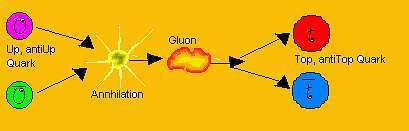
The topic antimatter has a very strong relation with the topic energy. When an ordinary matter particle collides with an antimatter particle annihilation occurs. Annihilation is the shared destruction of elementary particles (the so called building blocks of matter) by their antiparticles. When they meet they release a massive discharge of pure energy in the form of gamma rays. These gamma rays are both released in opposite directions. 4
A diagram of Annihilation.
Antimatter and the future.
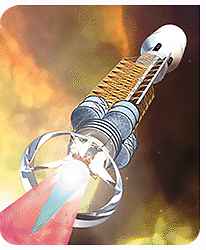
As you know, when matter contacts antimatter, they annihilate each other, releasing energy in greater densities than any other reaction known. An example is, in a beam-core engine concept, hydrogen and anti-hydrogen are fed from a spacecrafts onboard storage tanks. They contact in a chamber and the resulting products are directed out the back of the spacecraft by magnetic "nozzles" for thrust. This design if possible would be a way of reaching new stars and traveling over long distances. The only problem in this design is that we can't create enough antimatter; it is too difficult. Another use for antimatter in the future is that we may be able to use it to produce large amounts of electricity and energy for everyday use and still be environmentally friendly. 5
Key words.
|
Electron
|
Annihilation
|
Proton
|
|
Matter
|
Anti-particle
|
Antimatter
|
|
Particle
|
Forces
|
Gamma
Rays
|
|
Nuclear
Energy
|
Decay
|
Particle
Accelerator
|
|
A
Brief History of Time
|
Carl Anderson |
Paul
Dirac
|
|
Building
Blocks
|
Quark
|
Atom
|
Footnotes.
1. ABC's of Nuclear Science - www.user88.lbl.gov/NSD_docs/abc/home.html
2. The Particle Adventure - http://particleadventure.org
3. Stephen.W.Hawking 'A Brief History of Time', 1990, Bantam Books - Transworld Publisher, Australia, P.193
4. ABC's of Nuclear Science - www.user88.lbl.gov/NSD_docs/abc/home.html
5. Popular science Magazine, June 1999, Times Mirror Magazines - Canada, P.58
Feel free to E-MAIL me.