What is a laser?
The word laser comes from the first letters of Light Amplification by Stimulated Emission of Radiation.
The first ever laser was a ruby laser and was invented by a man named Theodore Harold Maiman. This event took place in California, nineteen sixty, and at first people thought the new invention would be of no real value to Science or Engineering. Since then though, many practical uses have been found. These include the treatment of cancer, measuring the speed of light, finding the distance between the Moon and Earth, cutting and welding hard metals, eye surgery, finding the shape of the Earth and cutting precise holes and shapes.
The reason lasers are so special and different from ordinary lights is due to three main things. Laser light contains only one color, or wavelength, where as ordinary light is a mixture of many wavelengths. A laser beam is said to be 'coherent' as its waves are identical. This means a laser beam could never be white as white is a mixture of many different wavelengths.
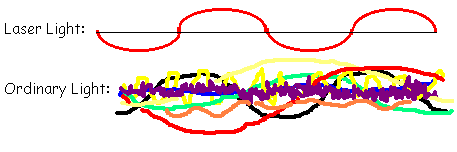
Laser light spreads out much less than ordinary light.
Laser light is also very powerful and is sometimes used to cut big, hard objects.
A laser is made up of three main parts. The material, or medium, the power source and a resonator (a devise that makes the beam more powerful).
How does a laser work?
Atoms in the laser's medium are given energy by the power source. These atoms then give out light that becomes trapped in the resonator and the strength of the beam of light builds up. There is a small hole in the reflecting resonator mirror where the light escapes. This is the light that we see. Note the light given off by each atom is coherent.
Is there more than one type of laser?
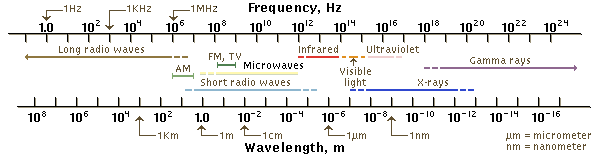
Yes, there most definitely is many different types of lasers. Some are very big with lots of power and some are small with low power levels. All different lasers are named after their particular medium (or part of the laser where the energy is formed). The medium is usually either a solid or gas, but liquids have occasionally been used to make lasers too. Some examples of lasers with solid mediums are Ruby and Neodymium. Examples of gas medium lasers are Helium and Carbon Dioxide. Different laser materials produce laser beams in different parts of the spectrum, or colors, and a lot of the time the laser's beam is invisible to the eye. An example of this is the carbon dioxide laser. Its beam is in the infrared part of the spectrum.
The Electromagnetic Spectrum.
More about laser types.
Solid-state laser: The most common solid laser medium is rods of ruby crystals and neodymium-doped glass. The ends of the rod are fashioned into two parallel surfaces coated with a highly reflecting nonmetallic film.
Gas lasers: The medium of a gas laser can be a pure gas, a mixture of gases, or even metal vapor. This is usually stored in a cylindrical tube of glass or quarts. Two mirrors are located outside the ends of the tube to form the laser cavity.
Semi conductor laser: The most compact laser, the semiconductor laser consists of a junction between layers of semi conductors with different electrical conducting properties. The laser cavity is confined to the junction by the means of two reflective boundaries.
Liquid lasers: The most common liquid laser media is inorganic dyes contained in glass vessels. Liquid lasers are much the same as solid-state lasers.
Free electron lasers: These are simply lasers using electrons unattached to atoms and pumped to lasting capacity by an array of magnets. These types of lasers in particular are now becoming important research instruments.
Lasers and Optical Fibers.
Optical fiber was invented in nineteen sixty-six from experiments in Chicago. It is simply glass that can transmit light through its length by total internal reflection. Total internal reflection occurs when light hits a boundary between two materials at a large angle. So in plain English, the walls of optical fibers act like mirrors to keep the light inside.
This is where lasers come in handy. An example is telephone communication. The information is put into optical fiber using a laser beam. Electrical signals are changed into pulses of light that can pass along the fibers. This has revolutionized communication as previously only copper cables were used to carry telephone conversations. Copper cables are very heavy. 500 metres of it weighs five tonnes, compared to twenty-five kilograms for the same length of optical fibers. Optical fibers (just one centimetre across) also carry nearly thirty-thousand conversations at once while a bundle of ten centimetre thick copper cables can only carry about six hundred.
Where did I get this information from?
I used a book out of the school library called Lasers and Holograms by John Griffiths. This book was published by MacMillan in nineteen eighty-three. Our Science text book: Heinemann Outcomes, Science 4 by Malcolm Parsons, had a little information on lasers too. I got the electromagnetic Spectrum picture from Encarta '95, by Microsoft. The internet was also handy while looking for information on this assignment.
Feel free to E-MAIL me.
|
|
|
| The Banner Co-op Exchange Free Advertising & Cash To Promote Your Site! Join Here! | |