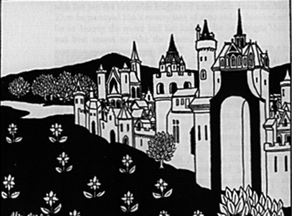
It is not certain whether Arthur ever existed, or where Camelot and Avalon actually were. If he had existed, Arthur would probably have been a strong Celtic leader who gained fame fighting Germanic invaders (like the Saxons) in the 5th or 6th Century AD. Merlin could possibly have been the same person as Myrrdin, a Celtic poet and prophet who lived in the 500's. About the rest of the people in Arthurian legend, it is not certain, since many of them have so many religious associations, they could possibly just be local deities that eventually ended up in legends as people.
Though Malory identified Camelot with Winchester, John Leland thought it was more likely to have been at Cadbury Castle in Somerset. Tradition supports this theory- as late as the reign of Henry VIII local people referred to it as Camelot, and as the home of Arthur. An excavation in the 1960's confirmed that a strong leader with a large group of followers refortified Cadbury Castle during Arthur's time. Cadbury is an earthwork fort of the Iron Age, which overlooks the Vale of Avalon to Glastonbury. However, Geoffrey Monmouth said in his book, History of the Kings of Britain, that Camelot was Caerleon Castle at Wales.
Avalon, where all the druids and priestesses lived, was an island somewhere across the Summer Sea, which was probably near Cornwall in the south. Glastonbury, a monastery and convent, was supposed to be very close to Avalon.
New findings! The San Jose Mercury News says:
LONDON (AP)- A stone bearing a sixth-century inscription resembling
the name Arthur has been unearthed at Tintagel Castle, the reputed
birthplace of the legendary king of the Round Table, English Heritage said
Thursday.
The stone- which archaeologists call "a find of a liftime"- could be a
new link between the Arthurian legend and Tintagel, an ancient military
base. All that remains of the castle today are its ruins, high on the
windswept coast of Cornwall.
The stone measures 14 by 20 inches and bears the Latin inscription
"ARTOGNOV." It was found July 4 as archaeologists dug further at the site
of excavations carried out in the 1930's, said Kevin Brady of the University
of Galsgow. The dig was sponsored by English Heritage, a government conservation agency.
No evidence links the stone directly with King Arthur, but it does prove
the name existed around the time he is said to have lived. "It is
certainly exciting that the name on the stone corresponds to the legend,"
Brady said.
The excavation also shows that after the Romans left England in 410,
some sort of ruler's headquarters existed at Tintagel from which contact
with the Roman Empire was maintained, Brady said.
If Arthur did exist, he lived in the sixth century, said English
Heritage. The first link between Arthur and Tintagel castle was made by a
Welsh author in the 12th Century.
In one story, Merlin the magician disguised Arthur's father so that
he might enter Tintagel and seduce a duke's young wife, Arthur's mother.
In another, Merlin found Arthur after the child had washed ashore in a cave
below the castle.
Back to Mists of Avalon