HONG KONG ADVANCED LEVEL EXAMINATION
AL PHYSICS
1994 Essay Type Question
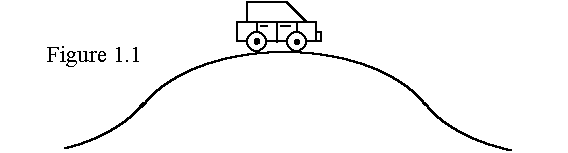
1. (a) Figure 1.1 shows a car travelling over a hump which is an arc of a vertical circle. Compared with travelling on a level road, would a passenger feel heavier, lighter or the same as usual when the car passes the top of the hump? Briefly explain your answer. (Assume that the passenger remains in contact with the seat) (3 marks)
(c) A man, with his arms stretched out, is standing at the centre of a light, horizontal circular platform which can rotate freely about its vertical axis. He and the platform are then set into rotation. Explain what happens if he puts down his arms. Discuss whether there is a change in his kinetic energy.
(5 marks)
(d) Two identical cylinders, A and B, are held with their axes horizontal and at the same height on slopes of the same inclination. When released from rest, cylinder A slides down a smooth slope while cylinder B rolls down a rough slope without slipping. By using the principle of conservation of energy, explain which cylinder has the greater linear speed when reaching the bottom of the slopes. (No mathematical derivation is required) (3 marks)
2. (a) State Huygens’ principle. With the aid of the diagrams, use the principle to explain
(ii) why plane waves refract as they pass from one medium to another.
(7 marks)
(b) (i) Explain why interference patterns cannot be successfully produced with too small, close light sources.
(ii) Explain, with the aid of a diagram, how the pattern in (i) is overcome in Young𠏋 experiment.
(iii) Describe and account for the observed interference pattern.
(7 marks)
(c) Describe and explain one practical use for light interference. (2 marks)
3. (a) (i) Solids can be thought of as networks of atoms connected by 鷔mall springs’. Explain how this method can be deduced from solids’ observed resistance to deformation.
(ii) Sketch the curve of potential energy against interatomic separation and use it to explain the phenomenon of thermal expansion of solids.
(6 marks)
(b) Glass is a strong, stiff and brittle material. Sketch the stress-strain graph for glass and briefly explain why it is so described. (3 marks)
(c) With suitable diagrams, use the Bernoulli principle to explain
(i) how a yacht can sail against the wind;
(ii) the curved flight of a spinning ball. Also suggest one design feature which increases the curvature of the ball𠏋 flight.
(7 marks)
4. (a) (i) Magnetic fields are usually described in terms of magnetic field lines. Use this concept to explain the term 鮎agnetic flux density’.
(ii) State the factor(s) which determine(s) the total flux linkage for a plane coil placed in a uniform magnetic field.
(3 marks)
(b) (i) With a suitable diagram, explain qualitatively the working principles of a Hall probe.
(ii) Briefly describe an experiment to investigate the variation of magnetic flux density along the axis of a solenoid by using a Hall probe. State any precaution(s) needed in the experiment.
(9 marks)
5. (a) (i) What is meant by the 𨘀inding energy’ of a nucleus?
(ii) Sketch a graph of binding energy per nucleon against mass number and use it to explain why
(I) a 235U nucleus is not as stable as a 56Fe nucleus; and
(7 marks)
(b) (i) For a nuclear fission reactor in normal operation, nuclear fissions must be controlled so that on average only one neutron from each fission produces another fission. Explain why this is necessary.
(ii) Give two components of a nuclear fission reactor which are responsible for controlling the number of neutrons producing further fissions. Briefly describe their actions.
(5 marks)
(c) (i) State two advantages of using fusion as a source of energy, compared with using fission.
(ii) Give the reason(s) for hindering the practical use of controlled fusion as a source of energy.
(4 marks)
- End of Paper -