HONG KONG ADVANCED LEVEL EXAMINATION
AL PHYSICS
1995 Structural Question
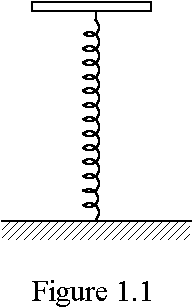
1. Figure 1.1 shows a light spring fixed vertically to the ground at its lower end and with a small aluminium pan of negligible weight attached to its upper end. When a small block of mass 0.1 kg is placed on the pan, a compression of 5 cm is observed after the pan settles. Assume the spring obeys Hooke𠏋 law and damping can be neglected.
(a) Find the force constant (i.e. force per unit extension or compression) of the spring. (1 mark)
(b) (i) If the block and the pan are pushed slightly downwards and released, calculate the period of oscillation of the system. (2 marks)
(ii) Find the maximum amplitude of oscillation for which the block would not leave the pan. (3 marks)
(iii) Figure 1.2 shows the variation of kinetic energy of the block with its height above the ground. (The gravitational potential energy of the block is taken to be zero at the ground.)
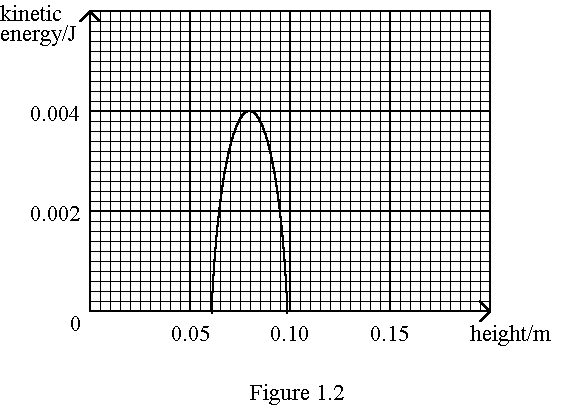
(I) Find the amplitude of oscillation of the block. (1 mark)
(c) The system is now brought to a planet with a smaller gravitational field strength than that of the earth. How would the answers to (b)(i) and (b)(ii) be affected? Explain briefly. (2 marks)
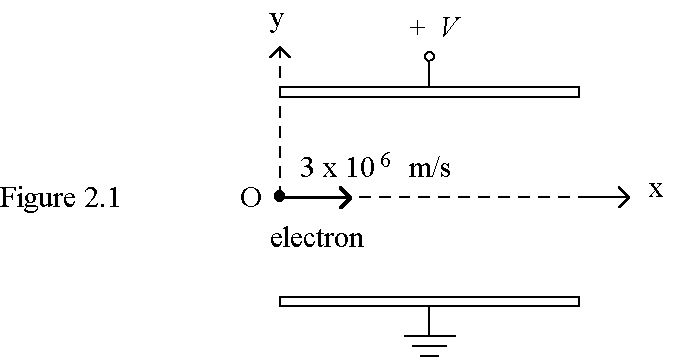
2. In Figure 2.1, a potential difference is applied across two parallel plates to establish a region of uniform electric field in between. An electron is fired with an initial velocity of 3 ´ 106 m/s into that region. After 5 ´ 10-8 s, the electron leaves the parallel plates with a velocity of 5 ´ 106 m/s.
(Given: mass of electron = 9 ´ 10-31 kg.)
(a) What is the direction of the force acting on the electron when it is between the parallel plates? (1 mark)
(b) Sketch on Figure 2.1 the path of the electron, showing its flight both inside and outside the region between the parallel plates. (2 marks)
(c) Find the change in electric potential energy of the electron after flying between the parallel plates. (2 marks)
(d) Find the magnitude of the acceleration of the electron when it is between the parallel plates. (3 marks)
(e) Find the displacements of the electron in x- and y- directions after flying between the parallel plates. (2 marks)
(f) What would the time of flight and the displacement in y-direction of the electron be if the potential difference across the plates is doubled? Explain briefly. (4 marks)
3.
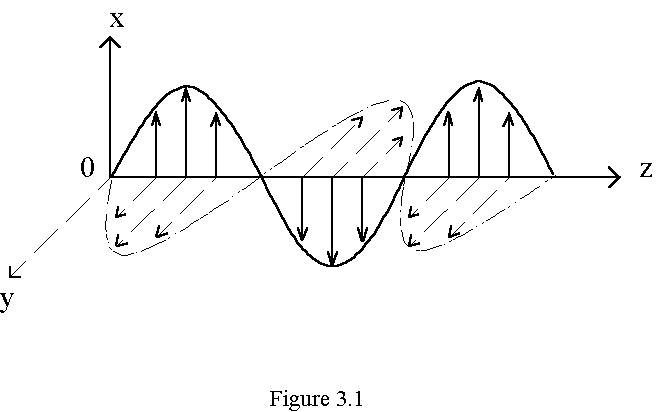
Figure 3.1 shows a section of a continuous plane polarized electromagnetic wave of frequency 10 000 MHz travelling in space at a certain time. The vectors in x-direction represent the varying electric field travelling along positive z-direction.
(b) Using the reference frame provided below, sketch the wave form at a time 0.5 ´ 10-10 s later. (2 marks)
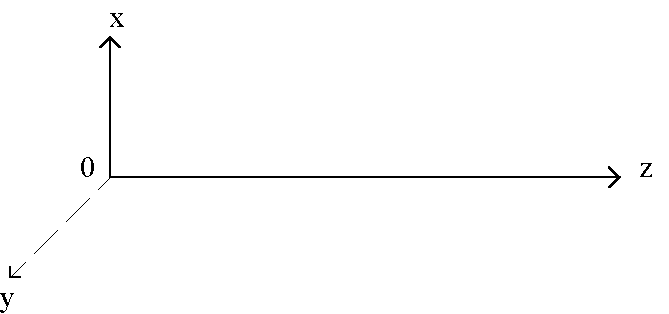
(d) What happens to the signal received by the antenna in (c) when a grid of parallel conducting wires is placed in front of the antenna, with the conducting wires
(i) parallel to the x-direction,
(ii) parallel to the y-direction.
Explain briefly. (4 marks)
(e) If an antenna is in the form of a plane circular loop, how should it be orientated to receive maximum signal? Explain briefly. (2 marks)
4.
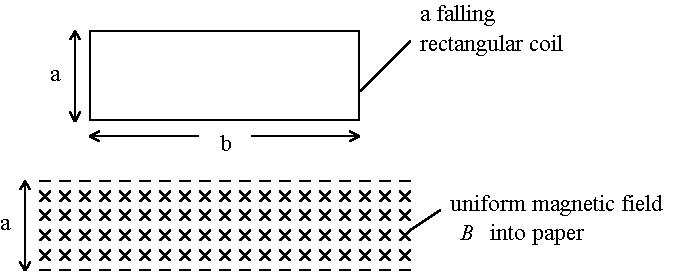
A rectangular coil of length a, breadth b, mass m and total resistance R falls freely, with its plane vertical. It enters a region of uniform magnetic field B normal to the plane containing the coil.
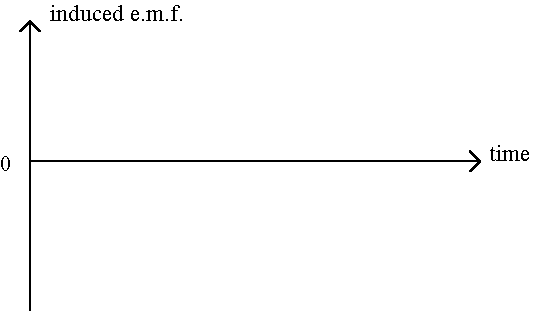
(c) The induced current causes a heating effect in the coil. Use the answer obtained in (b) to find an expression for the total thermal energy generated in the falling process. (3 marks)
(d) Where does the electrical energy come from? (1 mark)
(e) (i) Write an equation relating the forces acting on the coil when it falls with constant velocity in the field region. (1 mark)
(ii) Hence or otherwise express the total thermal energy obtained in (c) in terms of the mass and the dimensions of the coil. (2 marks)
5.
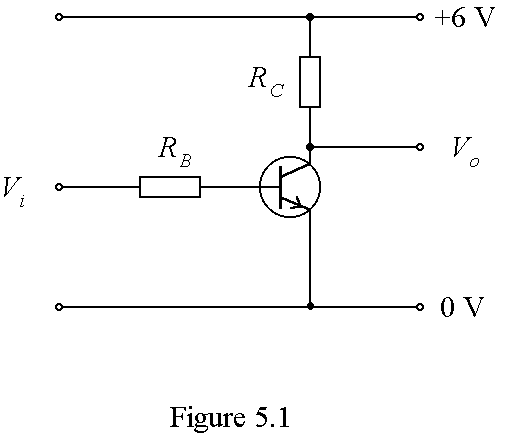
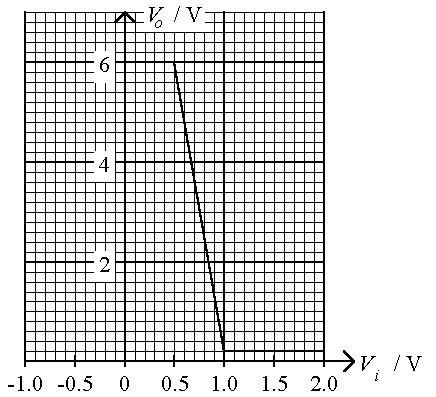
Figure 5.1 shows a typical silicon transistor circuit together with its input/output voltage characteristics.
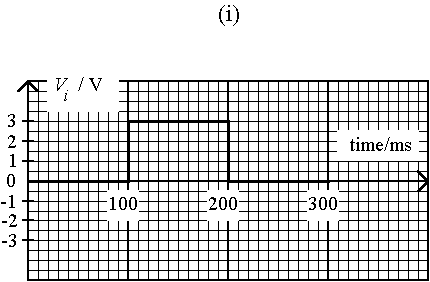
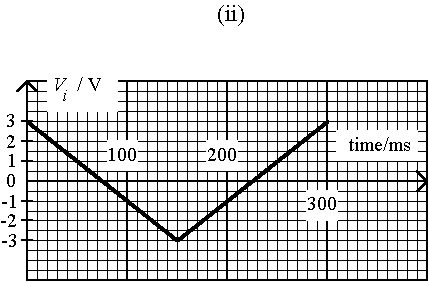
Figure 5.2
(i) When Vi is 1 V, what are the collector current and base current?
(3 marks)
(ii) Hence determine the value of RB. (The voltage between the base and the emitter is constantly 0.5 V when conducting.) (2 marks)
(c) If an input signal varying between -0.24 V and +0.24 V is to be accurately amplified without distortion, two resistors and two capacitors are added to the original circuit. The resulting circuit is shown in Figure 5.3.
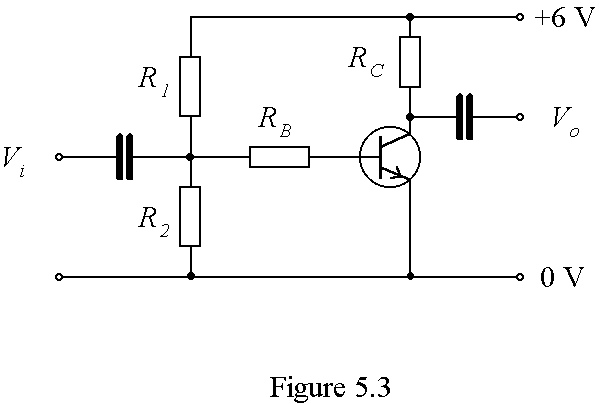
(ii) What is the peak voltage of the output signal? (2 marks)
6.
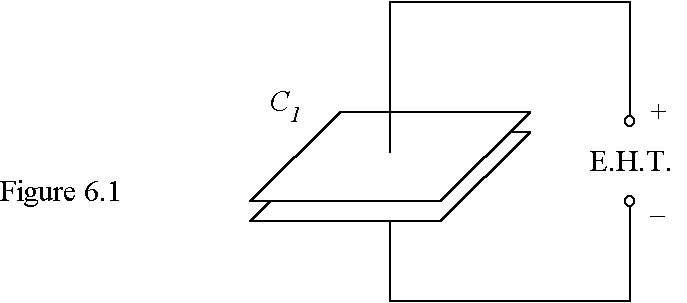
Figure 6.1 shows a capacitor C1, formed by two square metal plates of length 0.25 m, connected with a variable E.H.T. supply. The capacitance of the capacitor is 3.70 ´ 10-10 F.
(Given: permittivity of free space = 8.85 ´ 10-12 F/m)
(ii) It is known that electric breakdown occurs (i.e. conduction happens between the plates) when the electric field strength between the plates reaches 3 ´ 106 V/m. Find the potential difference at which electric breakdown occurs for capacitor C1. (2 marks)
(b) Another capacitor C2, identical to C1 but with a sheet of mica in between, is also connected to the same E.H.T. supply as shown in Figure 6.2.
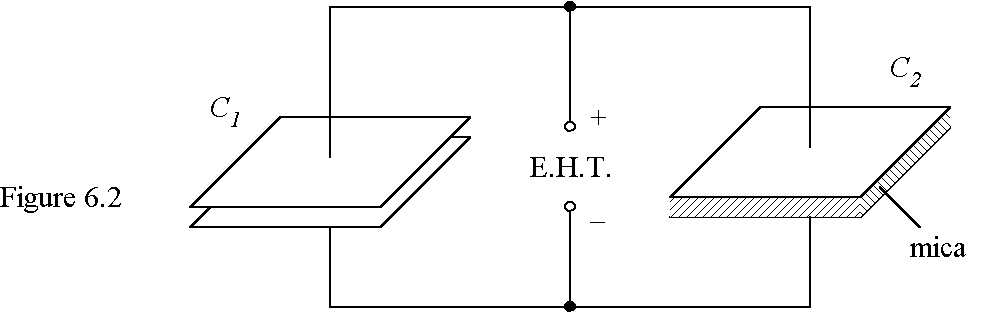
(ii) With both C1 and C2 charged to a potential difference of 500 V, the E.H.T. supply in Figure 6.2 is then removed, and the mica sheet is also removed from C2. Find the resulting charge and potential difference of C2. (4 marks)
(c) Give two advantages of placing a sheet of mica between the plates of a capacitor in practice. (2 marks)
7. A student uses the apparatus shown in Figure 7.1 to determine the speed of sound in air. A loudspeaker, L, is connected to the signal generator and a microphone, M, is connected to the Y-input and the earth terminal of a CRO. The loudspeaker L and the reflecting plate R are placed on a metre rule (not shown) with the microphone M between them. The axis of the loudspeaker is along the metre rule and perpendicular to the reflecting plate.
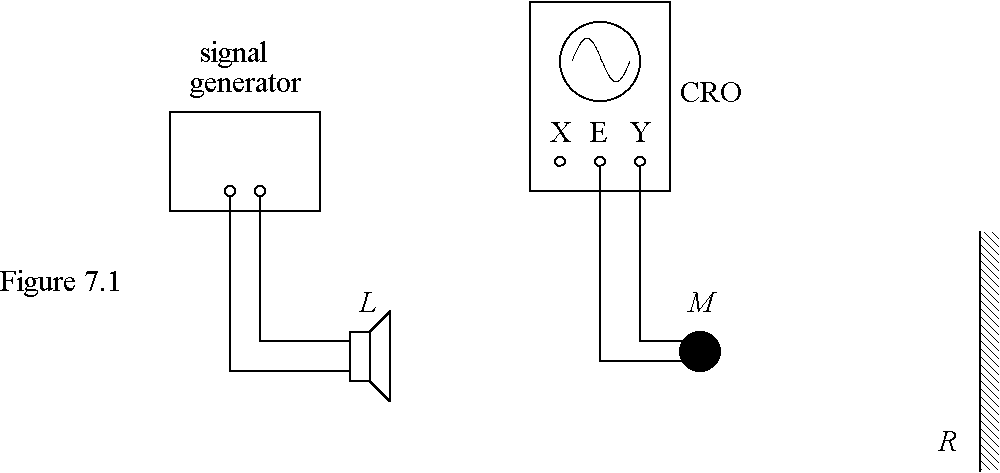
(b) With the signal generator set at a certain frequency, briefly describe the procedures you would follow to set up stationary sound waves between the loudspeaker and the reflecting plate. (2 marks)
(c) With the stationary waves set, the microphone M is moved along the axis of the loudspeaker and the trace on the CRO screen is seen to vary in size. Consecutive positions of M are recorded whenever the trace has its smallest amplitude. The procedure is repeated for different signal frequencies. The results are recorded in Table 7.1 below:
|
Frequency of signal generator/kHz |
Positions of M corresponding to the smallest amplitude of the CRO trace/cm |
Wavelength l /cm |
Period T/ms |
|
2.500 |
27.0, 34.0, 41.0, 47.9, 54.5, 61.6, 68.7 |
||
|
2.941 |
16.0, 22.0, 28.1, 33.7, 39.6, 45.7, 51.5 |
||
|
3.571 |
18.7, 23.7, 28.4, 33.3, 38.4, 43.5, 48.1 |
||
|
4.545 |
31.8, 35.8, 39.8, 43.6, 47.4, 51.5, 55.5 |
||
|
6.250 |
26.4, 29.4, 32.4, 35.2, 38.2, 41.5, 44.7 |
Table 7.1
(ii) Complete Table 7.1 and plot a graph of wavelength l against period T.
(5 marks)

(iii) Hence find the speed of sound in air. (2 marks)
(v) Explain why the graph does not pass through the origin. (1 mark)
(d) Explain an advantage of performing the experiment outdoors. Suggest one remedial measure when doing the experiment indoors. (2 marks)
8. (a) A student uses the circuit in Figure 8.1 to measure the resistance of a resistor, R, with an unknown order of magnitude. The voltmeter and the ammeter are ordinary moving-coil meters used in school laboratories. He first connects K to X with a flying lead and then to Y.
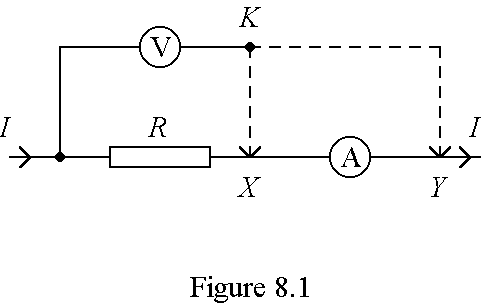
(i) Describe the change in the readings of the voltmeter and the ammeter, if any, when the flying lead from K is moved from X to Y for
(I) R of a few ohms, (1 mark)
(II) R of a few kilo-ohms. (1 mark)
(ii) The student decides to connect K to Y. The voltmeter and the ammeter read 6 V and 0.8 mA respectively.
(I) Comment, with reasons, on his choice of connecting K to Y.
(2 marks)
(II) Find the true value of R if the resistance of the ammeter is 20 W .
(1 mark)
(b) The circuit in Figure 8.2 is employed to measure the e.m.f., E, and the internal resistance, r (a few ohms), of a dry cell. (Assume the voltmeter and the ammeter used are ideal.)
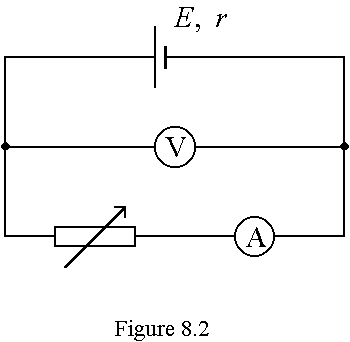
(i) If the full-scale deflection of the ammeter is 500 mA, suggest which ranges of the voltmeter and the rheostat it would be suitable to use.
(1 mark)
(ii) The voltmeter readings, V, and the ammeter readings, I, obtained for different rheostat settings are used to plot the graph below.
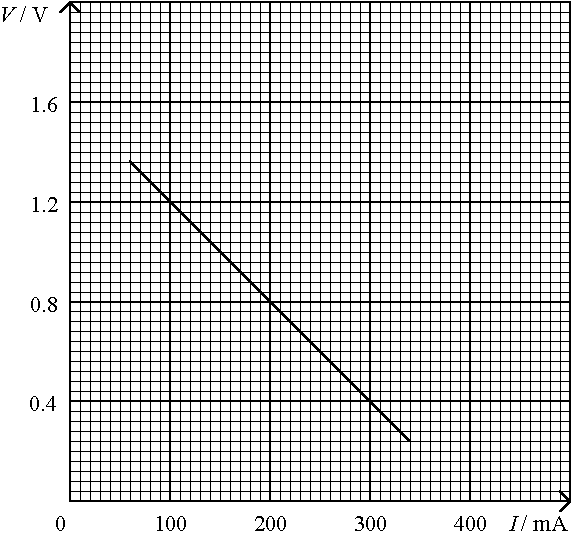
Express V in terms of E, I and r. Hence deduce from the graph the e.m.f. and the internal resistance of the cell. (3 marks)
(iii) It can be proved that when the resistance of the rheostat equals the internal resistance of the cell, maximum power output from the cell would be obtained. Find an expression of this maximum power output in terms of E and r, and calculate the corresponding output efficiency of the cell. ( 3 marks)
9.
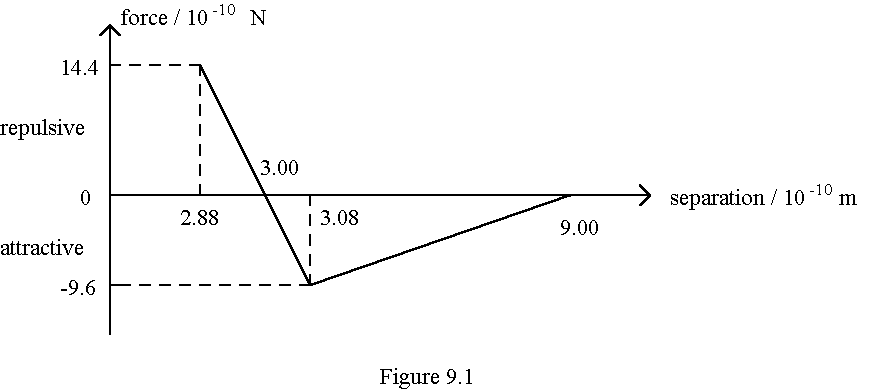
The graph in Figure 9.1 shows a simplified model of the force between two atoms plotted against their distance of separation.
(a) Use the graph to determine
(i) the energy required to separate two atoms completely. (2 marks)
(ii) the potential energy of the atoms at a separation of 2.88 ´ 10-10 m. (The potential energy is taken to be zero when the atoms are infinitely apart.)
(2 marks)
(b) For a solid formed by the atoms mentioned, estimate
(i) the Young modulus of the solid. (Hint: the atoms in a solid can be considered as connected by 鷔mall springs’.) (2 marks)
(ii) the breaking stress of the solid. (Assume the solid has a cubic arrangement of atoms.) (2 marks)
(c) The Young modulus and the breaking stress of a copper wire are 4.3 ´ 1011 Pa and 2.0 ´ 108 Pa respectively. Compare the strength and stiffness of copper with those of the above solid. Give reasons for your points of comparison.
(2 marks)
10. A geologist wants to find the age of a sample of rock containing 40K which decays to give the stable isotope 40Ar. The activity of the sample is found to be 1.6 Bq while the original activity of a similar rock having the same mass is 4.8 Bq. The half-life of 40K is 1.3 ´ 109 years.
(a) (i) Find the decay constant of 40K. (2 marks)
(ii) Give the physical meaning of the decay constant of a radioactive isotope.
(2 marks)
(b) Find the age of the rock sample. (2 marks)
(c) Give two factors that determine the activity of a radioactive source. (2 marks)
(d) The decay of 40K to 40Ar is spontaneous. How is the magnitude of the binding energy of 40K compared to that of 40Ar? (2 marks)
(e) Mention a difficulty involved in measuring such a small decay rate of 1.6 Bq.
(1 mark)
- End of Paper -