1. (a) With the aid of suitable diagram(s), show that, for a very short time interval, the change of velocity of a particle undergoing a uniform circular motion is directed towards the centre of the circle. (2 marks)
(b) The centripetal acceleration, a~ of a body undergoing a uniform circular motion of radius r can be expressed as either (1) a = v2/r or (2) a = w 2 r, where v and w are linear and angular speeds of the body respectively. For a uniform circular motion of constant period, student A thinks that a decreases with r according to equation (1), while student B argues that a increases with r according to equation (2). Comment on their arguments. (2 marks)
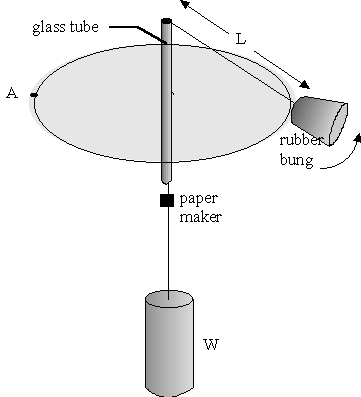
(c) To study a circular motion, a small rubber bung of mass m is attached to one end of a piece of string passing through a thin glass tube, which has a weight W hanging at its other end The rubber bung is set into a horizontal circular motion by a student holding the glass tube.
(i) Draw a diagram to show the forces acting on the rubber bung and explain why the string is not horizontal but dips at a small angle q .
(ii) Show that the weight W equals mw 2L in theory, where w is the angular speed and L is the length of the string beyond the upper opening of the glass tube. Give TWO reasons to explain why there are discrepancies between the experimental and theoretical results.
(iii) Suggest TWO ways to increase the rate of revolution of the rubber bung.
(iv) When the rubber bung is at position A, the string suddenly breaks. Describe and explain its subsequent motion. ( 7 marks )
(d) With the aid of a diagram, describe and explain the action of a centrifuge. Give a practical use of a centrifuge. ( 5 marks)